
Sellers: 3 Ways to Sell Tenant-Occupied Homes, Protect Tenant Rights
Yes, you can sell a house while a tenant lives in it. Your lease generally survives the sale, and the buyer inherits the tenant relationship. You have three practical paths: sell with the tenant in place, wait for the unit to sit vacant, or negotiate a documented early move-out. Whichever path you choose, clean records make the closing smooth. The right section below depends on your lease type, your timeline, and how much carrying cost you can absorb.
TL;DR:
- Selling with a tenant in place typically transfers the lease to the buyer, especially with fixed-term agreements, while month-to-month tenants can often be terminated with proper notice.
- Proper documentation, such as signed estoppel certificates and written cash-for-keys agreements, is essential to protect against disputes during and after the sale process.
- Showing occupied homes requires coordinated scheduling, written agreements, and incentives to tenants to ensure access and obtain quality listing photos.
- Buyers rely on documents like lease agreements, rent ledgers, deposit accounts, and condition photos to avoid post-closing claims of misrepresentation or deposit theft.
- State laws significantly influence notice periods, eviction rights, and lease renewal protections, making local legal compliance critical for a smooth transaction.
Table of Contents
- Which Option Is Right: Sell Occupied, Sell Vacant, or Negotiate a Buyout?
- What Do You Legally Owe a Tenant While You Market the Home?
- How Do You Structure a Fair Cash-for-Keys Agreement?
- How Do You Show a Tenant-Occupied Home Without Losing Buyers?
- What Documents Do You Need Ready at Closing?
- Can You Raise Rent or Change Lease Terms While the Home Is Listed?
- Can a Buyer Evict a Tenant Just Because the Property Sold?
- Does Selling the Property Affect a Tenant’s Lease Renewal Rights?
- Do You Need to Notify Tenants Specifically That the Property Is Being Sold?
- What Can a Tenant Do if Their Rights Are Violated During a Sale?
- How Do Tenant Rights and Sale Rules Differ by State?
- When Does It Make Sense to Sell Directly Rather Than List?
- How AAS Home Buyers Can Help You Sell With Tenants in Place
- Sources
- FAQ
Which Option Is Right: Sell Occupied, Sell Vacant, or Negotiate a Buyout?
The choice usually comes down to lease type and how much time you have. A fixed-term lease survives the sale, meaning the buyer becomes the new landlord for whatever term remains. A month-to-month tenancy is more flexible. You or the buyer can typically end it with the notice your state requires, which opens the door to a vacant sale without a buyout.
Selling occupied works best when the lease itself is an asset, such as a below-market unit an investor wants for immediate cash flow. Waiting for vacancy tends to pay off when you can absorb a few months of mortgage and utility costs, because vacant homes often sell faster and draw stronger offers from owner-occupants rather than investors looking for a discount. A negotiated buyout splits the difference: you pay for speed instead of waiting it out.
Run through this before you decide:
- Lease length remaining: a few weeks left favors waiting; a year or more favors selling occupied or negotiating a move-out.
- Tenant cooperation: a tenant who keeps the unit tidy and allows showings makes an occupied sale realistic.
- Carrying cost tolerance: if you can’t cover a vacant mortgage for months, occupied or buyout is the safer route.
- Buyer type you’re targeting: investors want the lease; owner-occupants want an empty house.
What Do You Legally Owe a Tenant While You Market the Home?
Listing a home for sale does not suspend your obligations as landlord. Whoever holds title still owes the tenant quiet enjoyment of the unit, and that duty doesn’t pause because there’s a for-sale sign in the yard.
Entry for showings has to follow the same rules that govern any landlord entry: advance notice and access during reasonable hours. Some leases spell out a specific notice window or blackout days, so check the lease before your agent schedules the first tour. Interior photography deserves its own conversation with the tenant. Get written consent before your photographer walks through occupied rooms, and note in the listing when certain areas weren’t photographed out of respect for the tenant’s privacy.
A few practices keep this phase from going sideways:
- Send a written notice of intent to sell, separate from routine showing notices.
- Confirm the lease’s entry clause and follow whichever notice period is longer, yours or the lease’s.
- Get consent in writing before photographing occupied interiors.
- Request an estoppel certificate early, since buyers and their lenders almost always ask for one before closing.
An estoppel certificate is a short document the tenant signs confirming the lease terms, the rent amount, and whether any disputes exist. It matters because it locks in the facts the buyer is relying on, protecting both of you if a disagreement surfaces later.
Pro Tip: Request the estoppel certificate the same week you sign the listing agreement. Waiting until under contract often turns a routine signature into a closing delay.
How Do You Structure a Fair Cash-for-Keys Agreement?
A cash-for-keys agreement pays a tenant to vacate early, and it’s one of the most common tools for converting an occupied listing into a vacant one before closing. Structured well, it protects both sides. Structured loosely, it invites a dispute right when you can least afford one.
A defensible offer includes four pieces: the payment amount, the exact move-out date, the condition the unit must be left in, and a receipt confirming keys were returned. Skip any one of these and you’re negotiating from memory if something goes wrong.
- Put the agreement in writing and have both parties sign it, not just a verbal handshake.
- Photograph the unit’s condition on move-out day, timestamped if possible.
- Keep receipts for any funds paid, whether by check, wire, or cash.
- Tie final payment to the actual handover of keys, not a promise to vacate.
Incentive amounts vary widely depending on your market and how badly you need the date, but documenting the agreement in writing reduces eviction risk far more than an informal understanding does. Negotiations tend to go smoother when you frame the payment as covering moving costs rather than as a reward for leaving.
Pro Tip: If the buyout amount exceeds a month’s rent, loop in an attorney to review the agreement. It’s a small cost against a stalled closing.
How Do You Show a Tenant-Occupied Home Without Losing Buyers?
Showings are where most tenant-occupied sales either succeed or stall. Ad hoc scheduling frustrates tenants and agents alike, so batch showings into a set window, such as two or three days a week with a two-hour block, rather than fielding requests one at a time.
A written showing agreement outlining exactly when access will happen, and for how long, gives the tenant predictability and gives your agent something enforceable if access gets denied. A short, written schedule with modest tenant incentives noticeably improves on-time access, which translates directly into better listing photos and smoother open houses.
Consider offering something concrete in exchange for cooperation:
- A gift card or small rent credit tied to each completed showing week.
- Professional cleaning before photography day.
- A cash bonus if the tenant keeps the unit show-ready through closing.
If the tenant doesn’t allow full interior photography, disclose that plainly in the listing rather than posting a handful of exterior shots and hoping no one notices. Buyers respect transparency more than they penalize a missing photo. Skip the lockbox in most tenant-occupied situations. A supervised showing, with your agent or the tenant present, avoids the awkward surprise of a stranger letting themselves in. For broader tenant relations during the sale window, marketing and communication tactics aimed at rental properties offer useful ideas for keeping a tenant engaged rather than defensive.
Uncooperative tenants do have a cost. Refusing photos, lockboxes, or regular access measurably narrows your buyer pool and stretches days on market, which is exactly why the incentive approach tends to pay for itself.
What Documents Do You Need Ready at Closing?
Buyers and their title companies expect a complete tenant file, and missing pieces are the single most common reason tenant-occupied closings slip.
- Gather the current lease along with any signed addenda or amendments.
- Pull a rent ledger showing payment history, current balance, and any late fees.
- Prepare an itemized security deposit accounting and confirm whether the deposit transfers to the buyer or gets returned to the tenant, with written notice either way.
- Collect the signed estoppel certificate and reconcile it against your own records before the closing date.
- Take dated condition photos of the unit to close out the file.
A clean file, lease, ledger, deposit accounting, and condition photos, are the single best defense against a buyer claiming after closing that a deposit went missing or a lease term was misrepresented. If your sale involves a title complication, such as a lien or a pending legal matter, resolving disputes over lease transfers and tenant removal before closing avoids compounding one problem with another. And once the file is set, understanding who takes possession and when keeps everyone’s expectations aligned on move-out day.
Can You Raise Rent or Change Lease Terms While the Home Is Listed?
Listing a property for sale doesn’t give you extra authority to modify the lease. A fixed-term lease locks the rent and terms for its duration regardless of who owns the property, and a pending sale is not grounds to raise rent mid-term. If the tenant is month-to-month, you can typically raise rent with the notice period your state requires, the same notice you’d need outside a sale process. Nothing about listing the house shortens or waives that notice window.
Where sellers run into trouble is trying to use a rent increase to pressure a tenant into leaving faster. That kind of move invites a retaliation claim in many states, and it can complicate the estoppel certificate process if the tenant disputes the increase before signing. If you genuinely need the unit vacant sooner, a documented cash-for-keys offer is a cleaner path than leaning on rent.
Any modification to the lease, whether it’s a rent change, a pet policy update, or an early termination clause, needs the tenant’s written agreement. A verbal understanding with a tenant who’s cooperating today can become a dispute with a buyer’s attorney six months from now if it was never put on paper. If you and the tenant do agree to modify terms as part of the sale, treat that agreement the same way you’d treat the lease itself: signed, dated, and kept with the rest of the closing file.
Can a Buyer Evict a Tenant Just Because the Property Sold?
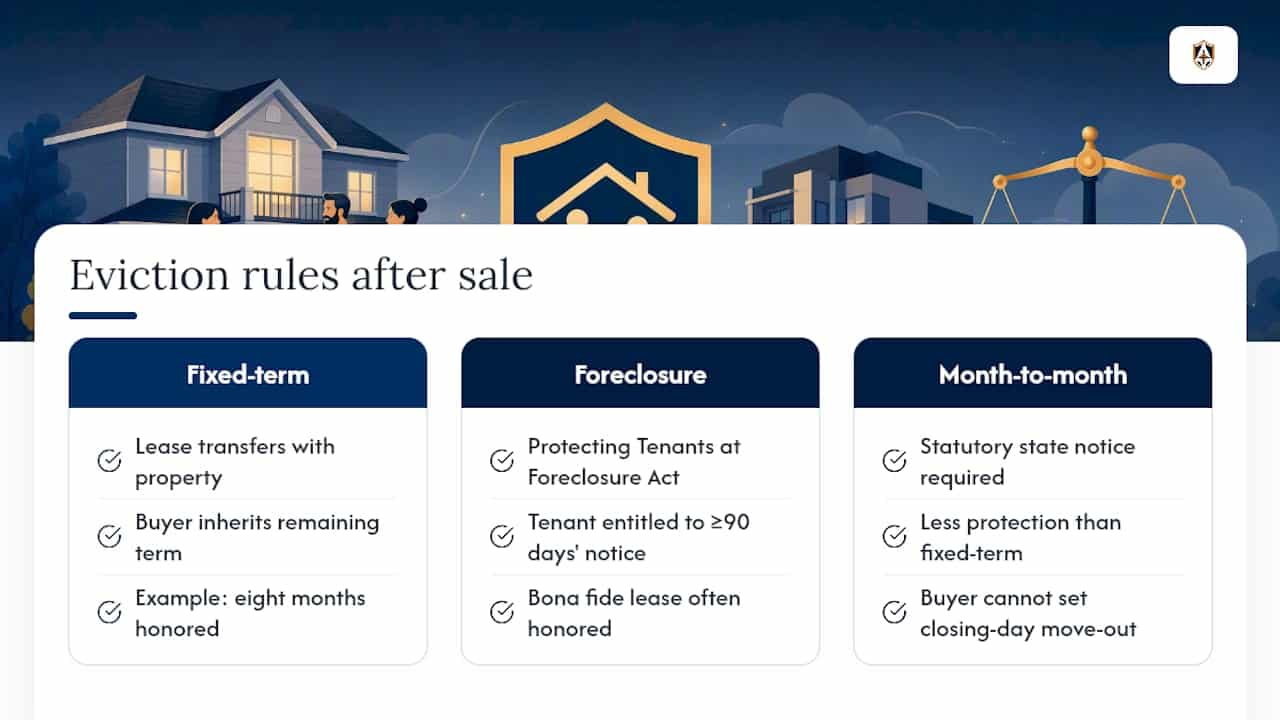
A sale by itself is not legal grounds to evict a tenant or terminate a lease. The lease transfers with the property, and the new owner steps into the landlord role subject to the same terms that governed the previous owner. If a tenant has eight months left on a fixed-term lease, the buyer inherits those eight months.
Foreclosure sales carry an extra layer of protection worth flagging separately. Under the Protecting Tenants at Foreclosure Act, tenants in a foreclosed property are generally entitled to at least 90 days’ notice before they have to leave, and a bona fide lease often has to be honored through its term even after foreclosure. If your sale involves any foreclosure element, this rule applies on top of the standard lease protections, not instead of them.
Month-to-month tenants have less structural protection than fixed-term tenants, but they’re still entitled to the statutory notice period their state requires before a new owner can end the tenancy. A buyer who wants the unit vacant can’t simply hand over a move-out date on closing day. They have to work within the same notice framework the seller would have had to use.
This is exactly why a buyer’s due diligence usually includes a close read of the lease and the estoppel certificate. Both documents establish precisely what protection the tenant carries into the new ownership, and neither the seller nor the buyer can rewrite that protection unilaterally.
Does Selling the Property Affect a Tenant’s Lease Renewal Rights?
A sale doesn’t erase renewal rights the tenant already has under the existing lease. If the lease includes an option to renew, that option transfers to the buyer along with everything else, and the new owner has to honor it if the tenant exercises it on time.
For month-to-month tenants, there’s no renewal clause to speak of, since the tenancy simply continues month by month until either party gives proper notice. A change in ownership doesn’t interrupt that continuity. The tenant keeps paying rent on the same schedule, and the new landlord keeps accepting it, unless notice to end the tenancy has been properly served.
Where this gets murky is when a seller and tenant had an informal understanding about renewal, something discussed but never put in the lease. That kind of verbal arrangement doesn’t bind a buyer. If a tenant genuinely has a renewal expectation you want to protect through the sale, put it in writing before you list the property, not after an offer comes in. A buyer evaluating the deal wants to know exactly what lease term and renewal terms they’re inheriting, and ambiguity there tends to slow negotiations or invite a lower offer.
Do You Need to Notify Tenants Specifically That the Property Is Being Sold?
Showing notices and sale notices are not the same thing, and sellers sometimes conflate them. A tenant deserves a distinct written notice that the property is going on the market, separate from the day-to-day notices you send before each showing.
That notice should cover a few basics: that the home is listed, roughly how showings will be scheduled going forward, and what happens to the lease if the property sells. Tenants who hear about a pending sale secondhand, from a sign in the yard or a neighbor, tend to become far less cooperative than tenants who got a heads-up directly from their landlord.
Once you’re under contract, a second notification is worth sending: confirming the closing date, introducing the incoming owner if appropriate, and explaining what happens with the security deposit. This is also the moment to clarify whether the buyer intends to keep the lease as is, offer a lease modification, or in the case of a month-to-month tenancy, plans to end it with proper notice. Some states impose specific disclosure timelines tied to a change in ownership, so check your state’s landlord tenant statute rather than assuming a verbal update covers the requirement.
What Can a Tenant Do if Their Rights Are Violated During a Sale?
Tenants who believe their rights were violated during a sale, entry without proper notice, an illegal rent hike, or a deposit that vanished at closing, have real recourse, and sellers should understand it because it shapes their own liability exposure.
The most common remedy is a complaint to a local housing authority or small claims court, particularly around deposit disputes. If a seller fails to transfer or return a security deposit with proper accounting, that gap is one of the most frequent sources of post-closing legal claims, and it can name either the seller or the new owner depending on how the transfer was handled.
Illegal entry, meaning showings conducted without the required notice, can also expose a seller to a claim for breach of quiet enjoyment, even if no damage occurred. And if a seller tries to force a move-out through harassment or utility shutoffs rather than a proper notice or a documented buyout, that crosses into constructive eviction territory, which carries real legal risk.
This is the practical argument for the documentation habits covered earlier in this guide. A signed estoppel certificate, a written showing agreement, and an itemized deposit accounting don’t just protect the buyer. They’re your best defense if a tenant later claims their rights were violated during the process.
How Do Tenant Rights and Sale Rules Differ by State?
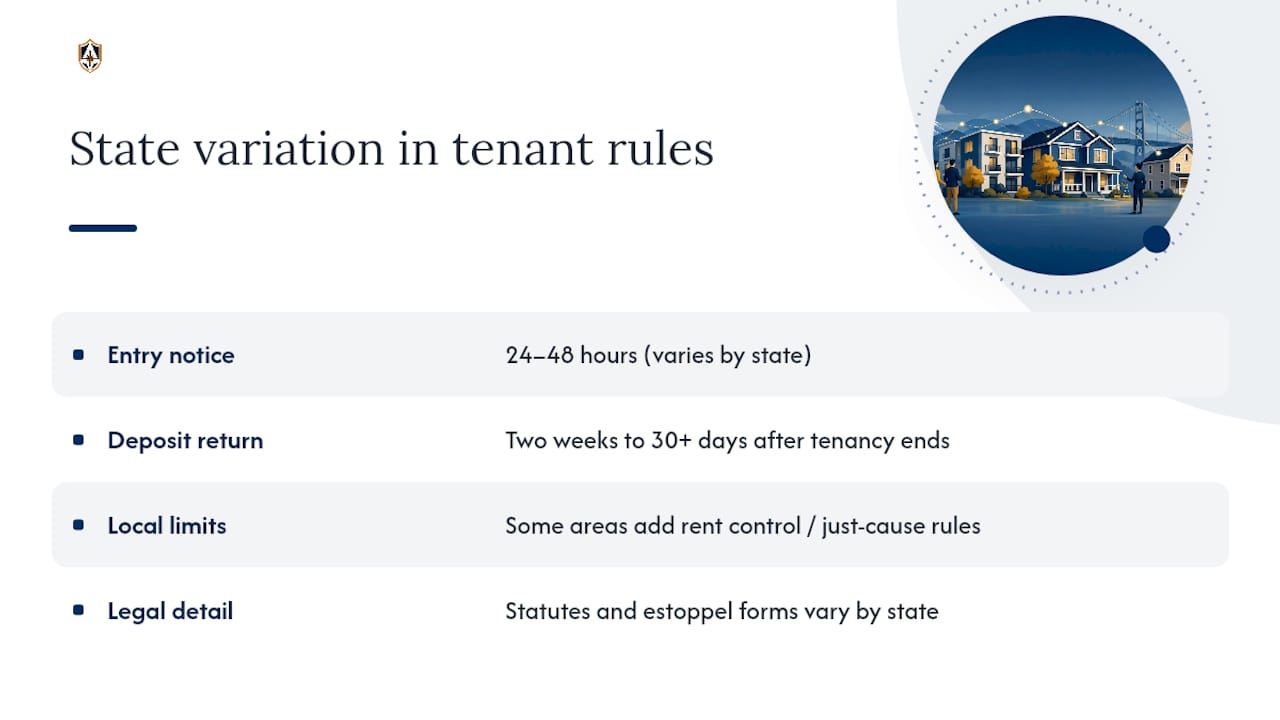
Landlord tenant law is set at the state level, and the differences matter more than most sellers expect. Notice periods for entry, for ending a month-to-month tenancy, and for returning a security deposit all vary by state, sometimes significantly.
Some states require 24 hours’ notice for entry; others specify 48. Deposit return deadlines after a tenancy ends can range from two weeks to 30 days or more, depending on the state. A handful of states and cities also layer on rent control or just-cause eviction ordinances that restrict what a new owner can do even after a legitimate sale, particularly in larger metro markets.
Because of that variation, treat every notice period and deposit rule referenced in this guide as a general framework, not a substitute for checking your specific state’s landlord tenant statute or a local real estate attorney before you list. What’s routine in one state can be a compliance problem in another, and the estoppel certificate process itself sometimes has state-specific formatting or disclosure requirements attached to it.
When Does It Make Sense to Sell Directly Rather Than List?
Some tenant situations are straightforward: a cooperative tenant, a clean lease, and enough time to run a normal listing. Others aren’t, a tenant who won’t allow showings, a lease that’s hard to explain to a retail buyer, or a timeline too tight for a buyout negotiation to play out.
Some companies work with sellers in that second category, offering options such as direct purchase, sales through investment partners, or managed Retail Buyer Programs when a traditional listing isn’t the right fit. Each option is built around the property’s actual condition and the seller’s real timeline, rather than forcing every tenant-occupied home through the same process.
If you’re weighing your options, have your lease, rent ledger, deposit accounting, and any tenant condition photos ready before reaching out. That file speeds up every path, whether you sell occupied, wait for vacancy, or negotiate an early move-out.
— AAS
How AAS Home Buyers Can Help You Sell With Tenants in Place
AAS Home Buyers is a practical alternative to the standard listing process when a tenant situation makes a traditional sale complicated, whether that’s a lease a retail buyer won’t touch, a tenant who won’t cooperate with showings, or a timeline that can’t absorb months of coordination. Instead of one rigid path, AAS Home Buyers offers a direct cash purchase, a sale through a vetted investment partner, or a managed Retail Buyer Program, so the tenant situation shapes the strategy instead of forcing you into a listing that doesn’t fit.

Before reaching out, pull together your lease and any signed addenda, your rent ledger, your security deposit accounting, and dated condition photos of the unit. That file is exactly what a direct buyer or a Retail Buyer Program coordinator needs to move quickly, and it saves you from repeating the paperwork chase mid-transaction. If your lease situation involves an early move-out you’re still negotiating, a rent-back arrangement may also be worth exploring depending on your closing timeline.
Reach out through AAS Home Buyers to walk through which option, direct purchase, partner sale, or Retail Buyer Program, fits your tenant situation and get a straightforward evaluation of your property.
Sources
- Selling a property with tenants living in it? Here’s what to know · Inman
- Tips for selling a property with existing tenants · Nolo
- Estoppel certificate · U.S. House of Representatives
- Selling a rental property with tenants (2026 guide) · DiscoveryMark
FAQ
Can a landlord sell a house with a tenant living in it?
Yes. A fixed-term lease survives the sale, and the buyer takes over as landlord for the remaining term. Month-to-month tenancies can typically be ended with the notice period your state requires, giving sellers flexibility to sell vacant instead.
Is cash for keys legal?
Yes, a cash-for-keys agreement is legal as long as it’s voluntary and documented in writing, covering the payment amount, move-out date, and condition expectations. Sellers should avoid anything that resembles pressure or harassment, since that can cross into constructive eviction.
How much should a cash-for-keys agreement pay?
Amounts vary by market and how quickly the seller needs vacancy, but the payment is typically framed as covering moving costs rather than a flat bonus. A written agreement tied to a specific move-out date and unit condition protects both parties regardless of the amount.
What is an estoppel certificate and why do buyers want one?
An estoppel certificate is a signed document from the tenant confirming the lease terms, current rent, and whether any disputes exist. Buyers and lenders request it to lock in the facts they’re relying on before closing.
Does a property sale cancel a tenant’s lease?
No. A sale alone is not grounds to end a lease or evict a tenant, and the lease terms transfer to the new owner. The only exceptions involve month-to-month tenancies ended with proper notice or specific circumstances like foreclosure.
What if my tenant won’t cooperate with showings?
Offer a written showing schedule and a modest incentive, such as a rent credit or cleaning service, to encourage cooperation. If the tenant remains unwilling, a documented cash-for-keys buyout or a direct sale through a program like AAS Home Buyers’ Retail Buyer Program can avoid the standoff entirely.