
Home Sellers: 4 Ways to Close When a Lis Pendens Clouds Title
Yes, you can sell a property with an active lis pendens, but a normal sale is rarely easy. Title insurers typically refuse coverage and lenders decline financing, which shuts most buyers out of the deal. Your realistic paths forward are resolving the underlying lawsuit, asking a court to expunge the notice, or selling to a cash buyer who accepts the title risk. Start with an attorney consultation before you list the property.
TL;DR:
- A property with an active lis pendens faces significant hurdles for traditional sales because title insurance is typically denied and lenders refuse financing, pushing buyers toward cash deals.
- Resolving the underlying lawsuit, asking a court to expunge the notice, or negotiating a voluntary release are the main legal options to clear the title before listing.
- Buyers and lenders perceive a lis pendens as a sign of litigation risk, which lowers offer prices, extends escrow times, and reduces the pool of available financing.
- Legal remedies such as expungement or settlement can take from weeks to over a year, with costs varying based on case complexity and legal procedures.
- When waiting for litigation is impractical, selling to a cash buyer or investor willing to accept the title risk can be a faster, more predictable solution.
Table of Contents
- What Is a Lis Pendens Sale, and How Does the Notice Work?
- Why Lis Pendens Notices Get Filed in the First Place
- How a Lis Pendens Blocks Financing, Insurance, and Buyer Confidence
- How to Remove or Neutralize a Lis Pendens Before You Sell
- Selling Strategies When You Cannot Wait for the Lawsuit to End
- What a Lis Pendens Sale Costs You in Time and Money
- What We See in Practice at AAS Home Buyers
- How AAS Home Buyers Can Help You Move Forward
- Sources
- FAQ
What Is a Lis Pendens Sale, and How Does the Notice Work?
A lis pendens is a recorded notice telling the public that a lawsuit affecting a specific property is pending in court. The term comes from Latin for “suit pending,” and county recorders file it in the same public records where deeds and mortgages live. Anyone pulling a title report on the property will see it.
The legal mechanics matter here. A recorded notice of pendency of action gives constructive notice to third parties, meaning any buyer who purchases the property after the filing date takes title subject to the outcome of that lawsuit. If the plaintiff wins, the buyer could lose the property or face a claim against it, regardless of what the seller promised at closing.
That said, a lis pendens is not itself a lien. It does not attach a dollar amount to the property or create a debt. It functions purely as notice that litigation is underway, which is a meaningful distinction for a lis pendens sale: the notice does not block a transfer of title on its own. The practical roadblock comes later, when title companies and lenders see the filing and decide the risk is too high to underwrite.
If you want to verify whether a lis pendens exists on a property, check the recorder’s office or clerk of court in the county where the property sits. Most counties now offer searchable online indexes, and a title company can run a full search for you in a day or two.
Why Lis Pendens Notices Get Filed in the First Place
A lis pendens shows up whenever a lawsuit claims a direct interest in real property, not just money owed. Recognizing which category your situation falls into helps you predict how the case, and the sale, will likely play out.
- Foreclosure and mortgage disputes. A lender initiating judicial foreclosure often files a lis pendens alongside the complaint to preserve its claim against the property during litigation.
- Specific performance claims. A frustrated buyer who believes a seller breached a purchase contract may sue for specific performance, demanding the court force the sale to proceed as agreed, and file a lis pendens to prevent the seller from selling to someone else in the meantime.
- Divorce, probate, and partition actions. When spouses or co-owners fight over who keeps a home, or when heirs dispute an inherited property, a lis pendens locks the title until the court sorts out ownership.
- Mechanic’s and contractor liens. A contractor who was not paid for work performed on the property may file suit and record a lis pendens to secure a judgment against the real estate itself.
- Boundary and title chain disputes. Disagreements over easements, property lines, or defects in the chain of title can also trigger a filing, particularly in older neighborhoods with messy historical deeds.
Divorce-related filings tend to be the most emotionally charged and the slowest to resolve, since they often depend on the pace of the broader family court case. If real estate and marital property division are at the center of your dispute, a family law attorney who handles divorce-related property matters can clarify how the litigation timeline is likely to affect a sale.
How a Lis Pendens Blocks Financing, Insurance, and Buyer Confidence
The lis pendens itself does not stop a deed from being signed and recorded. What stops most sales is the reaction of everyone else involved in the transaction, starting with the title company.
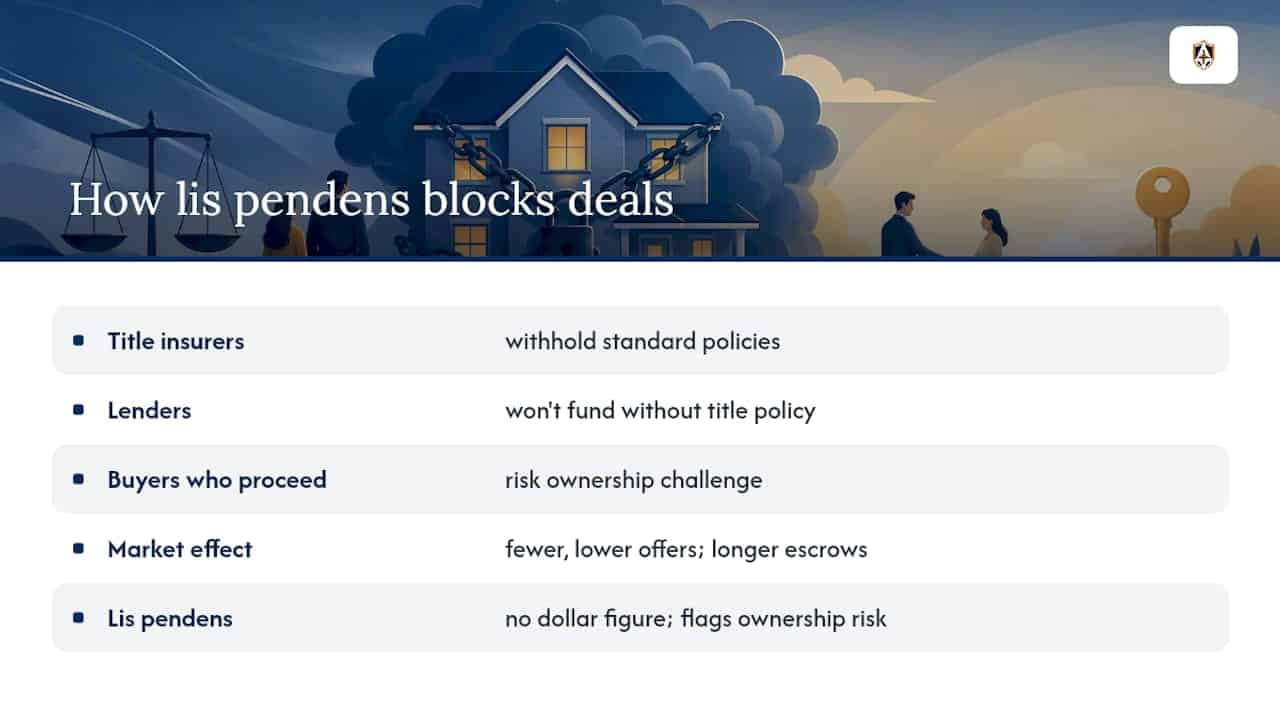
Title insurers withhold coverage almost every time. Underwriters commonly refuse to issue standard title policies on properties with active litigation noted on title, because insuring the property would mean accepting the risk that a court could later invalidate the buyer’s ownership. Without a policy, most buyers and their attorneys will walk away, since an owner’s title policy is the main protection a buyer has against exactly this kind of hidden claim.
Lenders follow the title company’s lead. Mortgage underwriting requires a clean or insurable title as a condition of closing. If the title company will not insure the property, the lender will not fund the loan. That single fact eliminates the vast majority of buyers in the marketplace, since most home purchases depend on financing rather than cash.
Buyers who proceed anyway take on real risk. A buyer who closes on a property with an unresolved lis pendens is stepping into the lawsuit itself. If the plaintiff prevails, the buyer’s ownership interest can be challenged, reduced, or unwound entirely, depending on what the court decides and how the state treats bona fide purchasers in that scenario. Few buyers are willing to accept that exposure without a steep discount, and fewer still without cash in hand and their own legal counsel reviewing the case first.
The market response is predictable. Fewer offers come in, the offers that do arrive tend to be well below comparable market value, and escrow periods stretch out while buyers and their attorneys try to assess the litigation risk. Some deals fall apart entirely once a buyer’s lender or title company flags the filing partway through underwriting.
It helps to separate a lis pendens from an actual lien or a completed foreclosure. A lien attaches a specific debt amount to the property and can usually be paid off and released at closing. A lis pendens carries no dollar figure. It is a flag that litigation could change who owns the property or what it is worth, and that uncertainty is harder for buyers, lenders, and insurers to price than a fixed debt.
How to Remove or Neutralize a Lis Pendens Before You Sell
Clearing a lis pendens before you list the property is almost always the cleanest path to a normal sale, since it restores your ability to get title insurance and attract financed buyers. Four routes generally exist, and which one fits depends on the underlying dispute and your state’s procedural rules.
- Resolve the underlying lawsuit. Settling the case, or getting it dismissed, is the most direct fix. Once the case ends, the party who filed the notice must record a release that formally removes the lis pendens from the public record. Get this release in writing and confirm it has actually been recorded, not just promised.
- File a motion to expunge. If you believe the lawsuit lacks merit, does not actually involve a real property interest, or was filed by someone without standing, you can ask the court to expunge the notice. Courts in many states will grant this when the claimant cannot show a valid claim affecting title, though the exact standard and burden of proof vary by state.
- Post a bond or other security. Where state law allows it, you can ask the court to accept a bond in place of the lis pendens. The bond guarantees the claimant a source of recovery if they eventually win, which lets the sale proceed while the underlying case continues. Bond amounts and procedures differ significantly from state to state, so this route needs prompt legal guidance.
- Negotiate a voluntary release. Sometimes the simplest option is asking the person who filed the notice to release it voluntarily, often in exchange for a partial settlement, an escrow holdback, or an agreement on how sale proceeds will be divided. Any release should specify the recording information of the original lis pendens so the county recorder can match and clear it.
Before you contact an attorney, gather every recorded instrument tied to the property (the original lis pendens, any prior deeds or liens), all correspondence with the opposing party, and a current title search. Walking in with these documents organized will save you a consultation or two in legal fees.
One wrinkle worth knowing about: even after a court dissolves a lis pendens, title underwriters sometimes still resist issuing a policy until the litigation fully concludes, an appeal period expires, or specific underwriting conditions are met. A dismissal “with prejudice” carries more weight with underwriters than a simple dismissal, since it forecloses the possibility of the same claim being refiled.
Selling Strategies When You Cannot Wait for the Lawsuit to End
Litigation on a property’s title rarely moves fast, and many sellers cannot afford to wait months or years for a court date. If that describes your situation, a handful of practical selling strategies exist alongside the legal remedies above.
- Sell to a cash buyer or investor. Buyers who purchase with cash do not need mortgage financing or a full title insurance policy the way a retail buyer does, which means the lender-driven blockade described earlier simply does not apply. Many investors specialize in properties with title complications and price the risk into their offer rather than walking away.
- Consider a managed, off-market sale. An off-market sale keeps the listing out of public search portals, which can reduce the number of buyers who see the litigation flagged in a title search before they even make an offer, and gives you more control over disclosure and timing.
- Use a bond or escrow holdback to allocate risk. Structuring the closing so a portion of proceeds sits in escrow until the underlying case resolves can reassure a buyer’s attorney enough to move forward, particularly when combined with a court-approved bond.
- Price and disclose the risk directly. A straightforward price reduction, paired with full disclosure of the litigation and its likely timeline, sometimes attracts a buyer willing to accept the risk in exchange for a below-market deal.
Pro Tip: Get a title search done before you list anywhere, even if you already know about the lawsuit. A full report will show you exactly how the recorded lis pendens reads, whether any other liens are stacked on top of it, and what a buyer’s attorney will see the moment they pull the same records.
If speed and certainty matter more to you than squeezing out top dollar, a direct cash sale or a managed retail buyer program tends to fit better than a traditional listing, since both are built around buyers who already expect to work through title complications rather than being surprised by them mid-escrow.
What a Lis Pendens Sale Costs You in Time and Money
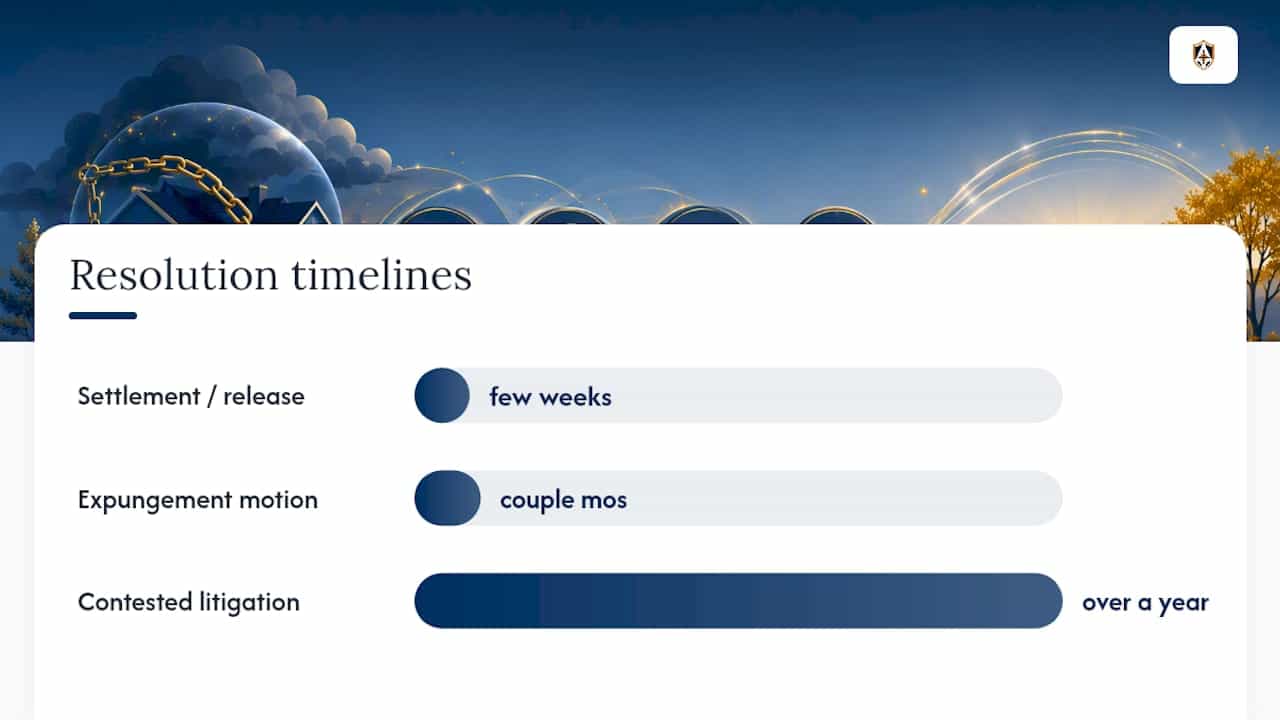
Timelines vary widely depending on which remedy you pursue. A negotiated settlement or voluntary release can sometimes close in a few weeks. A motion to expunge typically takes longer, often a couple of months, since it requires a court hearing and a judge’s ruling. Full litigation to a final judgment can stretch well beyond a year in contested cases.
Costs scale with complexity. Attorney fees for an expungement motion or settlement negotiation are generally lower than fees for carrying a case through trial. Bond costs depend entirely on state procedure and the size of the claim, so get a specific estimate from counsel rather than assuming a flat percentage. Beyond legal fees, factor in the market cost: discounted offers, extended carrying costs like taxes and insurance, and the opportunity cost of a property sitting unsold for months.
Ask yourself three questions before choosing a path: How fast do you need to close? How strong is the underlying claim against you? Can you afford to wait out a court date, or does a cash sale at a discount solve more problems than it costs you?
What We See in Practice at AAS Home Buyers
We work with sellers in exactly this bind on a regular basis, so a few patterns stand out. Sellers who move quickly to gather their title history and recorded documents almost always end up with more options than those who wait until a buyer’s attorney flags the issue mid-escrow. A cash purchase, a spot in a retail buyer program, or a referral to a local agent can each fit depending on how much time pressure you are under and how confident you feel about the underlying case.
Our take: legal clearance should be your first move whenever the timeline allows it, because a clean title almost always brings a better price. But when a lawsuit could drag on for a year or more, or when you simply need to move on, a direct sale to a buyer who understands title risk is a legitimate and often smarter choice than gambling on a courtroom outcome. If you are also dealing with a related lien, our guide on selling a house with liens walks through how that process typically unfolds, and our notes on possession after closing are worth a read if the litigation involves a dispute over who currently occupies the home.
— AAS
How AAS Home Buyers Can Help You Move Forward
If a lis pendens has stalled your sale and you need certainty more than you need top-dollar negotiations, some companies offer direct routes around the financing and title insurance wall that stops most traditional deals. Because these companies may buy with cash or manage sales through managed retail buyer programs, they can move forward on properties that typical financed buyers’ lenders would reject outright.

We start with a straightforward evaluation of your property and the litigation attached to it, so bring your recorded lis pendens, any related court filings, and a recent title search if you have one. From there, we walk you through your options: a direct cash offer, a managed sale, or a referral to one of our vetted agents if legal clearance is close and a traditional listing makes more sense. Review our process to see exactly how each step works, then reach out for a no-pressure evaluation of your specific situation.
Sources
- Lis Pendens | LegalTemplates
- Can a Lis Pendens Stop the Sale of a Property? – LegalClarity
- lis pendens | Wex | LII / Legal Information Institute
- Protecting interests or hindering real estate deals? Impact of a lis pendens when selling real property in Florida – The Florida Bar
FAQ
Can a property with a lis pendens be sold?
Yes, but the sale is legally complicated because title insurers usually refuse coverage and lenders decline to fund a mortgage, which pushes most sellers toward cash buyers or legal resolution first.
Can I buy a property with a lis pendens?
You can, but you would be taking on the risk of the underlying lawsuit, since a later ruling against the seller could affect your ownership; most buyers wait for the notice to be resolved or negotiate a significant discount to accept that risk.
How does a lis pendens affect buyers?
A recorded lis pendens gives you constructive notice that a lawsuit could change who owns the property or what it is worth, so if you buy before the case resolves, your title could be challenged depending on the outcome.
Is a lis pendens the same as a foreclosure?
No. A lis pendens is a notice of pending litigation and can be filed for many reasons, including foreclosure, but it is not itself a foreclosure proceeding or a lien with a fixed dollar value.