
What Sellers Should Budget for Closing Costs
Sellers typically pay between 8% and 10% of their home’s sale price in total closing costs when real estate agent commissions are included, according to EffectiveAgents. Strip out commissions, and the remaining fees — think title insurance, transfer taxes, and escrow charges — usually land between 1% and 3% of the sale price.
Commissions are almost always the biggest expense on a seller’s settlement statement. Everything else (title work, prorated taxes, recording fees, payoff processing) tends to be smaller and more predictable.
**On a median-priced home sale, total closing costs commonly represent a significant portion of the sale price, with non-commission fees making up a smaller share. Knowing this range before you list gives you a real number to plan around instead of guessing at what will hit your bottom line.
Key Takeaways
Total closing costs for sellers typically run 8% to 10% of the sale price with commissions included, and 1% to 3% without them.
| Point | Details |
|---|---|
| Budget the full range | Plan for 8% to 10% of your sale price in total costs if you’re keeping agent commissions in the deal. |
| Commission is now negotiable | The 2024 NAR settlement means buyer-agent compensation is optional, not mandatory, under MLS rules. |
| Costs come out at closing | Fees are deducted from your proceeds at the settlement table, not paid out of pocket beforehand. |
| Shop and negotiate | Title reissue discounts, commission rates, and settlement provider fees all have room to move. |
| Consider a direct sale | AAS Home Buyers offers a cash purchase and agent referral pathway for sellers who want fewer fee variables. |
This article is general information, not a substitute for advice from a qualified financial advisor. Consult a qualified financial professional about your own circumstances before acting on anything here.
Table of Contents
- Closing Costs for Sellers: A Fee-by-Fee Breakdown
- How Much Sellers Actually Pay: A Worked Example
- When Closing Costs Come Out of Your Proceeds
- Ways to Lower Your Seller Closing Costs
- Other Seller Costs to Budget Beyond Closing
- How the 2024 Commission Settlement Changed Seller Costs
- What This Shift Means for Sellers Weighing Their Options
- A Faster Path to Closing With Fewer Fee Surprises
- Sources
- FAQ
Closing Costs for Sellers: A Fee-by-Fee Breakdown
Every seller’s closing statement looks a little different, but most share the same core categories. Here’s what typically shows up and what you can expect to pay for each.
Agent commissions remain the largest single cost. Historically, sellers covered both the listing agent’s fee and a share for the buyer’s agent, combining for roughly 5% to 6% of the sale price. That structure has shifted, and we’ll cover why in the next section, but commission still tends to be negotiable and varies by market, agent experience, and how much service you need.
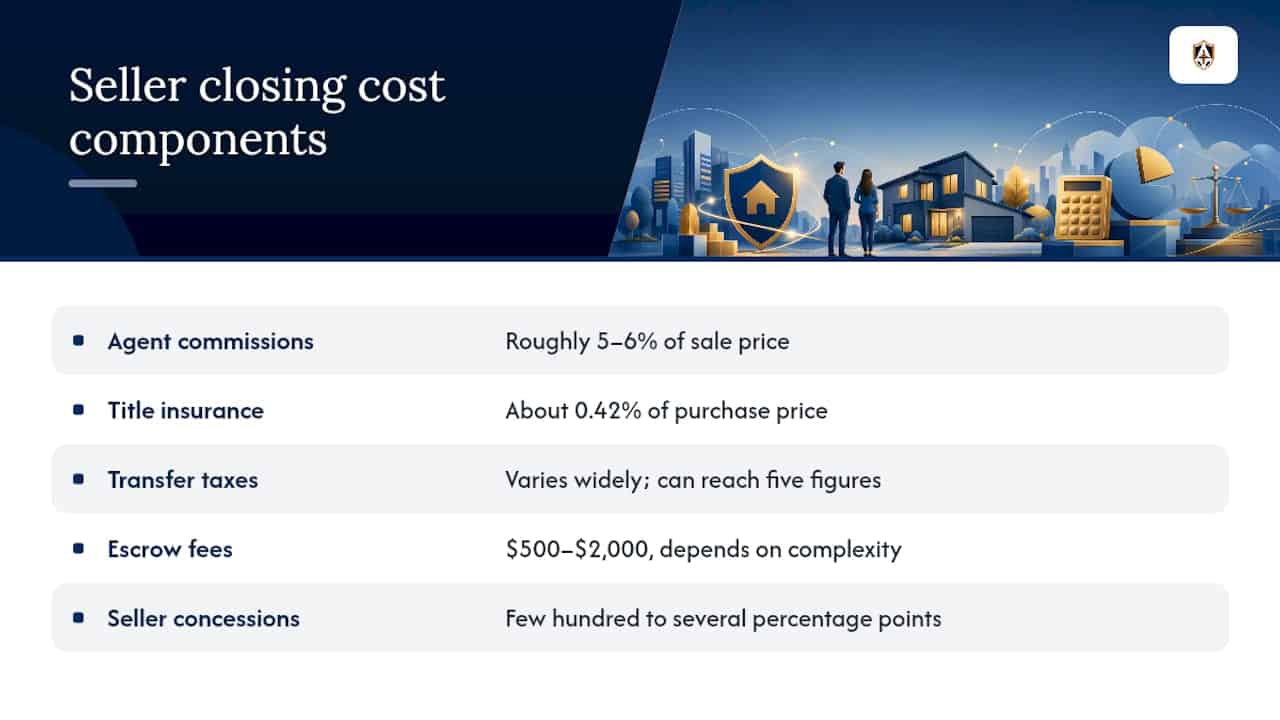
Title-related costs come next. Owner’s title insurance protects the buyer against ownership disputes and typically runs around 0.42% of the purchase price, per data cited by NerdWallet. If you bought title insurance recently on the same property, ask your title company about a reissue discount. Many insurers cut the rate significantly for sellers who held the property less than a decade.
Transfer taxes and recording fees vary more than almost any other line item. Some states charge nothing. Others, particularly in high-cost metros, can add thousands of dollars. Zillow points to cities like Los Angeles and San Francisco, where transfer taxes alone can run into five figures on a mid-priced home. Check your county recorder’s office or state tax authority before you assume a national average applies to you.
Escrow and settlement fees cover the administrative work of closing the deal: document preparation, wire transfers, courier charges, and the settlement agent’s time. These typically range from $500 to $2,000 depending on the transaction’s complexity.
Prorated property taxes and HOA dues get split between buyer and seller based on the closing date. If you’ve prepaid taxes or dues for a period past your closing, you’ll receive a credit; if you owe for time you’ve occupied the home, that gets deducted from your proceeds.
Mortgage payoff is straightforward but easy to underestimate. You’ll owe the remaining loan balance plus accrued interest through the closing date, and some lenders charge a small fee to prepare the official payoff statement.
Seller concessions and repair credits aren’t mandatory, but they’re common. If an inspection turns up issues or a buyer’s appraisal comes in low, offering a credit toward repairs or closing costs can keep the deal alive. These credits can range from a few hundred dollars to several percentage points of the sale price.
Attorney fees apply in states that require legal representation at closing, common throughout the Northeast and parts of the South. Where attorneys aren’t legally required, some sellers still hire one for complex situations like inherited property or title disputes.
Pro Tip: Ask your title company for a reissue rate quote before you assume you’ll pay full price for owner’s title insurance. It’s one of the easiest discounts sellers overlook, and it costs nothing to ask.
How Much Sellers Actually Pay: A Worked Example
Aggregated data consistently points to two numbers: 6% to 10% of sale price when commissions are included, and 1% to 3% when they’re excluded, according to Bankrate and EffectiveAgents. Where you land within that range depends heavily on your state’s transfer tax structure and the commission rate you negotiate.
Here’s how those percentages translate into dollars for a home selling at $400,000, a common median price point in many U.S. markets.
When Closing Costs Come Out of Your Proceeds
You don’t pay closing costs out of pocket in most transactions. Instead, the settlement agent deducts every fee, commission, and payoff amount directly from your sale proceeds at the closing table, then wires or checks you the remainder.
That said, a few things need to happen before that final number is set:
- Your lender issues a payoff statement showing the exact amount needed to satisfy your mortgage, including per-diem interest.
- The closing disclosure lists every fee both parties owe, and you should review it days before signing, not at the table.
- Any liens, judgments, or unpaid HOA assessments get identified and resolved before funds distribute.
Pro Tip: Request your mortgage payoff statement at least two weeks before closing and confirm whether your loan holds funds in an escrow account for taxes or insurance. Escrow refunds sometimes arrive separately from your sale proceeds. Knowing that in advance prevents a confusing gap between what you expected and what actually hits your account.
Ways to Lower Your Seller Closing Costs
You have more control over these numbers than most sellers realize. A few levers can meaningfully shrink your total bill, though each comes with a tradeoff worth weighing.
- Negotiate your listing commission. Rates aren’t fixed, and agents in competitive markets will often adjust their percentage, especially for higher-priced listings.
- Consider flat-fee MLS or limited-service listings. These cut commission costs substantially but usually mean less marketing support, professional photography, and negotiation help, which can affect your final sale price.
- Shop title and escrow providers. Fees for the same service can vary by hundreds of dollars between companies, and reissue discounts on title insurance aren’t automatic. You have to ask.
- Time your closing date carefully. Closing near the end of a tax period, or aligning with your mortgage’s interest accrual cycle, can reduce prorated amounts you owe.
- Weigh buyer concessions against competitive positioning. Offering a credit can make your listing more attractive in a slow market, but it directly reduces your net proceeds, so use it strategically rather than automatically.
Pro Tip: Cutting your commission rate too aggressively can backfire. A lower commission sometimes means less agent motivation to market your home aggressively, which can extend your time on market and cost you more in carrying costs than you saved on the fee itself.
Other Seller Costs to Budget Beyond Closing
Closing costs aren’t the only expenses that eat into your proceeds. Pre-sale preparation adds up fast: professional photography, staging, minor repairs, pre-listing inspections, and any municipal certificates your city requires before a sale can close.

Moving costs deserve their own line in your budget, and depending on your situation, you may also want to talk to a tax professional about capital gains exposure on the sale. This isn’t legal or tax advice, but it’s worth a conversation before you finalize your pricing strategy.
Watch for costs that surface late in escrow. Unresolved liens, old judgments, or a buyer’s last-minute repair request after inspection can all add unexpected expenses right when you thought your numbers were locked.
How the 2024 Commission Settlement Changed Seller Costs
The 2024 National Association of Realtors settlement reshaped how commissions get disclosed and negotiated. Sellers are no longer required under MLS rules to offer buyer-agent compensation, a shift that gives sellers more control over one of their largest closing expenses, according to EffectiveAgents.
That doesn’t mean buyer-agent compensation has disappeared. Many sellers still choose to offer it because homes that do tend to attract more showings and offers in competitive markets. What’s changed is that it’s now a strategic choice rather than an MLS mandate.
- Commission rates remain fully negotiable between you and your listing agent.
- Offering buyer-agent compensation is now optional, not required for MLS listing.
- State and local custom still dictates plenty about who pays what, so check your market before assuming national trends apply directly to your transaction.
What This Shift Means for Sellers Weighing Their Options
We’ve watched sellers spend weeks negotiating commission percentages down by half a point, only to lose more than that in a longer time on market or a lower final offer. The math doesn’t always work in the seller’s favor, and that’s the gap between what a fee negotiation promises and what actually shows up in net proceeds.
That’s part of why AAS Home Buyers built more than one path to a sale. Our direct cash purchase option, Retail Buyer Program, and vetted agent referrals each change your closing-fee exposure differently, and the right one depends on whether speed, certainty, or maximum sale price matters most to you. If you want a no-obligation evaluation of which path fits your situation, we’re glad to walk through the numbers with you.
A Faster Path to Closing With Fewer Fee Surprises
AAS Home Buyers is the alternative to a traditional listing when speed and predictable numbers matter more than squeezing out every last dollar through months of negotiation. Instead of budgeting for commissions, staging costs, and the uncertainty of buyer financing falling through, sellers who work with AAS Home Buyers get a straightforward cash offer with fewer moving pieces at the closing table.

Our transparent three-step process is built to give you clarity on what you’ll walk away with before you commit to anything. Whether your property needs major repairs, you’re facing foreclosure, or you simply want to skip the months-long listing cycle, we evaluate your situation and present real options, including a direct cash purchase or a referral to one of our vetted local agents if a traditional sale still makes sense for you. Get your offer started today and see the numbers for yourself.
Sources
- Seller Closing Costs: Complete Fee Breakdown, Calculator & Savings Guide | EffectiveAgents®
- What Are the Closing Costs for a Home Seller? – NerdWallet
- How Much Are Closing Costs for Sellers? | Zillow
- Closing Costs When Selling A House | Bankrate
FAQ
How common is it for sellers to pay closing costs?
Nearly every home sale involves seller-paid closing costs. Commission, title fees, and prorated taxes are standard line items on almost all settlement statements, regardless of state.
How much should a seller budget for closing costs?
Budget 8% to 10% of your sale price if you’re paying a full commission, or 1% to 3% if you’re using a limited-service listing or direct-sale option that reduces commission exposure.
Are seller closing costs different for cash sales?
Cash sales often carry lower closing costs since there’s no buyer lender involved, which eliminates certain financing-related fees and can shorten the timeline enough to reduce prorated carrying costs.
Can FSBO sellers avoid all commission costs?
FSBO sellers avoid the listing-agent commission but may still offer buyer-agent compensation to attract offers, and they take on marketing and negotiation work themselves.
Does AAS Home Buyers charge closing costs like a traditional sale?
AAS Home Buyers structures its direct cash purchase option to simplify fee exposure compared to a traditional listing, giving sellers a clearer picture of net proceeds upfront.