
Who Gets Possession After Closing, and When?
Possession usually transfers the same day as closing, but “usually” isn’t a guarantee that your contract will enforce. Deed recording, loan funding, and the specific possession clause in your purchase agreement control the exact moment you get keys. If a seller needs to stay past that point, that arrangement only protects you when it’s written down as a formal post-closing occupancy agreement with dates, fees, deposits, and consequences spelled out in advance.
TL;DR:
- Immediate possession typically occurs within hours of recording, but delays can happen if state’s funding method is dry or delayed.
- Rent-back agreements usually last up to two months and require a written, signed contract to avoid legal, insurance, or lender issues.
- Pre-closing possession is discouraged and must be separately documented to prevent seller liability and potential legal complications.
- Escrow holdbacks, clear agreements, and final walk-throughs are essential to protect buyers from overstay and damages during possession transition.
- Lenders and insurers often impose strict occupancy and insurance conditions, so confirming with both before arranging delayed possession is crucial.
Table of Contents
- Possession After Closing: How It Differs From Closing Itself
- What Are the Common Possession Scenarios After Closing?
- Post-Closing Possession Agreements: What They Are and What Can Go Wrong
- What Should a Written Possession Agreement Include?
- How Do Lenders and Insurers Treat Delayed Possession?
- How Can Buyers Protect Themselves When Negotiating Possession Terms?
- What If the Seller Won’t Leave on Schedule?
- How AAS Home Buyers Approaches Possession Timing
- Need a Faster Close or More Control Over Your Possession Timeline?
- Sources
- FAQ
Possession After Closing: How It Differs From Closing Itself
Closing and possession are two different legal events that happen to line up most of the time. Closing is the moment title transfers and the deed gets recorded with the county. Possession is the moment you actually get to walk in, change the locks, and call the place yours.
In most transactions, these happen within hours of each other. But the sequence depends on how your state and lender handle funding. Some states use “wet funding,” where money changes hands and the deed records on the same day. Others use “dry funding,” where the lender holds a post-signing review before releasing funds, which can push move-in back by a business day or more. Arizona, California, and several other states fall into this dry-funding category.
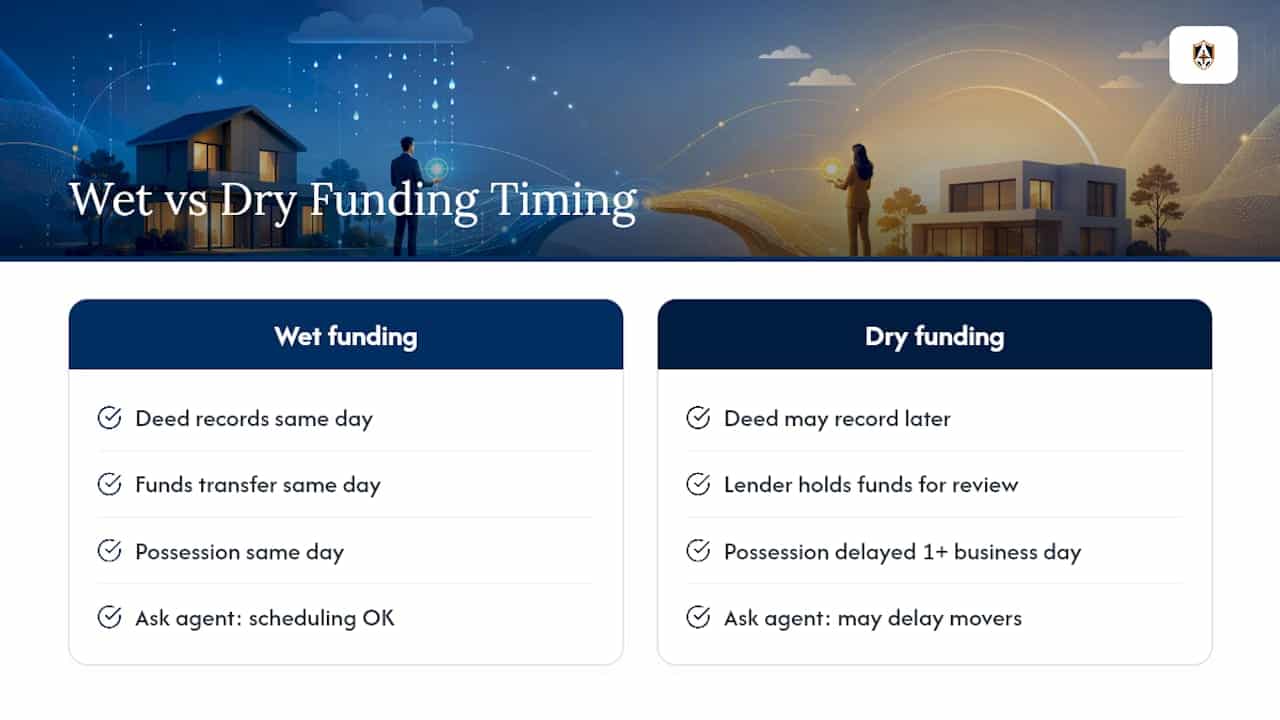
Here’s the practical takeaway: your keys and utility transfer date depend on two things, not one. The possession clause in your contract sets the intended timing. Your state’s funding and recording practice determines whether that intention holds up on paper. Ask your closing agent which category your transaction falls into before you schedule movers.
What Are the Common Possession Scenarios After Closing?
Three scenarios cover almost every real estate closing. Knowing which one applies to your deal changes what you need in writing.
Immediate possession is the default and the safest option for buyers. Most buyers get keys the same afternoon, often between 3 PM and 5 PM once the deed records and funds clear. Sellers typically vacate that morning, and a same-day final walkthrough confirms the home matches the contract’s condition terms.
Delayed possession, commonly called a rent-back or use-and-occupancy agreement, lets the seller stay in the home for a set period after closing. Sellers request this when their next home isn’t ready or when a contingent sale creates a timing gap. A typical window commonly used is up to about two months, and lenders financing the buyer’s purchase as a primary residence often cap that window to avoid conflicts with owner-occupancy requirements.
Pre-closing possession, where a buyer moves in before the sale is finalized, is the riskiest of the three. Sellers and their agents often decline it outright because it exposes the seller to liability if financing falls through after the buyer has already moved belongings in. When it does happen, it needs its own separate written agreement, not a verbal understanding based on goodwill.
- Immediate possession: the buyer gets keys same day, typically within hours of recording.
- Delayed possession: the seller stays under a signed rent-back agreement, usually 30 to 60 days.
- Pre-closing possession: the buyer moves in before the deed transfers, which most agents discourage.
Post-Closing Possession Agreements: What They Are and What Can Go Wrong
A post-closing possession agreement, sometimes called a rent-back or use-and-occupancy agreement, lets a seller remain in the home for a defined period after the buyer legally owns it. The seller pays the buyer for that time, and the buyer temporarily delays their own move-in.
These arrangements show up constantly in competitive markets where sellers need extra time to close on their next home. The problem is that convenience for the seller creates real exposure for the buyer if the paperwork is thin. Reporting from The New York Times has documented cases where informal rent-back deals turned into eviction fights, insurance disputes, and monthslong delays because nobody had written down what happens if the seller simply doesn’t leave on schedule.
For buyers, the risks cluster around three areas: a holdover seller who won’t move out and triggers a formal eviction process, a gap in homeowner’s insurance coverage because the buyer technically owns a home someone else occupies, and lender occupancy rules that assume the buyer will move in within a certain window.
For sellers, the obligations are just as real. A seller who overstays without a clear per-diem fee structure and a documented condition standard can end up owing damages, losing a security deposit, or facing legal costs that erase whatever convenience the rent-back provided.
- Buyer risk: holdover delays that require a formal eviction rather than a simple lockout.
- Buyer risk: insurance coverage gaps if the policy assumes owner occupancy.
- Buyer risk: lender occupancy covenants that expect move-in within a set timeframe.
- Seller risk: per-diem fees and damage costs if move-out is delayed.
- Seller risk: proof-of-insurance requirements during the occupancy period.
Pro Tip: Treat every rent-back longer than a few days as a formal transaction with its own paperwork, not a favor between neighbors. The fifteen minutes it takes to fill out a template agreement is cheaper than a single day of legal fees if things go sideways.
What Should a Written Possession Agreement Include?
A post-closing possession agreement needs to function like a mini-lease, even though it’s legally structured as a license rather than a lease. Every version worth signing covers the same core terms.
- Exact start and end dates and times, plus the notice procedure for early termination if either party needs to adjust the schedule.
- A daily occupancy fee, calculated either as the buyer’s daily principal, interest, taxes, and insurance (PITI) or at fair market rent, whichever the parties agree fits the situation.
- A security deposit or escrow holdback the buyer can draw against for damage or holdover, plus an escalating penalty for each day the seller stays past the agreed date.
- Insurance and liability requirements, including proof the seller carries renter’s insurance during the occupancy period.
- License, not lease, language. Brokers and attorneys consistently recommend this distinction because tenancy protections under landlord-tenant law can make removing a holdover seller far harder than removing a licensee.
- A condition standard and final inspection trigger tied to the move-out date, so damage disputes have an objective benchmark.
- A keys-and-access protocol, specifying who holds keys during the occupancy period and when locks get changed.
Standardized templates make this easier than drafting from scratch. The Colorado Division of Real Estate publishes a post-closing occupancy agreement with fields for possession dates, times, and a 60-day cap when the buyer intends to occupy the home as a primary residence. Fillable industry versions cover similar ground with per-diem and escrow language built in.
Pro Tip: Never rely on a handwritten side letter for a rent-back. Use a standardized template, fill in every blank, and have both parties initial the fee schedule specifically. Vague fee language is where most disputes start.
How Do Lenders and Insurers Treat Delayed Possession?
Lenders and insurers don’t treat a post-closing occupancy agreement as a minor scheduling detail. Many buyer loans carry an owner-occupancy covenant requiring the buyer to move in within a set window, and some lenders reference a roughly 60-day threshold as the outer limit before a rent-back starts to look like it violates the loan’s occupancy terms. Push past that window without lender awareness, and you risk technical default on your own mortgage.
Insurance carries a separate but related danger. A standard homeowner’s policy typically assumes the owner occupies the property. If a seller is living there instead and something happens, fire, injury, water damage, the insurer may deny the claim because the actual occupancy didn’t match what the policy was written to cover.
Before you agree to any delayed possession arrangement, call your lender and your insurance agent, not just your real estate agent. Ask the lender directly whether the rent-back duration you’re considering triggers any occupancy clause in your loan documents. Ask your insurer whether the policy needs an endorsement or rider to cover a non-owner occupant during that window. Skipping this step is how buyers end up discovering a coverage gap only after something’s already gone wrong.
How Can Buyers Protect Themselves When Negotiating Possession Terms?
Protection starts before you sign anything, not after a problem shows up. A few non-negotiable items belong in every buyer’s possession strategy.
- Require a signed, written possession agreement with specific dates, per-diem fees, and escalating holdover penalties. Never accept a verbal promise.
- Insist on an escrow holdback large enough to cover several weeks of holdover costs, not just a token deposit.
- Ask for a notarized vacancy certificate and proof of the seller’s renter’s insurance before releasing any escrow funds.
- Schedule utility transfers two to three weeks ahead of your target possession date so service doesn’t lapse the moment you get keys.
- Change the locks and rekey the property the day you take possession, regardless of how much you trust the seller.
At closing itself, walk through the property one final time, confirm it matches the agreed condition standard, and collect every warranty document, appliance manual, and access code the seller has. If the rent-back terms are anything beyond a simple few-day buffer, loop in your lender before signing and have an attorney review the agreement.
Pro Tip: Ask your closing agent to hold the occupancy fee and deposit in escrow rather than paying it directly to the seller. An escrow holdback gives you actual leverage if the seller doesn’t move out on schedule; cash already in the seller’s pocket gives you none.
What If the Seller Won’t Leave on Schedule?
Document the breach the moment the agreed move-out date passes. Note the date, time, and any communication with the seller, then notify your escrow or title company in writing that the occupancy period has ended without vacancy.
Your first move should be financial, not legal. If your agreement included an escrow holdback, ask the escrow company to release funds against the per-diem holdover penalty and any provable damages. A well-drafted agreement makes this a paperwork exercise rather than a courtroom fight.
If the seller still won’t leave, you’re looking at a formal eviction, and the process and timeline vary significantly by jurisdiction. This is exactly why license language matters more than most buyers realize going in: a licensee who overstays is typically easier to remove than someone with tenant status under local landlord-tenant law. Consult a real estate attorney as soon as the holdover starts, and bring the signed agreement, escrow records, and your written notice of breach. That paper trail is what makes the difference between a quick resolution and a drawn-out dispute.
How AAS Home Buyers Approaches Possession Timing
We’ve seen enough rent-back situations turn messy that our approach at AAS Home Buyers starts with transparency about timelines before a seller commits to anything. When a seller works with us through a direct cash purchase, our Retail Buyer Program, or one of our vetted local agents, we lay out exactly when funds move, when the deed records, and what flexibility actually exists on possession.
That clarity protects seller equity two ways. It keeps sellers from agreeing to a rent-back they can’t actually deliver on, and it gives buyers escrow mechanics they can trust instead of a handshake. We’d rather walk a seller through their real options for timing than let a vague verbal promise create a legal headache six weeks later.
— AAS
Need a Faster Close or More Control Over Your Possession Timeline?
If a rigid closing date and an uncertain move-out timeline are the two biggest headaches in your sale, a traditional listing isn’t always the fastest way through them. AAS Home Buyers gives sellers a direct path to a closing date they actually control, whether that means a quick cash sale, a managed listing through our Retail Buyer Program, or a referral to one of our vetted local agents.

Every option comes with a transparent valuation and no hidden fees, so you know your numbers before you commit to a possession window, not after. If you need extra time before you move out, or you need to be gone fast, that flexibility gets built into the offer instead of negotiated at the last minute. Review our transparent three-step process to see exactly how timing and funding work, or check your options directly at AAS Home Buyers to get a real answer on your specific possession timeline.
Sources
For deeper reading, see the Colorado DRE post-closing occupancy template, Realtor.com’s legal risk breakdown, and a fillable post-closing occupancy form. Confirm local rules with a real estate attorney.
This article is general information, not a substitute for advice from a qualified financial advisor. Consult a qualified financial professional about your own circumstances before acting on anything here.
- The New York Times — The Hidden Legal Dangers of Letting a Seller Stay Past the Closing Date
- LegalClarity — How long after closing can you move in? Same day or later
- Realtor
- Colorado DRE — Post-Closing Occupancy Agreement (clean)
FAQ
How Long After Closing Do You Get Possession?
Most buyers get possession the same day as closing, often that afternoon once the deed records and funds clear. In dry-funding states or with a negotiated rent-back, possession can be delayed by a day or several weeks depending on the agreement.
Do You Take Possession of a House at Closing?
In most transactions, yes, possession happens at or very shortly after closing once title transfers and funding clears. The exact timing still depends on your contract’s possession clause and any post-closing occupancy agreement in place.
Can a Buyer Take Possession Before Closing?
Pre-closing possession is legally possible but risky and frequently declined by sellers and agents, since it exposes the seller to liability if the sale falls through after the buyer has already moved in. Any early occupancy arrangement needs its own separate written agreement.
What Not to Do Right After Closing on a House?
Don’t skip the final walkthrough, and don’t let a seller stay past the agreed date without a written possession agreement covering fees, deposits, and holdover penalties. Also avoid delaying your homeowner’s insurance notification or utility transfer, since gaps in either can leave you exposed during the first days of ownership.