
Close a Deed in Lieu in Several Weeks: Lender Checklist for Homeowners
A deed in lieu is a voluntary transfer of your home to the lender in exchange for satisfaction of your mortgage debt, but the lender must agree to accept it. It typically avoids a formal foreclosure filing, yet it can still trigger tax consequences or leave you exposed to a deficiency judgment if the paperwork lacks the right waivers. The sections below walk through eligibility, the process, and the risks so you can decide if this path fits your situation.
TL;DR:
- A deed in lieu can trigger tax consequences and leave you exposed to deficiency judgments if the waiver is not properly documented.
- Lenders typically refuse deeds in lieu if the property has junior liens, poor condition, or if the title isn’t clear of unresolved claims.
- The process usually takes several weeks, with delays often caused by junior liens or incomplete documentation, so prompt responsiveness is crucial.
- A deed in lieu generally offers the quickest and most private resolution but results in no proceeds and possible tax liabilities, making it less suitable if there is still equity or time to sell.
- Legal review is advisable if the property has multiple liens, a large potential deficiency, or pending litigation, to ensure proper waiver and non-merger protections.
Table of Contents
- What a deed in lieu is and how it works
- Who qualifies and why lenders accept or reject a deed in lieu
- Step-by-step process: how to propose and close a deed in lieu
- Deed in lieu vs. short sale vs. foreclosure: pros and cons
- Tax and credit consequences to expect
- Legal risks and title issues to watch for
- How to prepare and negotiate: documents to gather and when to get help
- How AAS Home Buyers approaches homeowners facing foreclosure
- How long the deed-in-lieu process usually takes
- A balanced take on deed in lieu decisions
- How AAS Home Buyers can help as a practical alternative
- Sources
- FAQ
What a deed in lieu is and how it works
A deed in lieu of foreclosure, sometimes called a voluntary conveyance or mortgage release, is a negotiated agreement in which you sign your property over to the lender to settle a defaulted loan. According to the Consumer Financial Protection Bureau, the process is consensual on both sides: you offer the deed, and the lender decides whether to accept it. Nothing obligates a servicer to say “yes.”
This differs from foreclosure in a basic way. Foreclosure is a legal proceeding the lender initiates against you, often ending in a public sale. A deed in lieu skips that court process entirely and moves straight to a private transfer of title. In exchange, you give up any claim to the property and, in most cases, the right to remain in it.
The paperwork usually includes the deed itself, a settlement agreement spelling out each side’s obligations, an assignment of any leases if the home is rented, and, when negotiated, a written deficiency waiver. Some agreements also include a bill of sale for personal property left behind. Every one of these documents matters because verbal promises from a servicer representative carry no legal weight once the transaction closes.
Who qualifies and why lenders accept or reject a deed in lieu
Lenders look at a deed in lieu as a last resort, not a first option, and they screen candidates carefully before agreeing to one. From your side, you’re a reasonable candidate if you have little or no equity, can no longer sustain payments, and are willing to move out on a set timeline. From the lender’s side, the calculation depends heavily on the state of the title and the property’s condition.
Servicers generally look for:
- A clean title with no junior liens, judgments, or unresolved tax claims attached to the property.
- A home that’s in reasonably marketable condition, since the lender will need to resell it.
- Internal servicer policy that permits deed-in-lieu workouts for that loan type and investor.
- Confirmation that other loss-mitigation options, like a loan modification, have already been explored.
According to National Association of Realtors guidance, lenders frequently decline deeds in lieu when junior liens complicate the title or when the property would be difficult to resell. If you’re in this situation, it’s worth asking your servicer directly whether a deed in lieu is even on the table before investing time in the paperwork, and whether any second mortgages or liens need to be cleared first.
Step-by-step process: how to propose and close a deed in lieu
The process moves in a fairly predictable sequence, though timing varies by servicer and state.
- Contact your servicer and ask specifically for a loss-mitigation packet that includes deed-in-lieu as an option.
- Submit your hardship documentation, including income records, bank statements, and a written hardship letter explaining your situation.
- Allow the lender to order a valuation, usually an appraisal or broker price opinion, along with a title review to check for competing claims.
- Negotiate the terms, including a written deficiency waiver, any cash-for-keys payment, a possible short-term leaseback, and who pays transfer taxes.
- Sign the settlement agreement and deed, then confirm the lender records the deed and formally releases the mortgage lien.
Pro Tip: Ask your servicer for every commitment in writing, including the deficiency waiver, before you sign anything: a promise made over the phone won’t hold up if the loan is later sold to another investor.
Transfer tax responsibility is one of the more overlooked negotiation points. As the National Law Review notes, some states exempt deed-in-lieu transfers from transfer tax while others don’t, so this is worth confirming with a local title company before closing rather than assuming the lender will cover it.
Deed in lieu vs. short sale vs. foreclosure: pros and cons
Each path trades speed and privacy against equity and liability in different ways.
- Deed in lieu: fastest and most private, but usually means walking away with no proceeds and possible tax exposure.
- Short sale: lets you recover some equity if the home has any, but requires a buyer and lender approval, which can take months.
- Foreclosure: happens with or without your cooperation, does the most damage to your credit, and can still leave you owing a deficiency in recourse states.
A short sale tends to be the better choice when there’s meaningful equity to protect or a willing buyer already in the picture. Foreclosure becomes the default only when the lender won’t approve either alternative, or the timeline runs out before a deed in lieu or sale can close.
State law plays a real role here too. In recourse states, a lender can pursue you for the difference between what’s owed and what the home sells for, whether the resolution is foreclosure, short sale, or a deed in lieu without a waiver. In non-recourse states, that exposure is more limited. Servicers also tend to prefer whichever option gets the loan off their books fastest with the least legal friction, which is often the deed in lieu when the title is clean.
Tax and credit consequences to expect
Canceled mortgage debt is generally taxable income unless an exception applies. Under IRS Publication 4681, you may qualify to exclude canceled debt tied to your principal residence, or under an insolvency exception if your liabilities exceeded your assets at the time of the transfer. Claiming either exclusion typically requires filing Form 982, and you should expect to receive a 1099-C or 1099-A reporting the canceled amount.
The IRS explains that qualified principal residence indebtedness and insolvency exceptions can reduce or eliminate cancellation-of-debt tax liability, according to Publication 4681, though the rules include lookback dates and documentation requirements that are easy to miss without guidance.
On credit, a deed in lieu is reported differently than a foreclosure, and some lender guidelines treat it slightly less severely when evaluating a future mortgage application. Investopedia notes that many sources report shorter waiting periods for new financing after a deed in lieu compared to foreclosure, though the exact wait depends on the loan program and the lender’s own overlays, so it’s worth confirming with any lender you plan to approach later rather than assuming a standard timeline applies.
Legal risks and title issues to watch for
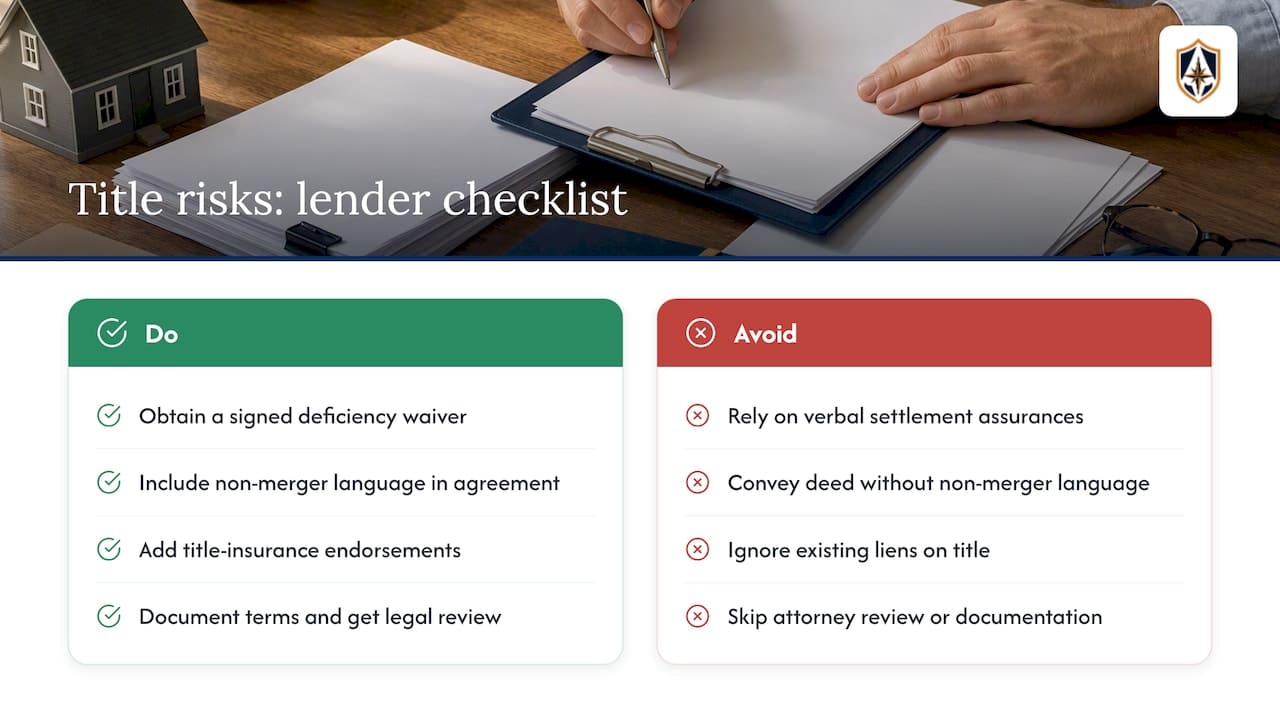
The biggest legal risk in a deed in lieu is a deficiency judgment: if the settlement agreement doesn’t include a specific, written waiver, the lender may still be able to sue you for the gap between the loan balance and the home’s resale value. A verbal assurance that the debt is “settled” isn’t the same as a signed waiver, and only the signed version protects you.
Merger is a subtler risk. When you convey your deed to the lender, the mortgage and the title can, under some legal theories, merge into one interest, which could complicate the lender’s ability to later foreclose on junior liens tied to the same property. According to Attorneys’ Title Guaranty Fund, lenders typically insist on non-merger language and specific title-insurance endorsements to prevent this outcome, which protects their lien priority more than it protects you directly.
There’s also a longer-tail risk: a subsequent bankruptcy filing or a creditor action from another party could attempt to unwind the transfer if it looks like it was done to defraud other creditors. Clear, well-documented settlement terms, done with legal review, reduce that risk considerably. If your property has existing liens complicating the title, this is exactly the kind of situation where a deed in lieu becomes harder to close cleanly.
How to prepare and negotiate: documents to gather and when to get help
Before you approach your servicer, gather:
- Recent mortgage statements and a current payoff demand.
- Two years of tax records and recent pay stubs or income proof.
- A title report or preliminary title search on the property.
- A written hardship letter explaining your circumstances plainly.
- Government-issued identification for every borrower on the loan.
Pro Tip: Request the payoff demand in writing early: it tells you the exact number you’re negotiating against and prevents disputes later about what was actually owed.
During negotiation, insist on a written deficiency waiver, confirm who covers transfer taxes, and if you need extra time to move, ask about a short-term leaseback rather than assuming you’ll need to vacate immediately. If the property carries multiple liens, faces pending litigation, or the potential deficiency is large, retaining a real estate attorney or tax advisor before signing is a reasonable investment rather than an unnecessary expense. Understanding the difference between a quitclaim and warranty deed also helps you follow exactly what you’re signing away.
How AAS Home Buyers approaches homeowners facing foreclosure
We work with homeowners weighing exactly this kind of decision, and a deed in lieu isn’t always the option that best protects your interests. There are options to sell the home outright, which can preserve equity a deed in lieu would surrender, buy you time to relocate on your own schedule, and avoid the cancellation-of-debt tax question altogether since the loan gets paid off through a sale rather than forgiven.
If you’d rather explore a managed listing, a Realtor Referral Program can connect you with vetted local agents. As the author of this guide and someone affiliated with AAS Home Buyers, I’d encourage you to request a no-obligation evaluation before committing to any single path.
How long the deed-in-lieu process usually takes
Expect the servicer’s initial review to take several weeks, followed by an appraisal or broker price opinion and a title search before terms are finalized. Junior liens or missing documentation are the most common causes of delay, so clearing those early and responding to servicer requests promptly keeps things moving.
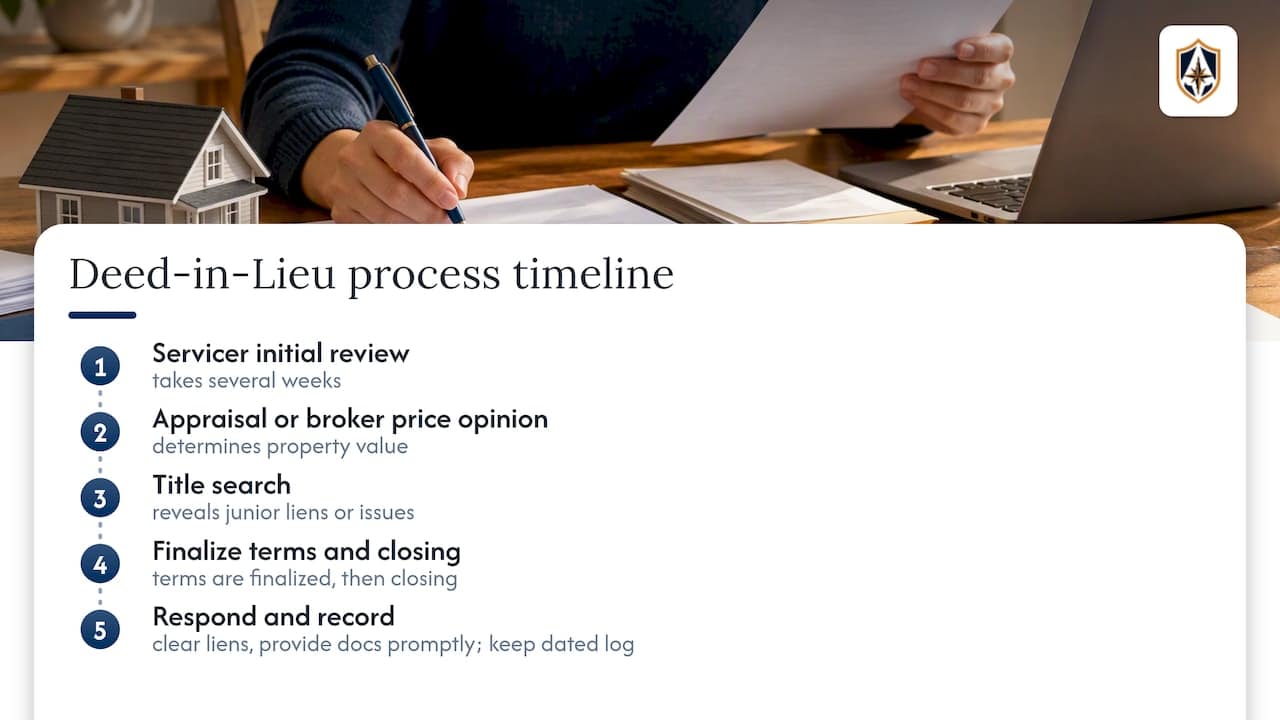
Keep a dated log of every call and document you submit. If your loan has been transferred between servicers before, this record becomes essential if a previous verbal agreement gets disputed later.
A balanced take on deed in lieu decisions
A deed in lieu makes the most sense when you have little equity to protect, no realistic path to keep the home, and a lender willing to put a deficiency waiver in writing. Where equity exists, or where you need more time to plan your next move, a sale or short sale usually serves you better.
Whatever you choose, start by contacting your servicer, gathering your documents, and talking to a tax or legal advisor before signing anything permanent. If selling on your own terms sounds more appealing, AAS Home Buyers can walk you through what a direct sale would look like for your property.
— AAS
How AAS Home Buyers can help as a practical alternative

If the idea of handing your deed to a lender doesn’t sit right, you have another option. Our Direct Purchase and Retail Buyer Program let you sell on a timeline you control, often without the tax uncertainty that comes with canceled debt, and without waiting on a servicer’s approval process. If your situation involves liens, an inherited property, or a tight timeline before a foreclosure filing, reaching out early gives you more room to choose the right path rather than the fastest one.
Visit our process page to see how a direct sale or Retail Buyer Program listing works, and request a no-obligation evaluation to compare it against a deed in lieu before you decide.
This article is general information, not a substitute for advice from a qualified financial advisor. Consult a qualified financial professional about your own circumstances before acting on anything here.
Sources
- Publication 4681 (Canceled Debts, Foreclosures, Repossessions, and Abandonments) | IRS
- Deed in Lieu of Foreclosure | National Association of Realtors
- Deeds in Lieu of Foreclosure: Advantages, Disadvantages, and Drafting | Attorneys’ Title Guaranty Fund, Inc.
FAQ
What are the downsides of using a deed in lieu?
The main downsides are potential tax liability on canceled debt, exposure to a deficiency judgment without a written waiver, and losing any remaining equity in the property. Title complications from junior liens can also delay or derail the transfer entirely.
Can I stay in the home after a deed in lieu?
Generally no, you’re expected to vacate once the deed transfers, though some homeowners negotiate a temporary leaseback or cash-for-keys arrangement with the lender. According to National Association of Realtors guidance, this isn’t a guaranteed right and depends entirely on what you negotiate in writing.
How long does a deed in lieu process take?
Timing varies by servicer, but expect several weeks for loss-mitigation review, plus additional time for appraisal, title clearing, and final closing. Junior liens or incomplete paperwork are the most common causes of delay.
Should I get a lawyer for a deed in lieu?
Legal help is especially worthwhile when your property has multiple liens, you’re facing a significant potential deficiency, or litigation is already pending. An attorney can also help confirm your deficiency waiver and non-merger language are drafted correctly before you sign.