
How to Sell Your House Before Foreclosure Fast
You can stop foreclosure by selling your home before the lender takes it. Contact your loan servicer today, reach a HUD-approved housing counselor, and then choose the fastest realistic sale path for your situation. The trade-off is real: a cash sale closes in days or weeks but typically yields less than a traditional listing. A traditional listing may net more money but takes months you may not have. Speed wins when foreclosure is imminent.
- Contact your servicer before missing another payment. Loss-mitigation programs close fast.
- Call a HUD counselor at 800-569-4287 (TTY: 800-877-8339). Free, no upfront fees.
- Get a payoff quote so you know exactly what the sale must cover.
- Choose a sale path based on your equity, timeline, and home condition.
- Aashomebuyers offers direct cash purchases and managed listing options for homeowners who need to move quickly.
Pro Tip: Never pay an upfront fee to any company promising to stop foreclosure. HUD-approved counselors provide the same negotiation support for free or very low cost.
Table of Contents
- What should you do in the first 24–72 hours?
- How do your options compare on speed vs. net proceeds?
- Short sale vs. cash sale vs. deed-in-lieu: when does each actually work?
- How do lenders evaluate your request and what speeds approval?
- How does your state’s foreclosure timeline change your window?
- What might you owe after a fast sale?
- Where can you get immediate free help?
- How to handle communication with co-owners or family during a fast sale
- Emergency financing or bridge loan options during the sale process
- Key Takeaways
- Why speed usually matters more than maximum price when foreclosure is close
- Aashomebuyers: a faster path when you need to sell now
- Authoritative resources and contact numbers for immediate help
What should you do in the first 24–72 hours?
The first three days set the tone for everything that follows. Lenders respond to documented effort, and courts notice it too.
- Contact a HUD-approved counselor at 800-569-4287 or visit usa.gov/avoid-foreclosure. Counselors can organize your finances and represent you in negotiations.
How do your options compare on speed vs. net proceeds?
Four realistic routes exist. Each one trades time for money differently.
Selling with equity means your sale price covers the mortgage balance and costs, leaving you with a clean exit and possibly a surplus. That is the best outcome when equity exists.
Cash sale / direct buyer (fastest)
- Closes quickly, typically within a few weeks; no lender approval needed to sell
- Net proceeds lower than market value
- No repair requirements; minimal credit impact compared to foreclosure
- Con: You accept a discount for speed
Short sale (moderate)
- Requires lender approval to accept less than the loan balance
- Timeline: a couple of months once lender reviews the loss-mitigation application
- Avoids foreclosure on your record; credit impact is significant but less than foreclosure
- Con: Lender can reject the offer or pursue a deficiency judgment
Deed-in-lieu (moderate)
- You surrender the title to the lender in exchange for release from the debt
- Faster than foreclosure if the lender agrees; requires negotiation
- Con: Lender must agree in writing to waive deficiency claims
Traditional listing (slowest)
- Best net proceeds when time allows; 30–90 days to close in a normal market
- Lender approval not required if you have equity
- Con: Takes months — a window many homeowners in active foreclosure do not have
Pro Tip: Nolo’s preforeclosure selling guide recommends getting a payoff quote before listing so you know whether the sale price will actually clear the debt.
Short sale vs. cash sale vs. deed-in-lieu: when does each actually work?
The answer depends almost entirely on how much equity you have.
If you have equity, a cash sale or traditional listing pays off the mortgage at closing. No lender approval is needed to sell. The payoff goes directly to the servicer from escrow, and you keep whatever remains.
If you owe more than the house will sell for, a short sale or deed-in-lieu becomes the path. Fannie Mae’s loss-mitigation guidance makes the distinction clear: a short sale requires the servicer to approve a sale price below the outstanding balance. That approval runs through a formal loss-mitigation application.
Documents a servicer typically requires for a short sale:
- Completed loss-mitigation application
- Hardship letter explaining why you cannot continue payments
- Two months of recent bank statements
- Two years of tax returns
- Recent pay stubs or proof of income
- Signed purchase offer from a buyer
- Comparative market analysis or appraisal
A deed-in-lieu skips the buyer entirely. You negotiate directly with the lender to hand over the title. It can resolve faster than a short sale, but the lender must agree to release you from any deficiency. Get that release in writing. Verbal promises are not enforceable.
How do lenders evaluate your request and what speeds approval?
Servicers are not looking for a reason to say no. They are looking for evidence that the debt will not be resolved any other way.
What they evaluate: your hardship (job loss, medical bills, divorce), current arrears, the property’s current market value, and your remaining assets and income. A borrower with $80,000 in savings and a $20,000 shortfall will face more scrutiny than one with no assets.
Practical tactics that move the process faster:
- Submit a complete package the first time. Missing documents are the single biggest cause of delays.
- Include a letter from your HUD counselor. Servicers treat counselor-assisted files as more credible.
- Propose a price supported by comparable sales, not a number you prefer.
- Ask in writing whether the lender will waive deficiency claims. Many will, especially if the alternative is a costly foreclosure proceeding.
- Follow up every 5–7 business days and document each contact.
How does your state’s foreclosure timeline change your window?
This is where most homeowners underestimate urgency.
Non-judicial states, common across the West and South, allow lenders to proceed from a Notice of Default to a trustee sale in about three to four months. Some states move even faster. HUD notes that in certain states, the window between notice and sale can be as short as 2–3 months.
Judicial states require the lender to file a lawsuit and obtain a court order before selling. That process typically takes 6–18 months, giving homeowners considerably more time to sell.
Warning: If you are in a non-judicial state and have already received a Notice of Default, you may have fewer than 90 days before the sale date. Act within the first 30 days of any foreclosure notice to preserve the most options.
The federal 120-day delinquency rule requires most servicers to wait until a borrower is at least 120 days past due before initiating foreclosure. That window is your best opportunity to contact the servicer, engage a counselor, and execute a sale.
What might you owe after a fast sale?
Sale proceeds are distributed in a specific order at closing:
- Outstanding principal balance
- Accrued interest and late fees
- Attorney or trustee fees charged by the lender
- Any subordinate liens (second mortgage, HOA, tax liens)
- Closing costs and real estate commissions (if applicable)
- Remaining balance to you, if any
Deficiency judgments occur when the sale price does not cover the full debt. In a short sale or deed-in-lieu, ask the lender in writing to waive the deficiency as a condition of approval. Many will. Without a written waiver, the lender may pursue the difference in court.
Tax note: Canceled or forgiven debt can be treated as taxable income by the IRS. Consult a tax advisor before closing and review current IRS guidance on debt cancellation exclusions. This is general information, not tax advice; confirm your specific situation with a qualified tax professional.
Where can you get immediate free help?
- HUD-approved housing counselors: Call 800-569-4287 (TTY: 800-877-8339) or visit hud.gov. Counselors are free or very low cost and can negotiate directly with your servicer.
- USA.gov foreclosure help: usa.gov/avoid-foreclosure lists federal steps, FHA servicer contacts, and state-specific resources.
How to handle communication with co-owners or family during a fast sale
A fast sale under financial pressure is hard enough without family conflict slowing it down. If the home has co-owners, all of them must sign the deed and closing documents. One co-owner cannot sell without the others’ consent.

Start with a direct conversation early. Lay out the timeline, the options, and what foreclosure means for everyone on the title: damaged credit, possible deficiency liability, and loss of any equity. When everyone understands the shared downside, agreement tends to come faster.
Designate one person as the primary contact for the servicer, counselor, and buyer. Multiple people calling the servicer with conflicting information creates delays. Put decisions in writing, even in a simple group text or email thread, so there is no dispute later about what was agreed.
If a co-owner is unresponsive or refuses to cooperate, consult a real estate attorney quickly. A partition action is a legal remedy, but it takes time you may not have.
Emergency financing or bridge loan options during the sale process
Bridge loans and emergency financing exist, but they carry real costs and risks worth understanding before you pursue them.
A bridge loan is a short-term loan secured by your home’s equity. It can cover mortgage arrears, closing costs, or moving expenses while the sale is pending. Lenders typically require at least some equity and a clear exit strategy, meaning a signed purchase contract or a firm closing date.
Hard-money lenders move faster than banks, sometimes funding in 5–10 business days, but interest rates are significantly higher than conventional loans. If the sale closes on schedule, the cost may be manageable. If the sale falls through, you have added debt on top of an already stressed situation.
A few alternatives worth checking first:
- Nonprofit emergency mortgage assistance — programs exist in many metro areas. Your HUD counselor can identify local options.
Use emergency financing only when the sale timeline is confirmed and the loan can be repaid at closing. Borrowing to delay an inevitable foreclosure without a clear exit plan compounds the problem.
Key Takeaways
Selling before foreclosure is achievable in most states if you act within the first 30–90 days of a default notice, contact your servicer immediately, and choose a sale path matched to your equity and timeline.
| Point | Details |
|---|---|
| Act within 30–90 days | The first 30–90 days after a default notice preserve the most sale options before lender deadlines close. |
| Call HUD at 800-569-4287 | Free counselors negotiate with servicers and help you choose the right loss-mitigation path. |
| Match path to equity | Positive equity opens all options; negative equity points to short sale, deed-in-lieu, or a cash buyer. |
| Get lender agreements in writing | Verbal promises on deficiency waivers or short sale approval are not enforceable. |
| Aashomebuyers as an immediate option | Aashomebuyers offers direct cash purchases and a managed listing program for homeowners who need to close fast with no upfront fees. |
Why speed usually matters more than maximum price when foreclosure is close
The conventional framing of a home sale, maximize proceeds and negotiate hard, breaks down completely when a foreclosure sale date is approaching. At that point, the question is not “how much can I get?” It is “can I close before the gavel falls?”
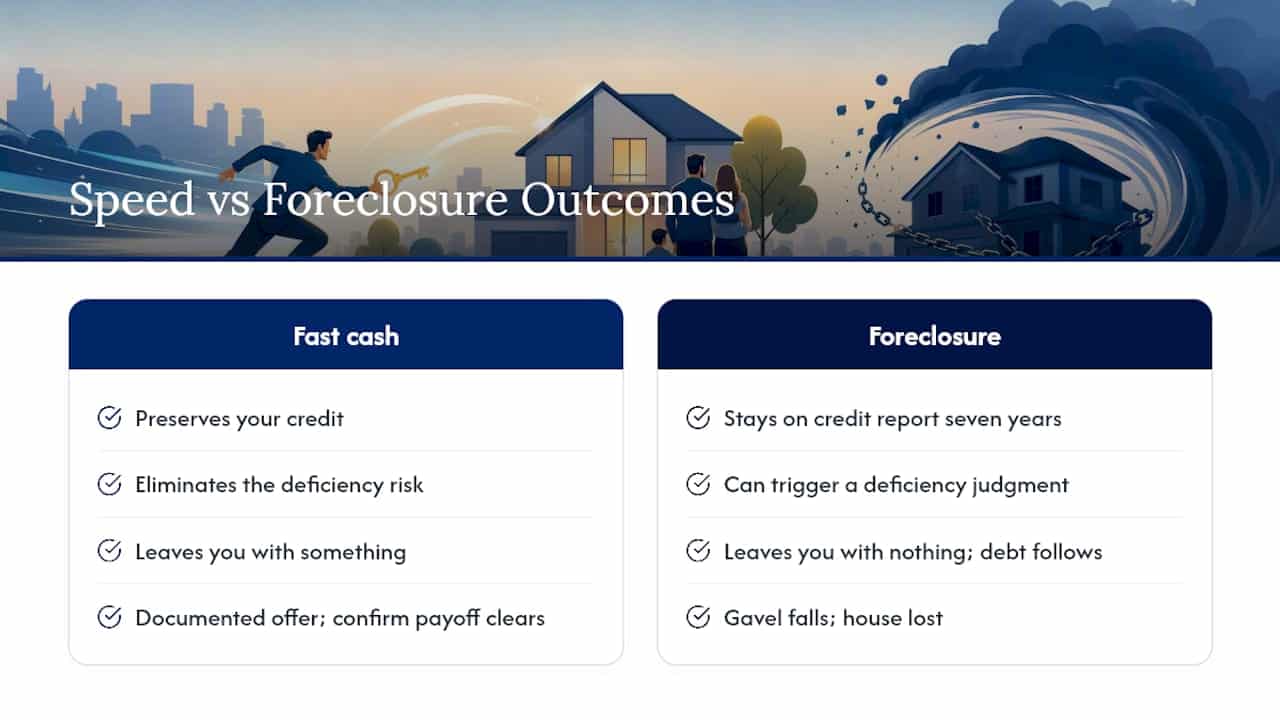
Foreclosure does not just cost you the house. It stays on your credit report for seven years, can trigger a deficiency judgment, and makes it significantly harder to rent or buy again in the near term. A cash sale at a discount preserves your credit, eliminates the deficiency risk, and leaves you with something. Foreclosure often leaves you with nothing and a debt that follows you.
The homeowners who regret a fast sale are usually the ones who waited too long hoping for a better offer, then lost the house anyway. The ones who move quickly, get a documented offer, confirm the payoff clears, and close, typically land in a far better position than the foreclosure alternative would have produced.
Aashomebuyers’ approach reflects this directly: transparent terms, a documented process, and no hidden fees mean you can evaluate the offer against your payoff quote and make a clear-eyed decision, not a panicked one.
Aashomebuyers: a faster path when you need to sell now
When foreclosure is weeks away, a traditional listing is not a realistic option. Aashomebuyers gives homeowners facing urgent timelines a concrete alternative: a direct cash offer, a managed Retail Buyer Program, or a vetted agent referral, all with transparent valuations and no upfront fees.

The 3-step process is built for exactly this situation. You get a property evaluation, a clear offer with documented terms, and a closing timeline you can plan around. Homes in any condition qualify. There is no repair requirement, no waiting for a buyer to secure financing, and no surprise deductions at closing.
If you are behind on your mortgage and need to move fast, get a no-obligation evaluation at aashomebuyers.com today. Bring your payoff quote and let the numbers speak for themselves.
Authoritative resources and contact numbers for immediate help
- Trouble Paying Your Mortgage or Facing Foreclosure? | Consumer Advice
- Avoiding Foreclosure | HUD.gov / U.S. Department of Housing and Urban Development (HUD)
- Avoid foreclosure | USAGov
- How Selling with Equity Can Help You Avoid Foreclosure – My Home by Freddie Mac
- Fact sheet: Helping borrowers avoid foreclosure | Fannie Mae
- Selling a house before foreclosure | Nolo
- Our Process | Our Transparent 3-Step Home Selling Process
Keep a single folder, physical or digital, with every document, call log, offer, and lender communication. If a dispute arises later, that paper trail is your protection.