
Act Now: Pre Foreclosure vs Foreclosure in 121 Days for Sellers & Buyers
Pre-foreclosure means you still legally own your home and have time-limited options to fix the default or sell on your own terms. Foreclosure means the lender has taken control, your home may head to auction, and most of your choices have already disappeared. If you’re behind on payments, the difference between these two stages is the difference between steering the outcome and having it decided for you. Buyers and investors face the opposite tradeoff: pre-foreclosure means negotiation and inspections, foreclosure means speed and risk.
TL;DR:
- Pre-foreclosure lasts several months, with formal notices filed around 60 to 90 days after missed payments, depending on state laws.
- Homeowners in pre-foreclosure retain full ownership and occupancy rights until the process turns into foreclosure.
- During pre-foreclosure, homeowners can pursue reinstatement, loan modification, short sale, or voluntary sale to avoid losing the property.
- Buyers in pre-foreclosure can negotiate directly with owners, access inspections, and finance deals more easily than at auction or on bank-owned sales.
- The foreclosure process duration varies widely, from a few months to several years, influenced heavily by state procedures and whether courts are involved.
Table of Contents
- What Is Pre-Foreclosure, and How Does It Start?
- What Foreclosure Actually Means Once It’s Completed
- How Long Does Each Stage Actually Last?
- What Can a Homeowner Do During Pre-Foreclosure?
- Buying in Pre-Foreclosure vs Foreclosure: What Changes for You
- The AAS Perspective: What Sellers Should Actually Do
- Need to Sell Before Foreclosure? Here’s Where to Start
- Where to Verify Timelines and Get Free Guidance
- Sources
- FAQ
What Is Pre-Foreclosure, and How Does It Start?
Pre-foreclosure begins when a homeowner falls behind on mortgage payments and the lender files a formal notice. That filing, often called a Notice of Default or Notice of Intent to Foreclose, kicks off a legal clock, but it does not strip away ownership. Chase’s own borrower education material makes this point directly: a notice of default gives the homeowner a limited window to cure the delinquency or sell before the lender moves further.
That distinction matters for anyone tracking a property. Because the notice is a public filing, buyers and investors can find pre-foreclosure listings before a home ever reaches auction. Meanwhile, the homeowner keeps the title, keeps living there, and keeps every legal right that comes with ownership.
- The homeowner retains full title and occupancy rights during this stage.
- Missed payments and the default notice become part of the public record.
- Whether the process moves through the courts (judicial) or outside them (nonjudicial) depends on the state, and that choice changes how fast things unfold.
- Curing the default, negotiating with the lender, or selling the property are all still on the table.
What Foreclosure Actually Means Once It’s Completed
Foreclosure is what happens when pre-foreclosure options run out. The lender completes the legal process, and the property either sells at a public auction or becomes real estate owned (REO) by the bank when no bidder steps forward. Investopedia describes this shift plainly: once the default goes uncured, the lender can proceed with foreclosure, which routinely ends in auction or bank-owned inventory.
Ownership changes hands at this point, and so does occupancy. Eviction can follow soon after the sale closes, though a small number of states grant a redemption period that lets former owners reclaim the property by repaying what’s owed. Buyers stepping into this stage take on real exposure.
- Auction sales are typically final, cash-heavy, and offer no walkthrough beforehand.
- REO properties go through a bank-managed listing process, usually with more transparency than auction.
- Homes sell “as is,” meaning the new owner absorbs whatever repairs, liens, or damage they inherit.
- Redemption rights, where they exist, can complicate a buyer’s timeline to full possession.
How Long Does Each Stage Actually Last?
Pre-foreclosure usually runs several months, but the duration varies depending on the loan investor, the servicer, and the state. Foreclosure itself can wrap up in a few months or drag on for years, particularly in judicial states where every step needs court approval.
Pro Tip: Don’t wait for a specific date on your calendar to act. The clock starts ticking the day you miss a payment, not the day the notice arrives in the mail.
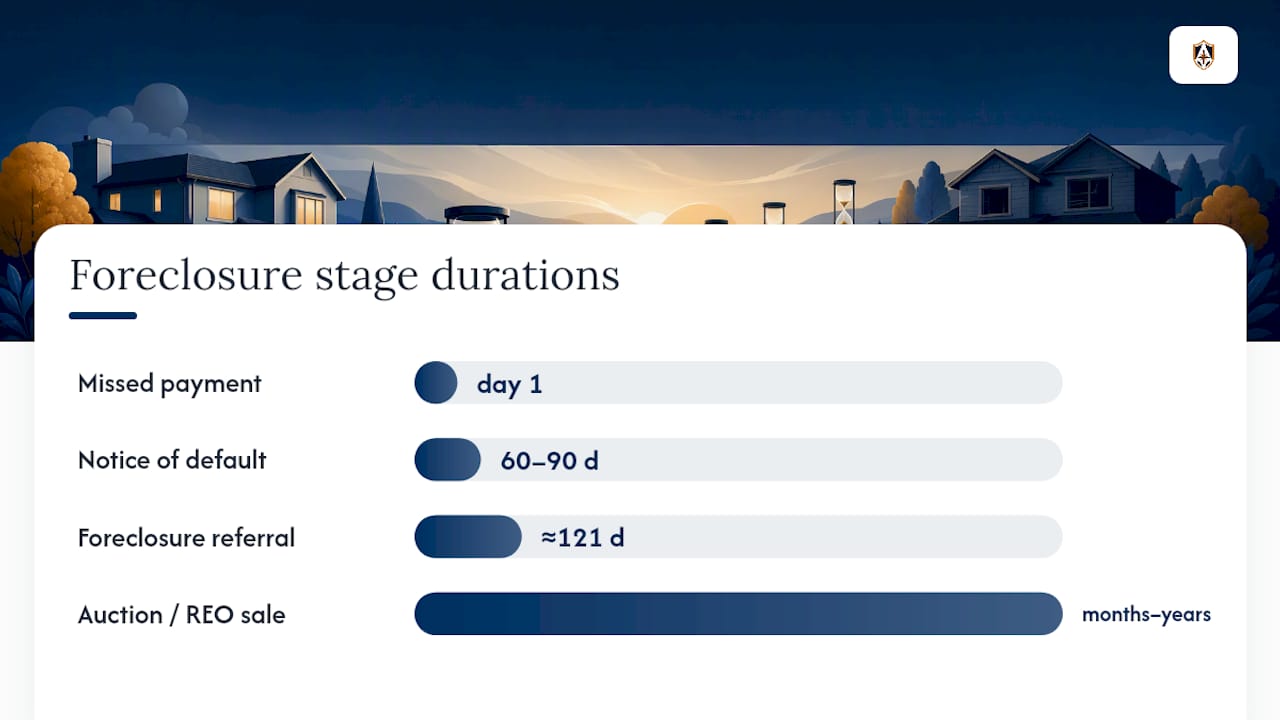
Some numbers help frame the urgency. Rocket Mortgage notes that certain servicers begin the formal foreclosure referral around 121 days after a missed payment for owner-occupied loans, and judicial foreclosures can extend total completion time well beyond a year. State procedures vary enough that a flowchart for one state, like this Michigan foreclosure timeline breakdown, looks nothing like the process next door.
- Missed payment (day 1): the delinquency clock starts immediately, regardless of paperwork timing.
- Notice of default (roughly 60 to 90 days): the lender files publicly and pre-foreclosure formally begins.
- Foreclosure referral (around 121 days for many servicers): loss mitigation options start narrowing fast.
- Auction or REO sale (timing varies by state): judicial states can take months to years; nonjudicial states move faster.
Vacant or abandoned properties often move through this timeline far faster than owner-occupied homes, since fewer legal protections apply. Every deadline for reinstatement, modification review, or short sale paperwork ties back to these dates, so missing one narrows what’s left of the homeowner’s options.
What Can a Homeowner Do During Pre-Foreclosure?
This is the stage where real choices still exist, and lenders generally prefer a negotiated resolution over the expense of foreclosing. Forbes Advisor notes that lenders often favor working out a solution rather than absorbing the cost of taking a property back.
- Reinstatement: pay the missed amount in a lump sum if the shortfall is small and temporary.
- Loan modification or forbearance: restructure payments or pause them, though approval isn’t guaranteed and both carry limits.
- Short sale: sell for less than what’s owed with lender sign-off, which stops the foreclosure clock but requires patience.
- Deed-in-lieu of foreclosure: hand the property back voluntarily, avoiding an auction but still affecting credit.
- Sell conventionally or to a cash buyer: move fast when time is the biggest constraint, including through a managed sale process built for exactly this situation.
Selling during pre-foreclosure, rather than letting the process reach completion, tends to protect more of a homeowner’s equity and softens the long-term credit hit. If the debt load is unmanageable regardless of the property, a bankruptcy attorney or HUD-approved counselor can outline whether that route makes more sense than selling.
Buying in Pre-Foreclosure vs Foreclosure: What Changes for You
Buyers and investors face a real tradeoff between access and discount. Pre-foreclosure properties allow standard inspections, appraisals, and financed purchases because you’re negotiating directly with a motivated owner. According to guidance from PropertyShark on searching listings, pre-foreclosure and foreclosure listings sit in different channels entirely, with different risks attached to each.
- Inspection access: full walkthroughs in pre-foreclosure; often none at auction.
- Pricing: off-market negotiation in pre-foreclosure; steep discounts possible at auction, but with more uncertainty.
- Title and liens: auction purchases can carry unresolved tax liens; REO sales are usually cleared but sold “as is.”
- Financing: pre-foreclosure deals can be financed conventionally; auctions typically demand cash on the spot.
An investor chasing certainty and financing flexibility should lean toward pre-foreclosure deals. One built for tolerating risk in exchange for a deeper discount, and who can pay cash immediately, is better suited to the auction floor.
The AAS Perspective: What Sellers Should Actually Do
Most guidance on foreclosure treats the homeowner’s options as a checklist to work through alone, but that ignores how little time some sellers actually have. We built our approach around the reality that reinstatement, modification, and short sale all take weeks you may not have. Our Retail Buyer Program, direct cash offers, and vetted agent referrals exist because “sell fast” and “protect your equity” aren’t always the same goal, and a seller facing foreclosure deserves an honest look at both.
The real mistake we see isn’t choosing the wrong option. It’s waiting until the foreclosure timeline has already narrowed every door but one.
— AAS
Need to Sell Before Foreclosure? Here’s Where to Start
If you’re sitting in pre-foreclosure right now, the math is simple: every week you wait is a week fewer options remain. There are services that can provide a faster path than negotiating alone with a lender or racing a court deadline, without locking you into a single sale method before you know your numbers.

Some services evaluate your property and offer options such as direct cash purchase, managed retail buyer programs, or agent referrals, allowing you to pick based on your timeline and equity protection needs. There are no hidden fees buried in the process, and our transparent process spells out exactly what happens at each step. If you’re weighing a fast exit, start by reading how to sell your house before foreclosure or request a valuation today to see what your specific timeline actually allows.
Where to Verify Timelines and Get Free Guidance
State procedures vary enough that you should confirm your own deadlines rather than rely on national averages. New York’s foreclosure flowchart is a useful model for understanding how court-driven steps unfold in judicial states. HUD’s housing counseling directory connects homeowners with free, approved counselors who specialize in loss mitigation. For anything involving deed transfers, bankruptcy, or contested filings, an attorney licensed in your state remains the most reliable source, not a general guide like this one.
This article is general information, not a substitute for advice from a qualified financial advisor. Consult a qualified financial professional about your own circumstances before acting on anything here.
Sources
- Pre-foreclosure: What It Means and How It Works | Chase
- Pre-foreclosure definition and process | Investopedia
- What does preforeclosure mean and how can you avoid it? | Rocket Mortgage
FAQ
Is It Better to Buy Pre-Foreclosure or Foreclosure?
Pre-foreclosure purchases suit buyers who want inspections, financing options, and room to negotiate directly with the owner. Foreclosure auctions suit cash buyers comfortable with “as is” risk in exchange for a potentially deeper discount.
How Long Can a House Be in Pre-Foreclosure?
Pre-foreclosure typically lasts three to six months, though it depends on the loan investor and state; some servicers refer loans to formal foreclosure around 121 days after the first missed payment.
Can You Get Your House Out of Pre-Foreclosure?
Yes. Reinstating the loan, securing a modification, completing a short sale, or selling the home outright, including through a fast cash sale, can all stop the process before it reaches foreclosure.
What Happens if a House Is in Pre-Foreclosure?
The homeowner has received a default notice but still owns the property and retains the right to cure the debt, negotiate with the lender, or sell before the lender moves to complete foreclosure.