
Avoid $28,000 Hidden Fees When Selling a House: Calculate Net Proceeds
Moving expenses, mortgage payoff interest, and buyer concessions add smaller but real amounts on top. Before you list, ask for a seller-side net-proceeds worksheet so these numbers stop being a surprise.
TL;DR:
- Overlooking early mortgage payoff costs, unpaid HOA dues, or liens can unexpectedly add thousands to the final expenses, especially in markets with high transfer taxes.
- Running personalized net-proceeds estimates helps sellers compare traditional listings and alternative options, such as direct purchases or cash buyers, to avoid hidden fees.
- Negotiating commissions, ordering pre-listing inspections, and requesting itemized closing estimates can significantly lower overall selling expenses.
- Factors like extra overlapping housing costs, buyer concessions, or repair costs can easily fluctuate the net proceeds and should be carefully considered before listing.
Table of Contents
- 1. What hidden fees show up when you sell a house
- 2. Worked examples: estimating your net proceeds
- 3. Taxes and capital gains on your home sale
- 4. Closing costs breakdown and who typically pays
- 5. How to reduce or avoid hidden fees when selling
- 6. Where AAS Home Buyers fits into the fee picture
- 7. Inspection fees and who typically pays them
- 8. Home warranty fees and seller-paid warranty options
- 9. Costs tied to required disclosures and compliance
- 10. Cleaning and landscaping costs before you list
- 11. Deciding between a faster sale and a higher price
- A simpler path if hidden fees are the problem
- Sources
- FAQ
1. What hidden fees show up when you sell a house
Most sellers focus on the sale price and forget the list of deductions between that number and what actually lands in their bank account. Here is what typically shows up on a settlement statement, and why.
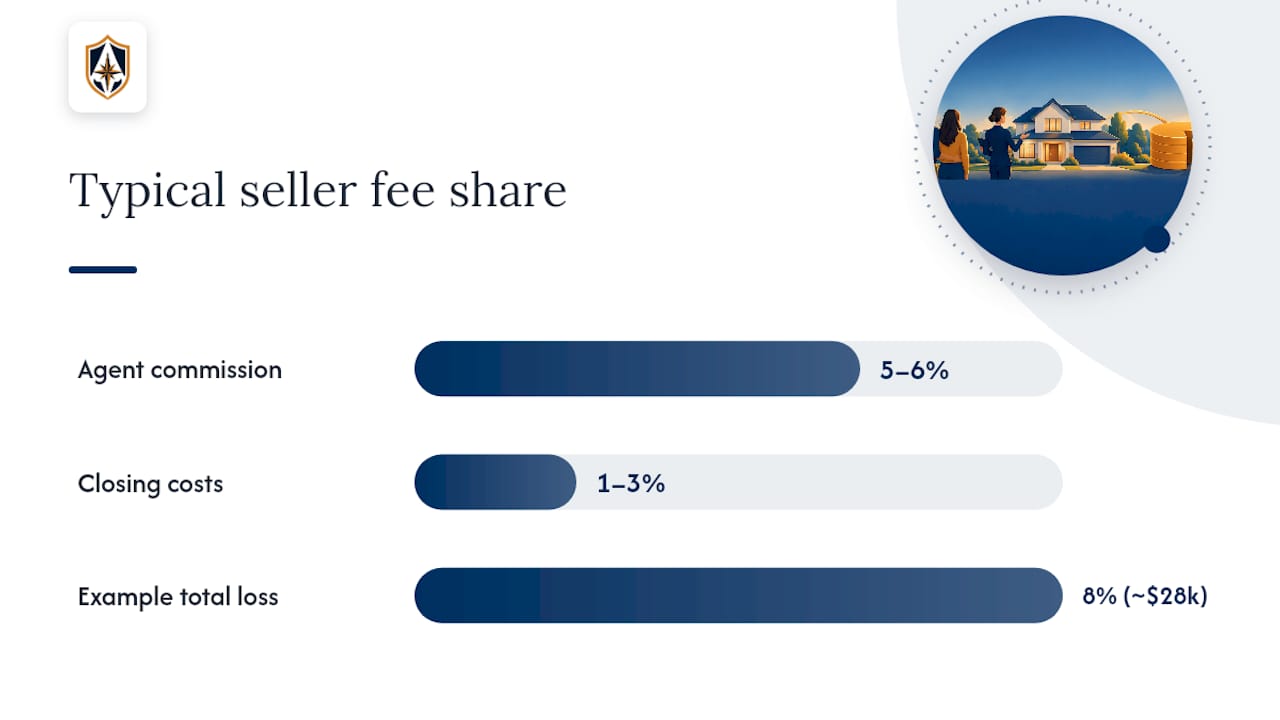
Real estate commission is usually the single largest cost. Combined buyer and seller agent commission traditionally falls in the 5% to 6% range of the sale price, split between the two agents, though this is negotiable and has become more so since recent industry changes. On a $400,000 home, that alone can mean $20,000 to $24,000 before anything else is subtracted.
Closing costs come next, and they are rarely a single line item. Title insurance, escrow or attorney fees, transfer taxes, recording fees, and prorated property taxes typically add up to 1% to 3% of the sale price, according to market averages compiled by Kiplinger. Transfer taxes in particular vary enormously by state and even by county, since transfer tax rates are set locally rather than nationally.
Pre-listing repairs and staging are the next layer. Minor fixes like touch-up paint or landscaping cleanup might run a few hundred dollars, while structural repairs, roof work, or major systems replacement can reach into the thousands. Staging and professional photography together commonly cost anywhere from a few hundred to a few thousand dollars depending on home size and market.
Moving and overlap housing costs are easy to underestimate. If your sale and your next move do not line up perfectly, you may pay a mortgage or rent on two properties at once, plus movers, storage, and utility transfers.
A few more items sellers often miss:
- Mortgage payoff costs: accrued interest through the closing date, and a check for any prepayment penalty buried in your loan terms.
- Seller concessions: credits toward the buyer’s closing costs or repairs, negotiated during the offer stage.
- HOA transfer fees and unpaid dues: a lump-sum charge to move HOA membership, plus any outstanding balance you owe.
- Title issues or liens: unresolved claims against the property that must be cleared before the sale can close.
A seller on a $350,000 home who pays 6% commission plus 2% in closing costs loses $28,000 before repairs, staging, or moving costs are even counted, based on the percentage ranges Kiplinger and Realtor.com compile for typical seller costs.
2. Worked examples: estimating your net proceeds
The basic formula is straightforward: Net proceeds = Sale price minus mortgage payoff minus commission minus closing costs minus repairs/concessions. Each input can swing your final number by thousands of dollars, so it helps to run the math with your own estimates rather than relying on a rule of thumb.
- A $300,000 home with a $180,000 mortgage balance, 6% commission ($18,000), 2% closing costs ($6,000), and $3,000 in repairs nets the seller roughly $93,000.
- A $400,000 home with a $250,000 mortgage balance, 5.5% commission ($22,000), 2.5% closing costs ($10,000), and a $5,000 buyer concession nets roughly $113,000.
- A $600,000 home with no mortgage remaining, 6% commission ($36,000), 3% closing costs ($18,000), and two months of overlapping housing payments (about $6,000) nets roughly $540,000.
The mortgage balance and concessions move the needle the most. A seller who agrees to a $10,000 concession to close faster is effectively lowering their own proceeds by that same amount, even though the sale price on paper looks unchanged.
3. Taxes and capital gains on your home sale
Most sellers of a primary residence owe no federal tax on the sale at all. Under IRS Publication 523, single filers can exclude up to $250,000 of gain, and married couples filing jointly can exclude up to $500,000, provided they meet the 2-of-5-year residency test. Our guide on the $250,000/$500,000 exclusion walks through how to confirm you qualify.
To find your taxable gain, start with your adjusted basis: what you paid, plus capital improvements like a new roof or an addition, minus routine maintenance, which does not count. Subtract that basis from your sale price to get your gain, then apply the exclusion.
A few situations need extra care:
- Second homes and rental properties do not qualify for the primary-residence exclusion.
- Inherited property usually gets a stepped-up basis, which often reduces taxable gain significantly.
- 1031 exchanges apply only to investment properties, not primary residences.
If your gain is large or your situation involves any of these cases, a CPA can confirm your numbers before you file.
4. Closing costs breakdown and who typically pays
Closing costs are not one fee but a bundle, and sellers should expect to see title insurance, escrow or attorney fees, transfer taxes, recording fees, and prorated property taxes on their settlement statement. In dense markets with local transfer tax rules, these figures can vary sharply, as one breakdown of New York City closing costs shows for buyers and sellers of condos versus co-ops.
The CFPB notes that many closing costs are technically the buyer’s responsibility, but negotiation and market conditions often shift some of those costs onto the seller through credits. In a buyer’s market, this shift is common and worth planning for.
To protect your numbers:
- Ask your title or escrow company for a seller-side estimate before you sign a listing agreement.
- Shop title and escrow providers, since fees are not fixed by law in most states.
- Request a line-item explanation for any fee you do not recognize.
Our closing costs budgeting guide walks through a full checklist for sellers.
5. How to reduce or avoid hidden fees when selling
You have more control over these costs than most sellers realize.
- Negotiate commission directly, or compare a discount brokerage, a flat-fee listing, or a for-sale-by-owner approach against a traditional full-service agent.
- Order a pre-listing inspection so you can negotiate repairs from a position of knowledge instead of reacting to a buyer’s inspector.
- Offer a buyer credit instead of completing an expensive repair yourself, which often costs less than the repair plus markup.
- Get itemized closing estimates from at least two title or escrow companies before choosing one.
- Pull your mortgage payoff statement early to check for a prepayment penalty and time your closing date to minimize accrued interest.
When speed matters more than maximizing every dollar, a direct-purchase sale skips repairs, staging, and the carrying costs of an extended listing period entirely.
Pro Tip: Ask any buyer, agent, or investor for a written net-proceeds estimate before you sign anything. A verbal number is not a commitment.
6. Where AAS Home Buyers fits into the fee picture
The company offers a Direct Purchase option, connections with investment partners, a Retail Buyer Program with managed listing and marketing, and a Realtor Referral Program for sellers who prefer an agent-assisted sale. A direct or partner cash purchase typically means skipping repair costs, staging expenses, and the commission structure of a traditional listing, since the home sells as-is. Our page on cash buyer closing costs explains which costs still apply even in a cash sale.
The company states it charges no upfront service fees and provides data-driven valuations. Sellers considering any option should still ask for a written, itemized net-proceeds estimate and compare it line by line against a traditional-listing estimate from an agent before deciding which path fits their goals.
7. Inspection fees and who typically pays them
A home inspection is usually ordered and paid for by the buyer as part of their due diligence, generally costing a few hundred dollars depending on home size and region. That said, sellers often choose to pay for their own pre-listing inspection to identify problems before a buyer’s inspector does, which shifts negotiating leverage in the seller’s favor.
If a buyer’s inspection turns up issues, the seller does not automatically pay for repairs. Instead, the two sides negotiate: the seller might complete specific repairs, offer a credit toward the buyer’s closing costs, or reduce the sale price. Specialized inspections, such as radon, sewer scope, or pest inspections, are typically requested and paid for by the buyer, though this varies by contract and local custom. Sellers in areas prone to specific issues, like termites in humid climates or foundation movement in clay-soil regions, sometimes pay for these inspections upfront to avoid last-minute renegotiation.
Building the cost of a pre-listing inspection, often a few hundred dollars, into your pre-sale budget can prevent a much larger price reduction later if a buyer’s inspector finds something you did not know about.
8. Home warranty fees and seller-paid warranty options
A home warranty is a service contract that covers the repair or replacement of major systems and appliances, separate from homeowners insurance. Sellers sometimes purchase a home warranty for the buyer as an incentive, typically covering the first year of ownership. This is a seller concession that shows up as an out-of-pocket cost, generally a few hundred dollars, paid at or before closing.
Offering a home warranty can make a listing more attractive without lowering the sale price outright, since it addresses a buyer’s worry about inheriting a hidden mechanical problem. It is optional in nearly every market and is not required by law or by most purchase contracts. Sellers who choose not to offer one should expect buyers in some markets to ask for one anyway, either as a direct request or folded into their offer terms.
Whether a home warranty makes financial sense depends on the age of your major systems. A home with a newer HVAC system, water heater, and appliances may not need the added expense, while an older home might benefit from the reassurance it gives buyers.
9. Costs tied to required disclosures and compliance
Sellers are required to disclose known material defects, and in homes built before 1978, federal law requires a lead-based paint disclosure. These disclosures themselves typically do not cost money to complete, since they are paperwork rather than inspections, but they can trigger costs if they reveal a problem a buyer wants addressed.
If a lead paint disclosure or a buyer’s own testing reveals lead paint, mold, asbestos, or another hazard, remediation costs can range from a few hundred dollars for minor mold treatment to several thousand for lead abatement or asbestos removal, depending on scope. State disclosure requirements vary, so sellers should check their state’s specific rules on what must be disclosed and in what format.
Failing to disclose a known issue can expose a seller to legal liability well beyond the cost of fixing the problem in the first place, so treating disclosure paperwork as a formality rather than a real compliance step is a common and costly mistake.
10. Cleaning and landscaping costs before you list
Professional deep cleaning before photography and showings typically costs a few hundred dollars for an average home, and it is one of the highest-return expenses a seller can make since it directly affects a buyer’s first impression. Carpet cleaning, window washing, and pressure washing exteriors are common add-ons that each carry their own smaller fee.
Landscaping cleanup, including mowing, mulching, trimming, and removing dead plants, is often handled for a few hundred dollars by a local service, though larger properties or overgrown yards can push costs higher. Market research on pre-listing improvements shows that presentation-focused spending like this tends to support faster sales and stronger offers, though the exact return varies by property and local market conditions.

These costs are modest compared to commission or closing costs, but they are easy to overlook when budgeting, and sellers who skip them sometimes see it reflected in lower offers or a longer time on market.
11. Deciding between a faster sale and a higher price
If your property needs significant repairs, you are facing a tight timeline, or carrying costs each extra month on market would erase any price gain, a faster sale path usually makes more financial sense than chasing top dollar. If your home is in strong condition and your market rewards presentation, investing in repairs and staging can produce a genuinely higher net return.
Run the net-proceeds math for both paths before deciding, and talk to a CPA if your tax situation is not straightforward.
— AAS
A simpler path if hidden fees are the problem
If the list of fees above feels like more risk than you want to take on, AAS Home Buyers offers a way to sell without absorbing repair costs, staging expenses, or the uncertainty of a traditional commission structure. Depending on your goals, that might mean a Direct Purchase, a sale through one of our Vetted Investment Partners, our Retail Buyer Program with managed marketing, or a referral to a vetted agent through our Realtor Referral Program if a traditional listing is still your best option.

- Request a written, itemized net-proceeds estimate before comparing any offer.
- Ask what happens to repair, staging, and commission costs under each option.
- Review our process page to see which path fits your timeline and property condition.
You can also look at our breakdown of realtor commission trends if commission size is your main concern. Reach out through Aashomebuyers to get your estimate started.
Sources
- IRS Publication 523, Selling Your Home
- CFPB: What fees or charges are paid when closing on a mortgage and who pays them?
- How Much Does It Cost to Sell a House? | Kiplinger
This article is general information, not a substitute for advice from a qualified financial advisor. Consult a qualified financial professional about your own circumstances before acting on anything here.
FAQ
What are the hidden fees when selling a house?
The main hidden fees are agent commission, closing costs like title insurance and transfer taxes, pre-listing repairs and staging, moving and overlap housing costs, and mortgage payoff interest or penalties. Together, these commonly total in the single-digit or low double-digit percentage range of the sale price, according to Kiplinger’s compiled averages.
How much are closing costs for a $400,000 house?
Using the typical 1% to 3% range Kiplinger reports for seller-side closing costs, the exact amount depends on your state’s transfer taxes and the title or escrow fees in your area. The exact amount depends on your state’s transfer taxes and the title or escrow fees in your area.
What are some examples of hidden fees?
Examples include HOA transfer fees, unpaid HOA dues, prorated property taxes, mortgage prepayment penalties, home warranty costs offered as a buyer incentive, and buyer concessions that shift some of the buyer’s closing costs onto the seller. Many of these do not appear until the settlement statement is finalized.
Do realtors still charge 6%?
Commission rates are negotiable and have shifted since recent industry changes, but combined buyer and seller agent commission commonly still falls in the 5% to 6% range in many markets, per Kiplinger’s market data. Sellers can negotiate this rate directly or compare discount brokerage and flat-fee alternatives.