
5.7% Average Realtor Commission After NAR: How Sellers Can Pay Less
Sellers typically pay the realtor commission at closing, but that arrangement is a matter of contract, not law. The fee is fully negotiable and must be spelled out in your written listing agreement. Since the 2024 NAR settlement, buyers are now often responsible for their own agent’s fee unless you, the seller, choose to offer a concession to make your listing more attractive.
TL;DR:
- Most sellers can negotiate lower realtor commissions, especially on high-priced homes or when they are willing to handle some tasks themselves.
- After the 2024 NAR settlement, buyer agents’ fees are no longer automatically included in MLS listings, requiring buyers to negotiate their own compensation.
- Typical total commissions average around 5.7% of the sale price, with individual agents often netting between $9,975 and $14,250 on a $300,000 to $500,000 home after splits.
- Commission splits usually divide fees evenly between listing and buyer sides, then further split between brokerages and agents, which should be verified at closing.
- Alternatives to traditional listings include selling FSBO, using flat-fee brokers, or cash sales to investors, based on your market conditions and time constraints.
Table of Contents
- What Does Realtor Commission Cover, and How Is It Structured?
- Who Pays Commission Now After the NAR Settlement?
- How Much Does a Realtor Cost? Rates and Real Dollar Examples
- How Commission Splits Work and Where They Show Up at Closing
- How to Negotiate a Lower Realtor Commission
- Alternatives to Paying a Traditional Percentage Commission
- What to Check in Your Listing Agreement Before You Sign
- How AAS Home Buyers Changes the Commission Equation
- When Paying Full Commission Actually Pays Off
- Sell With Fewer Fees on the Table
- Where This Information Comes From
- Sources
- FAQ
What Does Realtor Commission Cover, and How Is It Structured?
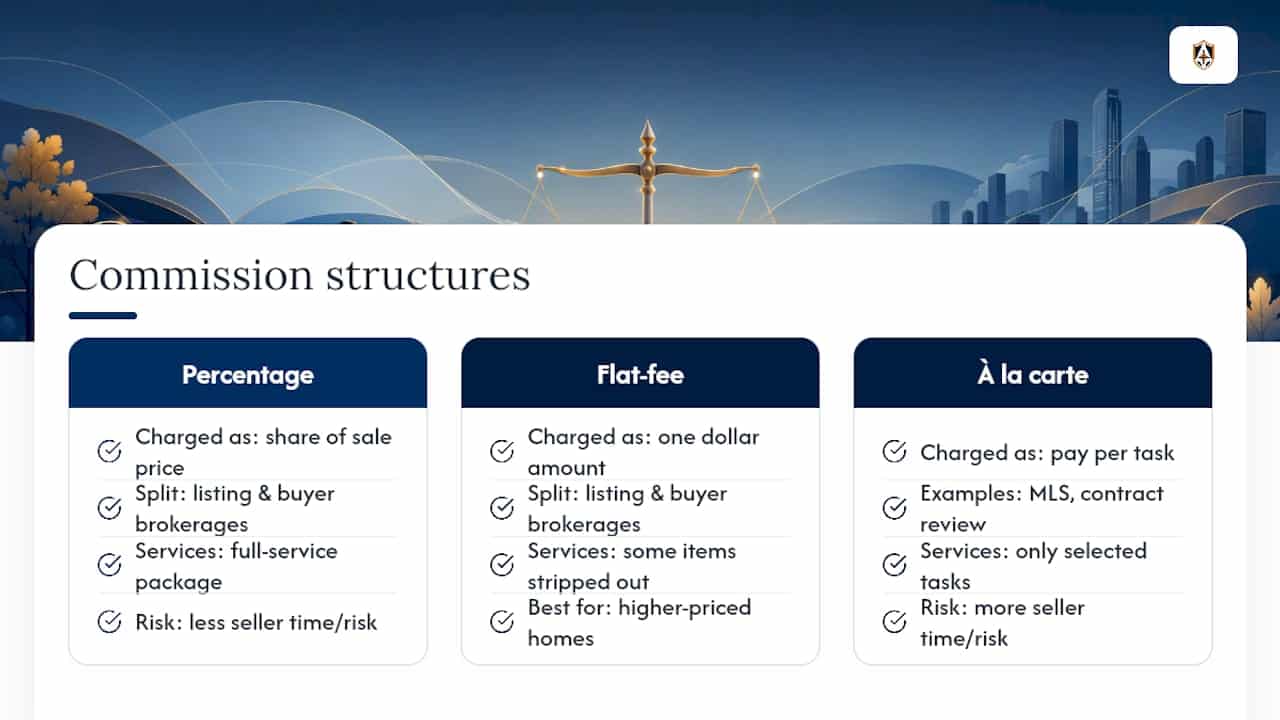
Most sellers picture one flat “6%,” but the fee actually comes in three structures. Percentage-of-sale is the most common: you agree to pay a set share of the final sale price, split between your listing agent and the buyer’s agent. Flat-fee pricing charges one dollar amount regardless of sale price, which can work in your favor on higher-priced homes. À la carte, sometimes called limited-service, lets you pay only for specific tasks, such as MLS placement or contract review, while you handle the rest yourself.
No money changes hands until the deal closes. Commission is paid out of sale proceeds at the closing table, not upfront, and not if the deal falls through. That single fact gives you more negotiating room than most sellers realize, since the agent’s income depends entirely on a completed sale.
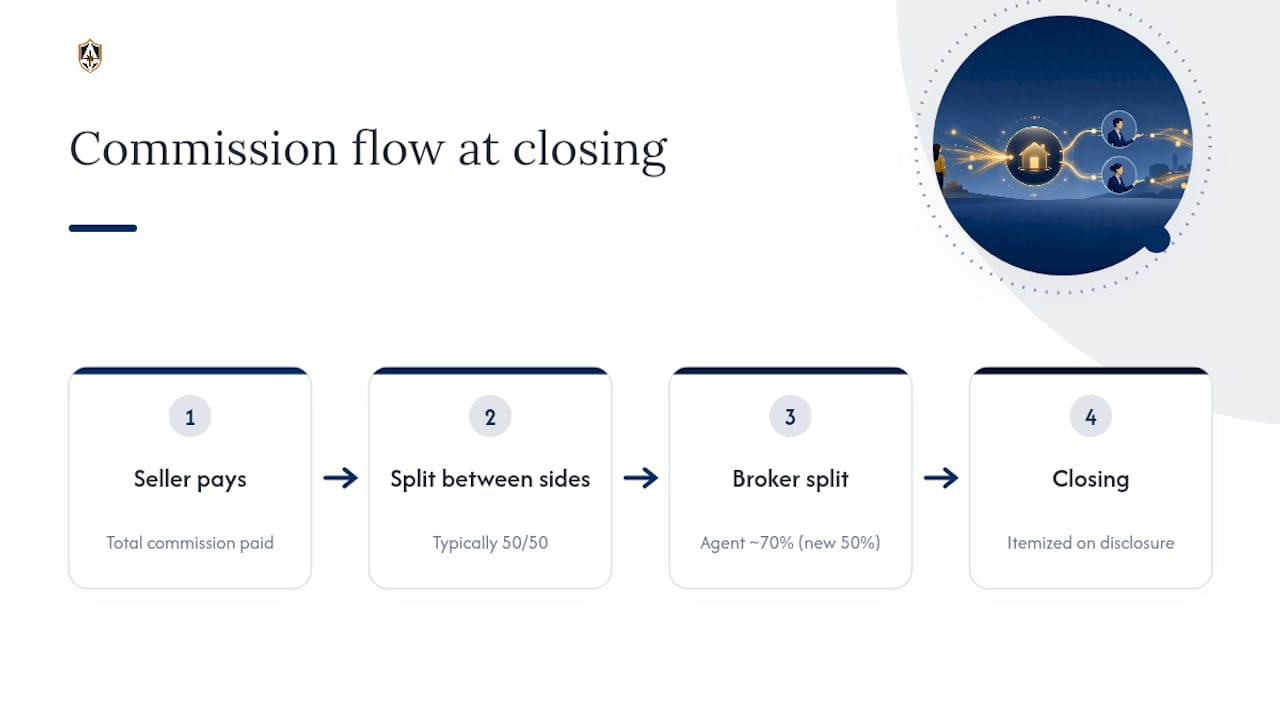
Once the total commission is collected, it gets divided twice. First, it splits between the listing brokerage and the buyer’s brokerage. Then each brokerage splits its half again with the individual agent, based on that agent’s arrangement with their broker. A newer agent might keep only 50% of their side, while a top producer with a strong track record might keep 70% or more.
A full-service commission generally buys you professional photography, MLS syndication, showing coordination, pricing strategy backed by comparable sales data, contract negotiation, and management of the closing process. Flat-fee and à la carte options strip some of that out, which is fine if you are comfortable handling showings, negotiations, or marketing yourself. The trade-off is time and risk, not just money.
Who Pays Commission Now After the NAR Settlement?
Buyers are no longer automatically entitled to have their agent’s fee covered by MLS-published seller offers. Following the 2024 NAR settlement, buyer-agent compensation moved off the MLS and into private negotiation between buyers and their own agents. Buyers now typically sign a buyer-broker agreement upfront, spelling out how much they owe their agent and under what conditions.
That does not mean sellers are off the hook. In practice, most sellers still choose to offer a buyer-agent concession, because a home that comes with a pre-arranged incentive for the buyer’s agent tends to draw more showings and more competitive offers. It has become a strategic choice rather than an automatic MLS-listed requirement, and you can decide, deal by deal, whether offering that concession makes sense for your property and your market.
If you decline to offer any buyer-agent concession, buyers in many transactions are contractually on the hook to pay their own agent directly, per their buyer-broker agreement. That can shrink your buyer pool in markets where buyers are stretched thin on cash, since asking them to fund their own agent’s fee on top of a down payment is a real barrier. In hot seller markets with tight inventory, agents have less incentive to negotiate their own fees down, since demand alone brings buyers. In slower markets, you typically have more leverage to negotiate both your listing fee and whether to offer a buyer-side concession at all.
How Much Does a Realtor Cost? Rates and Real Dollar Examples
The national average total commission runs around 5.7% of the sale price, typically split close to 2.88% for the listing agent and 2.82% for the buyer’s agent.
By the Numbers: On a $300,000 home at the 5.7% average, total commission comes to $17,100, or roughly $8,550 per side before any brokerage split. On a $500,000 sale, total commission runs about $28,500, with each agent’s side landing near $14,250. After a typical 70/30 brokerage split, the individual agent might personally take home somewhere around $9,975 to $14,250 of their side, depending on their arrangement with their broker.
Those numbers are averages, not fixed prices. Rates vary by region, by how competitive the local agent market is, and by how much negotiating you do upfront. A luxury market with heavy competition among agents might see rates trend lower per listing, while a rural market with fewer active agents might see less flexibility.
It helps to think of commission as a marginal trade, not a flat cost. If it does not move the needle on your final number, that extra percentage point comes straight out of your equity.
How Commission Splits Work and Where They Show Up at Closing
Commission flows through two layers before anyone gets paid. The listing side and buyer’s side typically split evenly, often 50/50, though sellers can negotiate a different ratio, including offering a smaller buyer-agent concession. Each brokerage then splits its half with the agent who did the work, commonly on something like a 70/30 arrangement favoring the agent, though newer agents may see closer to a 50/50 split with their broker.
At closing, you will see the commission itemized on your closing disclosure, usually broken out as a single line item or split into listing-side and buyer-side amounts. Confirm this figure matches what your listing agreement specified before you sign anything at the closing table. Discrepancies here are rare, but they are far easier to fix before signing than after funds have moved.
One structure worth watching closely is dual agency, where a single agent represents both you and the buyer. Some states restrict or heavily regulate this arrangement because it creates a built-in conflict of interest: an agent representing both sides has less incentive to push hard for your highest price, since doing so works against the other client they also represent. If your listing agent proposes representing the buyer too, ask direct questions about how they will handle negotiating strategy, and consider whether a second agent might serve your interests better.
How to Negotiate a Lower Realtor Commission
Commission rates are a starting offer, not a fixed price. Real estate agents routinely open the door to reductions, particularly on higher-priced listings where the dollar amount at 3% is already substantial, or when a seller is willing to take on part of the marketing workload themselves.
A few approaches consistently work:
- Ask for a straight percentage cut. Many agents will drop from 3% to 2.5% or lower on listings above a certain price point, since their dollar payout stays healthy even at a reduced rate.
- Propose a tiered or bonus structure. Offer a lower base rate with a bonus if the agent sells above your target price, aligning their incentive with your equity instead of just closing fast.
- Consider a flat fee or limited-service listing if you are comfortable handling some showings or paperwork yourself.
- Offer something in exchange for a lower rate, such as a shorter listing agreement term, exclusive representation with no other agents involved, or covering some of your own staging and photography costs.
A simple script works better than an ultimatum: “I’m comparing a few agents and I’d like to work with you, but I need the commission closer to 2.5%. Can we do that if I handle the initial staging myself?” Most agents will counter rather than walk, especially in a competitive local market.
Watch for red flags during this conversation. An agent who refuses to put any fee terms in writing, or who promises a guaranteed sale price increase in exchange for a higher commission, is making a claim no honest agent can actually back. Commission structure belongs in your signed listing agreement, in plain language, every time.
Alternatives to Paying a Traditional Percentage Commission
If commission math is the main thing holding you back from listing, you have real options beyond negotiating with a traditional agent.
- For Sale By Owner (FSBO). You skip the listing agent commission entirely, but you take on pricing, marketing, showings, negotiation, and paperwork yourself. It can save thousands, but it demands real time and comfort handling legal documents. Our FSBO plan walks through the steps if you go this route.
- Flat-fee or discount brokerages. These pre-negotiate a lower listing rate, sometimes a few hundred to a couple thousand dollars flat, in exchange for reduced marketing support compared to full-service listings. Confirm exactly what is included before signing; some flat-fee packages only cover MLS placement.
- Selling to a cash buyer or investor. This route trades some percentage of top-dollar sale price for speed and certainty, often closing in days rather than months, with no agent commission at all. You will still see some closing costs, detailed in our cash buyer closing cost breakdown.
Choosing among these comes down to your timeline, your property’s condition, and how much of your own time and stress tolerance you want to spend on the sale. A move-in-ready home in a hot market might do best FSBO or with a negotiated low-commission agent. A property needing repairs, or a seller facing a tight deadline, often nets out better with a cash offer once you factor in carrying costs and repair expenses avoided.
What to Check in Your Listing Agreement Before You Sign
Your listing agreement should itemize the fee, the scope of services, and any buyer-agent concession language in plain terms, not vague references to “standard commission.”
Before signing, verify:
- The exact commission percentage or flat fee, written as a number, not a range
- Whether the fee changes if you find the buyer yourself
- The listing term length and what happens if you want to cancel early
- Whether the agreement is exclusive or allows other agents to also market your home
- Buyer-agent concession language and whether it is optional or fixed
- Who authorizes commission payment at closing and how it appears on your closing disclosure
If any of these terms feel vague, ask for an edit before you sign, not after. A real estate attorney or a second agent can review the contract in under an hour for most standard listings. Cross-check the final commission figure against your closing cost estimate so nothing surprises you at the closing table.
How AAS Home Buyers Changes the Commission Equation
AAS Home Buyers gives you selling paths built around a simple idea: not every seller should have to pay a full commission to get a fair, well-managed sale. Our direct cash purchase option removes agent commission from the equation entirely. Our Retail Buyer Program manages listing and marketing for sellers who want more support without full traditional overhead. For sellers who prefer a licensed agent, our vetted agent referral network connects you with agents already screened for fair, transparent fee practices.
Each path changes your net proceeds differently, and we walk you through the real numbers for your specific property before you commit to any route. You can see how the full workflow operates on our transparent process page.
When Paying Full Commission Actually Pays Off
Full-service commission earns its keep on complex properties: unusual layouts, competitive luxury markets, or homes that need aggressive marketing to reach the right buyer pool. Sellers who are price-sensitive but time-flexible often do better negotiating a reduced rate rather than cutting service entirely.
Lower-fee routes make more sense when you are working against a deadline, your property needs work that limits traditional showings, or you are genuinely willing to run your own marketing. Whichever path you choose, put every fee term in writing and negotiate it openly. Nobody benefits from a commission conversation that happens after the fact.
— AAS
Sell With Fewer Fees on the Table
AAS Home Buyers gives commission-sensitive sellers a real alternative to the standard listing-and-negotiate cycle: a direct cash purchase with no agent commission at all, or a managed Retail Buyer Program if you want marketing support without full traditional overhead.

Before you reach out, gather your property address, your current mortgage payoff amount, and a rough sense of what comparable homes nearby have sold for recently. That’s enough for us to give you a transparent, data-driven valuation with no hidden fees attached. If a traditional listing with a negotiated commission still makes more sense for your situation, our agent referral network connects you with vetted local agents instead. Start by reviewing our three-step process and see which path fits your timeline and your equity goals.
Where This Information Comes From
- Rocket Mortgage: confirms commission negotiability and listing agreement requirements.
- Realtor: explains post-NAR buyer-broker agreements and closing cost mechanics.
- Bankrate: source for national average commission rates and per-agent splits.
- ListWithClever: covers discount brokerage models and regional rate variance.
Sources
- Who pays REALTOR® fees? What buyers and sellers should know | Rocket Mortgage
- Realtor
- Real estate commissions: How much do agents make? | Bankrate
- Average real estate commission rate | ListWithClever
FAQ
Do Sellers Normally Pay Realtor Fees?
Sellers commonly pay the listing agent’s fee and often choose to offer a buyer-agent concession too, but this is negotiated per deal rather than automatic, especially since the 2024 NAR settlement changed how buyer-agent compensation gets arranged.
How Can Sellers Reduce Realtor Commission Costs?
Sellers can negotiate a lower percentage, use a flat-fee or limited-service listing, or work with a direct cash buyer like AAS Home Buyers to remove agent commission from the transaction entirely.