
Close Fast With Unpermitted Work: 3 Seller Focused Routes
Yes, you can sell a house with unpermitted work. Most sellers do it every year. The real question is which path fits your situation: getting a retroactive permit to legalize the work, disclosing it fully, and selling as-is at an adjusted price, or selling to a cash or investor buyer who can absorb the risk. Your best route depends on safety and code severity, how buyers will finance the purchase, your timeline, and what it actually costs to bring the work up to code.
TL;DR:
- Most unpermitted work can be legally sold but requires full disclosure and honest pricing adjustments based on appraisal and lender restrictions.
- Appraisers often exclude or heavily discount unpermitted square footage, which can significantly lower the home’s appraised value.
- Legalizing unpermitted work through retroactive permits involves costs, time, and potential renovations, but recovers most appraised value if the work is sound.
- Selling as-is to cash or investor buyers skips permit costs and delays but usually results in a lower sale price.
- Preparation of thorough documentation and understanding your specific situation are key to choosing the best sale route.
Table of Contents
- Can You Legally Sell With Unpermitted Work?
- How Unpermitted Work Affects Appraisal, Financing, and Insurance
- How to Tell If Your Home Has Unpermitted Work
- Your Options as a Seller: Three Practical Routes
- Retroactive Permits: Process, Costs, and Timeline
- Selling As-Is: How to Document and Disclose Properly
- Pricing and Negotiating Around Unresolved Permits
- Documentation to Assemble Before You List
- Timeline and Cost Quick Reference
- How AAS Home Buyers Helps Sellers With Complex Situations
- A Practical Checklist for Choosing Your Fastest Low-Risk Route
- Get an Offer Without the Permit Guesswork
- Sources
- FAQ
Can You Legally Sell With Unpermitted Work?
Selling a house with unpermitted work is legal in every state, but it comes with obligations you cannot skip. The law does not require you to fix unpermitted additions before selling. It does require you to tell the truth about them.
Every state uses some version of a seller’s property disclosure form, and these forms typically ask directly whether any additions or alterations were made without a permit. Colorado’s disclosure form, for example, asks pointed questions about non-permitted work and warns sellers of legal liability for failing to answer honestly, a pattern echoed in disclosure requirements%20(fillable)_for%20use%20on%20or%20after%20January%201, %202026_0.pdf) across most states. Answer incompletely, and you open yourself up to a lawsuit years after closing, even if the buyer never mentioned the issue during escrow.
Real estate agents face their own version of this duty. State licensing boards, including North Carolina’s, instruct brokers to verify permit status and flag discrepancies to protect both buyer and seller from later disputes, a responsibility spelled out clearly in guidance for real estate brokers. If your agent discovers unpermitted work during a listing walkthrough, expect them to raise it. Trying to hide it from your own agent rarely ends well.
A few scenarios can genuinely stall a sale rather than just complicate it:
- Active code enforcement action or a red-tagged structure that limits occupancy
- Unpermitted work involving load-bearing walls, gas lines, or electrical panels that a lender’s appraiser flags as a safety concern
- A buyer’s lender requiring permits before funding, which can force a closing delay while you scramble to open a permit application
Most unpermitted work, especially cosmetic or minor jobs like a finished closet or a small deck, will not trigger these outcomes. Structural, electrical, and plumbing work involving unpermitted work sits in a different risk category entirely, and that distinction should guide every decision you make from here.
How Unpermitted Work Affects Appraisal, Financing, and Insurance
Appraisers are trained to catch unpermitted square footage, and when they do, the numbers on your home can shift fast. Fannie Mae’s Selling Guide instructs appraisers to comment specifically on the quality, safety, and market impact of any unpermitted addition, and to use comparable sales with similar non-compliant characteristics when they exist, according to the improvements section of the appraisal report. In practice, that means an appraiser may exclude an unpermitted addition from your gross living area entirely, or apply a discount to reflect the risk a lender is taking on.
A common pattern in the market: appraisers frequently exclude or heavily discount unpermitted square footage from a home’s valuation, and that gap tends to be the single biggest surprise for sellers who assumed their finished basement or converted garage counted at full value, according to analysis of appraisal treatment of unpermitted work.
Whether that space counts at all often comes down to the buyer’s specific lender. Appraisers measure the unpermitted addition and report its permit status, but the lender’s own underwriting instructions determine if that square footage counts toward value, per guidance on how appraisers handle unpermitted square footage. Two buyers with two different lenders can get two very different appraisal outcomes on the same house.
Government-backed loans complicate things further. FHA and VA underwriting standards, laid out in the HUD Single Family Housing Policy Handbook, often require unpermitted space to be excluded from value or permitted before closing. This narrows your buyer pool if a large share of your unpermitted square footage is driving your asking price. A buyer relying on FHA financing may simply be unable to close until the work is legalized, no matter how much they want the house.
Insurance carries its own quiet risk. Homeowners insurance underwriters can and do deny claims tied to unpermitted work, particularly electrical or structural failures traced back to work that never passed inspection. Buyers researching your home’s history sometimes uncover this risk on their own, and savvy ones will factor it into their offer, or walk away from financing a home where a major system was never permitted. That combination, appraisal discount plus insurance exposure plus financing friction, is why unpermitted work rarely disappears quietly during a transaction. It surfaces, usually at the worst possible moment in escrow.

How to Tell If Your Home Has Unpermitted Work
Before you list, run your own audit. Most sellers discover unpermitted work the hard way, during an appraisal or a buyer’s inspection, and by then you have far less control over the outcome.
- Pull your permit history. Contact your city or county building department, or search its online portal, using your address or parcel number. Baltimore’s building permits and licensing portal is a typical example of the kind of searchable record most municipalities now maintain.
- Compare that history against your assessor’s records. If your county assessor lists more square footage or more bedrooms and bathrooms than your permit file shows, that gap is a strong signal something was built without approval.
- Walk the property looking for physical tells. Mismatched flooring where a room was added, electrical panels with amateur wiring, water heaters or furnaces in spaces that were clearly not original construction, or a bathroom added where plumbing lines look improvised.
- Check your paperwork drawer. Missing contractor invoices, missing inspection sign-offs, or a suspicious absence of any paper trail for a renovation you know happened are all red flags.
- Escalate when the signs point to structural or systems work. Hire a licensed inspector or structural engineer, and consider a permit expediter if you suspect multiple unpermitted projects layered over each other.
Pro Tip: Order your permit history before you order a pre-listing inspection. Knowing what’s on record first helps you interpret what the inspector finds, instead of getting blindsided by two separate surprises at once.
Your Options as a Seller: Three Practical Routes
Once you know what you’re dealing with, three routes generally cover almost every situation.
Retroactive permitting legalizes the work after the fact. It costs more upfront, since you’re paying for permit fees, possible demolition and rebuild of non-compliant elements, and inspection time. In exchange, you restore full appraisal value and reopen your buyer pool to anyone using conventional, FHA, or VA financing. This route makes the most sense when the unpermitted work is otherwise sound and can realistically pass inspection with modest corrections.
Disclosing and selling as-is works best for lower-risk, cosmetic, or easily reversible unpermitted work, a finished basement, a small shed, a converted den. You price the home to reflect the appraisal discount buyers will likely encounter, and you disclose the issue clearly and completely on your state’s seller disclosure form. The tradeoff: your buyer pool shrinks to cash buyers and lenders comfortable with the risk, and you’ll likely face negotiation for credits or a lower price.
Selling to a cash or investor buyer is the fastest path, particularly useful when:
- Your timeline is urgent (job relocation, inherited property, financial distress)
- The unpermitted work involves structural or systems issues too costly to correct before a normal listing timeline
- You want to avoid the appraisal and financing gauntlet entirely, since cash buyers typically waive appraisal contingencies
Each route trades speed against dollars in a different way. Legalizing costs the most time but usually recovers the most value. A cash sale costs the least time but usually means accepting a lower price than a fully permitted, fully financeable home would command.
Retroactive Permits: Process, Costs, and Timeline
Getting a retroactive permit follows a fairly consistent sequence, even though the specific forms and fees vary by city and county.
Start by commissioning as-built drawings that document exactly what was constructed, since building departments need to see what exists before they can evaluate it against current code. From there, you apply for the retroactive permit itself, often through your state or municipal portal. Massachusetts, for instance, runs building permit applications through a standardized state process that illustrates the kind of documentation most jurisdictions expect: project scope, contractor licensing, and structural or electrical details where relevant.
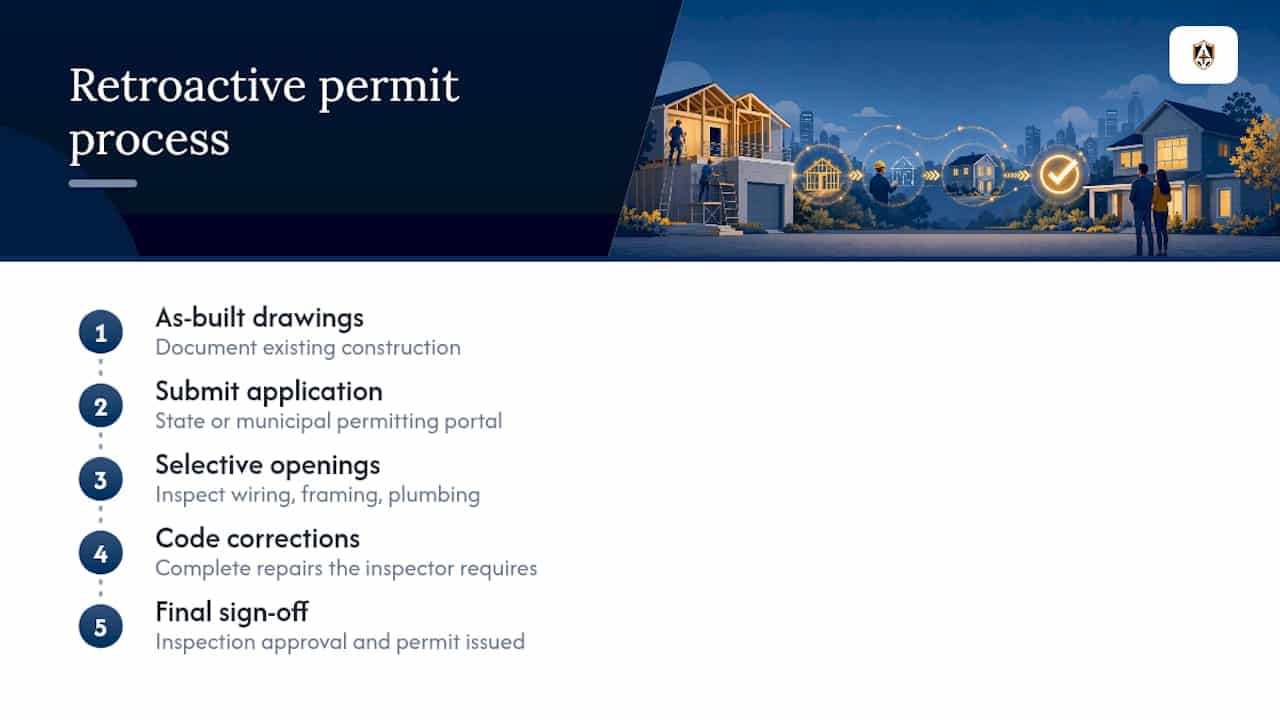
Once the application is filed, expect the building department to require selective opening of walls, ceilings, or floors so an inspector can verify wiring, framing, or plumbing that’s currently hidden behind finished surfaces. This is often the step sellers underestimate, both in cost and disruption. If the inspector finds work that doesn’t meet current code, you’ll need to complete corrections before the department issues final sign-off.
Costs and timelines vary widely by project type:
These ranges reflect permit fees, engineering reports, corrective construction, and reinspection costs, not the original construction. A coherent pattern in the appraisal industry suggests the cost to legalize unpermitted work is often lower than the value an unpermitted status strips from your appraisal, particularly when the underlying work is sound and only the paperwork is missing, according to analysis of retroactive permitting outcomes.
For anything involving structural or electrical scope, bring in a permit expediter or a licensed engineer early. They know which inspectors handle which jurisdictions and can often shave weeks off the process by preparing documentation the way your specific building department expects it.
Pro Tip: If you’re mid-escrow and can’t finish permitting before closing, ask your real estate attorney about structuring an escrow holdback. The buyer’s lender releases funds for the sale now, and a set amount stays in escrow until you complete the permit and corrections after closing.
Selling As-Is: How to Document and Disclose Properly
If you choose the as-is route, your disclosure paperwork becomes the most important document in the transaction. Fill out your state’s seller property disclosure form completely, not just checking “unknown” to avoid the topic. Most forms, including Colorado’s seller’s property disclosure form%20(fillable)_for%20use%20on%20or%20after%20January%201, %202026_0.pdf), ask directly whether additions were made without a permit, and vague or incomplete answers create exactly the liability the form was designed to prevent.
Attach supporting documentation to strengthen your disclosure rather than leaving it as a bare admission:
- Copies of any permit search results you ran, even ones showing no permit on file
- Contractor invoices or receipts, if you have them, showing when work was done and by whom
- Notes or reports from any inspection you’ve already had done
- Photos documenting the current condition of the unpermitted work
When describing the issue in writing, be specific rather than general. “Finished basement, electrical work not permitted, no known safety issues identified during 2024 inspection” tells a buyer far more, and protects you far better, than “some work may not have permits.” If the unpermitted work touches anything structural, electrical, or involves a habitable addition, get a real estate attorney to review your disclosure language before it goes to the buyer. A pre-listing inspection run before you write your disclosure can surface issues you didn’t know existed, which is far better than a buyer’s inspector finding them first.
Credits, escrow holdbacks, and limited warranties all help close the gap between your price and a buyer’s remaining hesitation. A seller credit toward future permitting costs, for example, lets the buyer take on the legalization process themselves at a price that reflects the risk. Selling as-is doesn’t mean selling without documentation. It means selling with complete documentation and a price that matches the real condition.
Pricing and Negotiating Around Unresolved Permits
Start with a realistic permit discount rather than hoping buyers won’t notice. Order a pre-listing inspection so you know exactly what an appraiser or buyer’s inspector is likely to find, then price the home to reflect that reality rather than the value you’d get with everything fully permitted.
- Estimate your discount honestly. Compare recent sales of similar homes with disclosed unpermitted work in your area, if you can find them, or work with your agent to model a conservative appraisal outcome.
- Market the property accurately. Never list unpermitted square footage as part of your official gross living area. Describe the space honestly (“bonus room, no permit on file”) rather than folding it into your advertised square footage.
- Target the right buyers. Cash buyers, investors, and fix-and-flip buyers are generally more comfortable absorbing permit risk than a first-time buyer stretching for a conventional loan.
- Negotiate with tools built for this exact problem. Buyer credits toward permitting costs, repair allowances, escrow holdbacks tied to corrective work, or a conditional close date that gives you time to finish a permit in progress.
Pro Tip: If your unpermitted work touches something structural, look into an appraisal gap clause with your buyer. It protects both sides if the appraisal comes back lower than expected because of the discount.
Documentation to Assemble Before You List
The seller who walks into escrow with a complete paper trail moves faster, negotiates from a stronger position, and faces far fewer surprises from the buyer’s lender.
Gather these before your first showing:
- Full permit history printouts from your city or county, even for permits that were never pulled
- Contractor invoices, receipts, or written estimates tied to the unpermitted work
- As-built drawings if you have them, or a floor plan sketch showing the modification
- Photos documenting the condition of the work, inside walls where possible
- A completed seller disclosure form with the unpermitted work section filled out in detail
- Any prior inspection reports, even informal ones
Bundle these into a single escrow packet you can hand to your agent, the buyer’s agent, and the lender’s underwriter on request. Underwriters move faster when they don’t have to chase down documentation, and appraisers write more favorable reports when they see a paper trail showing the work was done competently, even without a permit.
Timeline and Cost Quick Reference
The three routes differ sharply in both speed and dollars, and seeing them side by side makes the tradeoff easier to weigh.
| Route | Typical Timeline | Cost Considerations |
|---|---|---|
| Retroactive permitting | 6 weeks | often recovers most lost appraisal value |
| Disclose and sell as-is | Standard listing timeline | Price reduced by appraisal discount; buyer pool narrows |
| Cash or investor sale | 7 days | No repair or permit cost; typically a lower offer than a fully permitted home |
If the unpermitted work is structural, involves electrical or gas systems, or would take months to correct, a cash sale often makes more financial sense than sinking money into permitting on a tight timeline. If the work is cosmetic and you have time, legalizing it before listing usually pays for itself in a wider buyer pool and a stronger appraisal.
How AAS Home Buyers Helps Sellers With Complex Situations
Homes with unpermitted work rarely fit into a standard listing process, and that’s exactly the kind of situation AAS Home Buyers is built to handle. Our direct purchase option lets you sell as-is, unpermitted work and all, without appraisal contingencies or financing delays working against you. If a faster close isn’t the priority and you have more flexibility, our Retail Buyer Program manages a full listing on your behalf, giving you a shot at preserving more equity while we handle marketing and negotiation. Our agent referral network connects you with local agents when a traditional sale fits your timeline better.
Have your permit history, disclosure form, and any inspection reports ready when you request an offer. We can typically evaluate a property and present options within days, regardless of which route ends up making sense for your situation.
A Practical Checklist for Choosing Your Fastest Low-Risk Route
Cosmetic, reversible unpermitted work with plenty of time to sell? Legalize it. The appraisal recovery usually justifies the cost. Structural or electrical unpermitted work with a tight timeline? Sell as-is to a cash buyer and skip the financing gauntlet entirely. Moderate risk with some time? Disclose thoroughly, price for the discount, and let the buyer pool sort itself.
The mistake we see most often is sellers assuming disclosure alone protects them without adjusting price to match. Match your price to the real risk, document everything, and the rest of the transaction tends to fall into place.
— AAS
Get an Offer Without the Permit Guesswork
AAS Home Buyers gives you a way to sell a home with unpermitted work without spending months chasing permits or gambling on whether a buyer’s lender will accept the space. Where a traditional listing forces you to legalize the work, discount your price, and hope a buyer’s financing survives appraisal, our direct purchase and partner investor options let you skip that entire gauntlet with a straightforward cash offer built around your home’s actual condition.

If your timeline allows for more equity preservation, our Retail Buyer Program and agent referral network give you a managed alternative that still accounts for permit issues honestly rather than papering over them. We provide valuations without upfront fees, so the number you see reflects your property. Have your permit history and any disclosure paperwork ready, then request your offer through our process page to see which option fits your situation best.
Sources
- Building permits: a broker’s responsibility (NCREC bulletin)
- Improvements section of the appraisal report | Fannie Mae
- HUD Single Family Housing Policy Handbook (4000.1)
- The Hidden Appraisal Killer: Unpermitted Work & 2026 Equity
FAQ
Should I Buy a House That Has Unpermitted Work?
It depends on the scope and your financing plan. Cosmetic unpermitted work with a full disclosure and a fair price is often a manageable risk, but structural, electrical, or plumbing work without permits can affect your ability to get FHA or VA financing and may create insurance claim denials down the line.
What Happens if the Previous Owner Did Unpermitted Work?
You inherit the responsibility for disclosing it when you eventually sell, and you may face code enforcement action if the local building department discovers it later. Getting a retroactive permit at that point often costs less than dealing with a forced correction under enforcement pressure.
Do Home Appraisers Look for Unpermitted Work?
Yes. Appraisers are instructed to comment on the quality, safety, and market impact of unpermitted additions and often exclude that square footage from a home’s gross living area calculation, which can lower your appraised value significantly.
Can You Sell a House With Unpermitted Work in Florida?
Yes, the same three routes, legalizing, disclosing and selling as-is, or selling to a cash buyer, apply in Florida as in every other state. Florida’s own disclosure form requires you to reveal known unpermitted alterations, and skipping that disclosure exposes you to legal liability after closing.
What Documents Do I Need Before Requesting an Offer From AAS Home Buyers?
Have your permit history, any contractor invoices, and a completed disclosure form ready if you have them, though AAS Home Buyers can still evaluate your property without a full document set. Current pricing and process details are available directly on the AAS Home Buyers site.