
Homeowners: Stop Foreclosure Now With HUD Options and a Direct Sale
Call your mortgage servicer today and tell them about your hardship, then contact a HUD-approved housing counselor at 800-569-4287 or through the CFPB’s counselor finder. From there, you have two paths: stay in your home through forbearance or a loan modification, or transition out through a sale, short sale, or deed-in-lieu. If a sale date is close, a bankruptcy filing can pause it temporarily while you sort out your next move.
TL;DR:
- Staying in your home may be possible if your hardship is temporary and you have sufficient income recovery prospects within a few months.
- Borrowers with home equity should consider selling outright, as it often yields better financial results and less credit damage than foreclosure.
- FHA borrowers are limited to one permanent retention remedy in most cases, so choose your loss mitigation option carefully before applying.
- Filing for bankruptcy can temporarily halt a foreclosure sale through an automatic stay, but this is not a permanent solution and depends on your specific case.
- Opening early communication with your servicer and a HUD-approved counselor is crucial; submitting a complete application can pause foreclosure actions and improve your options.
Table of Contents
- Retention vs. Disposition: Which Path Fits Your Situation
- How Loss Mitigation Options Work: Forbearance, Modification, and More
- Selling, Short Sale, or Deed-in-Lieu: Weighing Your Exit Options
- Can Bankruptcy Stop a Foreclosure Sale?
- Who to Call and What Documents You’ll Need
- Avoiding Foreclosure Rescue Scams and Understanding Your Timeline
- When Selling to a Direct Buyer Makes Sense
- Get a Straightforward Path Out Before Your Sale Date
- Where to Verify These Options and Get Direct Help
- Sources
- FAQ
Retention vs. Disposition: Which Path Fits Your Situation
Every homeowner facing foreclosure lands in one of two camps, and figuring out which one you’re in shapes everything that follows. Retention means staying in your home through a temporary or permanent change to your loan terms. Disposition means selling the property, whether through a standard sale, a short sale, or a deed-in-lieu of foreclosure, because keeping the home no longer makes financial sense.
The right path usually comes down to three questions:
- How far behind are you, and is that gap likely to close within a few months?
- Is your income recovering (new job, resolved medical issue, end of a temporary setback), or is the hardship permanent?
- Do you have equity in the home, or would selling leave you owing money at closing?
If your hardship is temporary and you have income to eventually catch up, retention options give you breathing room. If the numbers don’t work anymore, whether because of stacked-up arrears or a home that’s worth less than the loan balance, disposition often gets you out with less financial damage than waiting for a foreclosure sale.
How Loss Mitigation Options Work: Forbearance, Modification, and More
Loss mitigation is the umbrella term for the tools your servicer can offer to help you stay in your home. HUD’s own guidance breaks FHA borrowers’ loss mitigation program into several distinct tracks, and most conventional and other government-backed loans offer similar variations.
- Forbearance pauses or reduces your payments for a set period. It’s meant for short-term problems, like a temporary layoff, and it only works if you follow it with a repayment plan or modification. Skip that follow-up step, and you’re right back where you started, just with a bigger balance due.
- Repayment plans spread your missed payments across future months, added on top of your regular payment. This suits homeowners whose income has already recovered and who just need time to catch up.
- Loan modification permanently changes your loan terms, often lowering the interest rate or extending the term to reduce your monthly payment. Servicers typically require a trial payment plan (TPP) first, usually three months of on-time trial payments, before making the modification permanent. Expect to submit income documentation, a hardship letter, and bank statements.
- Partial claim puts your missed payments into a separate, interest-free loan that isn’t due until you sell, refinance, or pay off your primary mortgage. A payment supplement works similarly but can reduce your payment for up to three years by using that subordinate lien differently.
Pro Tip: FHA borrowers generally get access to only one permanent home-retention remedy within any typical period unless a presidentially declared disaster caused your hardship. That’s a real constraint, so make sure whichever option you pursue is the right fit before you commit.
Selling, Short Sale, or Deed-in-Lieu: Weighing Your Exit Options
When staying in the home isn’t realistic, three disposition routes can stop a foreclosure before it finalizes.
- Sell the home outright. If you have equity, a straightforward sale is usually your best financial outcome. You pay off the loan at closing and walk away with the remainder, and your credit takes far less of a hit than a completed foreclosure.
- Short sale (pre-foreclosure sale). When your home is worth less than what you owe, a short sale lets you sell for less than the payoff amount, with your lender’s approval. It causes less credit damage than a foreclosure, though you should confirm in writing whether the lender will waive any remaining deficiency balance.
- Deed-in-lieu of foreclosure. You voluntarily transfer the property title to your lender in exchange for release from the debt. Some servicers offer relocation assistance or a cash-for-keys arrangement to help you move out on a set timeline.
Timing matters more than most homeowners realize. A coordinated sale or short sale can often close faster than the foreclosure process itself, especially if you start the conversation with your servicer the moment you know keeping the home isn’t going to work. Every one of these routes requires servicer or lender sign-off, so open that line of communication early rather than waiting for a deadline to force your hand. If you’re weighing a fast sale against the clock, this guide on selling your house before foreclosure walks through the practical steps.
Can Bankruptcy Stop a Foreclosure Sale?
Filing for bankruptcy triggers what’s called an automatic stay, a court order that immediately halts most collection activity, including a scheduled foreclosure sale. It takes effect the moment you file, which makes it one of the few emergency brakes available if a sale date is bearing down on you.
- The stay is temporary. It buys you time, not a permanent solution to the underlying delinquency.
- Bankruptcy law is complicated, and the automatic stay’s scope and duration depends on the chapter you file and your specific case, so this isn’t a do-it-yourself project.
- A lender can, in some cases, petition the court to lift the stay and proceed anyway.
Pro Tip: If you’re considering bankruptcy, talk to an attorney before your sale date, not after. Many areas have legal aid organizations that offer free or low-cost consultations for homeowners in exactly this situation, and missing a filing deadline can close off options you’d otherwise have.
Who to Call and What Documents You’ll Need
Getting help moving quickly starts with three calls and one folder of paperwork.
Call your mortgage servicer first, using the number on your monthly statement, and ask specifically for their loss mitigation department. Next, call a HUD-approved housing counselor at 800-569-4287 or find one through the CFPB’s counselor finder; these counselors work for you, not the lender, and many will negotiate with your servicer directly. Finally, check whether your state runs a Homeowner Assistance Fund program, and look into local legal aid for anything with a legal deadline attached.
| Document | Why the servicer needs it |
|---|---|
| Current mortgage statement | Confirms loan number, balance, and delinquency amount |
| Payment ledger or history | Shows exactly when payments were missed |
| Hardship letter | Explains what happened and why |
| Proof of income (pay stubs, benefits letters) | Determines what payment you can realistically afford |
| Recent tax returns | Verifies income for self-employed borrowers |
| Bank statements (last 2 months) | Confirms available assets and cash flow |
| Government-issued photo ID | Standard identity verification |
Submitting a complete application matters more than most people assume. A complete loss mitigation application submitted before your servicer’s cutoff date can pause certain foreclosure actions while they evaluate it, so gathering everything at once beats sending documents piecemeal.
Avoiding Foreclosure Rescue Scams and Understanding Your Timeline
Foreclosure attracts predatory operators who prey on panic, and HUD’s guidance is blunt about it: avoid companies that promise to “stop foreclosure immediately” for an upfront fee.
- Walk away from anyone asking for payment equal to several months of your mortgage before they’ve done anything.
- Never sign over your deed or title to a stranger claiming it will “protect” your home.
- Legitimate help, through HUD-approved counselors, is free or low-cost. There’s no reason to pay a private company for the same service.
On timing, servicers typically don’t file for foreclosure until you’re more than 120 days delinquent, which gives you a real window to act before legal proceedings even start.
Pro Tip: If someone contacts you first, uninvited, offering to “save your home,” treat that as a red flag rather than a lucky break. Real help comes from resources you seek out, not from cold calls after your name shows up on a public delinquency notice.
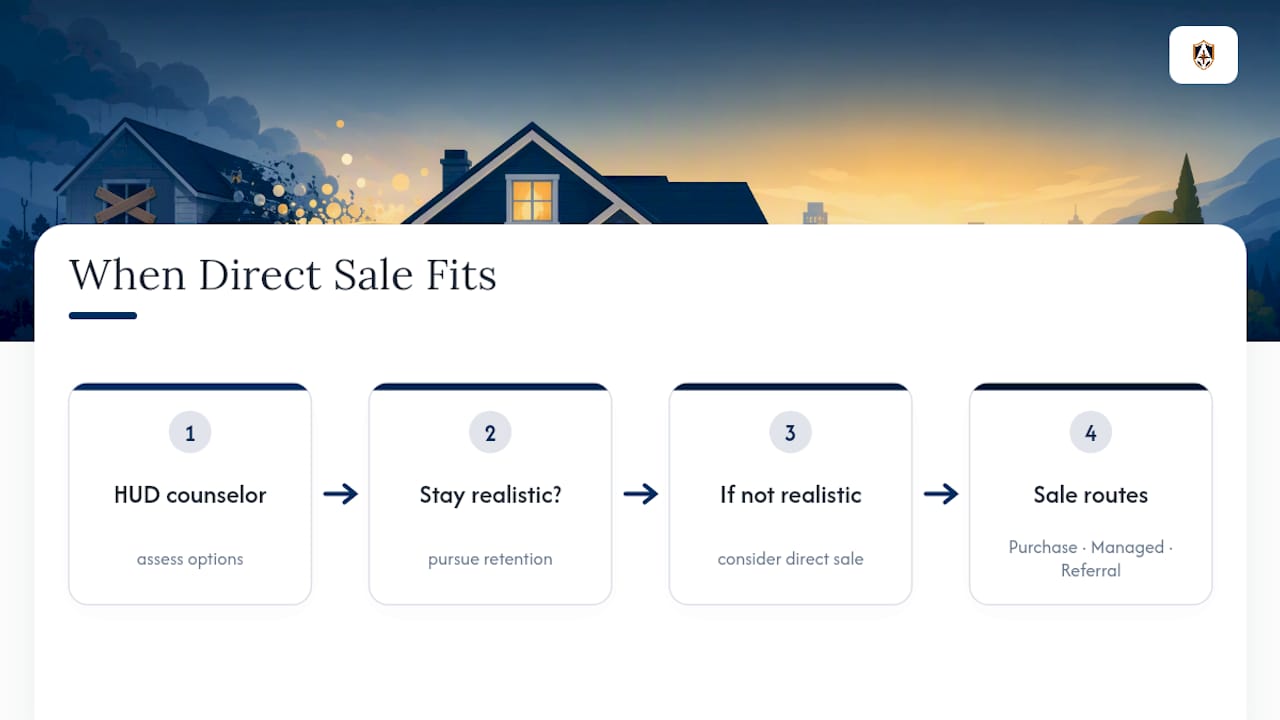
When Selling to a Direct Buyer Makes Sense
Retention only works when the math supports it: recovering income, a manageable arrears gap, enough time before a sale date. When those pieces aren’t there, and equity is thin or the clock has nearly run out, a foreclosure sale becomes the most likely outcome unless you act first.
That’s where a transparent, direct sale earns its place among stop foreclosure options. Some companies offer homeowners options such as direct purchase, managed listing programs, and realtor referral services for sellers who prefer working with vetted agents. None of these require you to have already exhausted retention options first, but we’d still tell you: talk to a HUD-approved counselor before deciding to sell if staying in your home is even remotely realistic. Selling should be a choice you make with full information, not a decision made in a panic.
Get a Straightforward Path Out Before Your Sale Date
If you’ve already worked through retention options and disposition is the right call, you don’t need to navigate a rushed, traditional listing on top of everything else. Some services provide an alternative to a standard agent-led sale for homeowners racing a foreclosure timeline, offering no upfront service fees, data-driven valuations, and a choice between direct purchase, sales through investment partners, managed listing programs, or referrals to trusted local agents, depending on what fits one’s situation.

Getting started is simple. Reach out through the our-process page to see how each option works, and expect a request for basic property details, your mortgage payoff amount, and your timeline. If your loan is a reverse mortgage, this breakdown of reverse mortgage servicing steps covers what borrowers need to know before contacting their lender. And if there’s any real chance forbearance or a modification could keep you in your home, make that call to a HUD-approved counselor first. Selling is one honest option among several, not the only one.
Where to Verify These Options and Get Direct Help
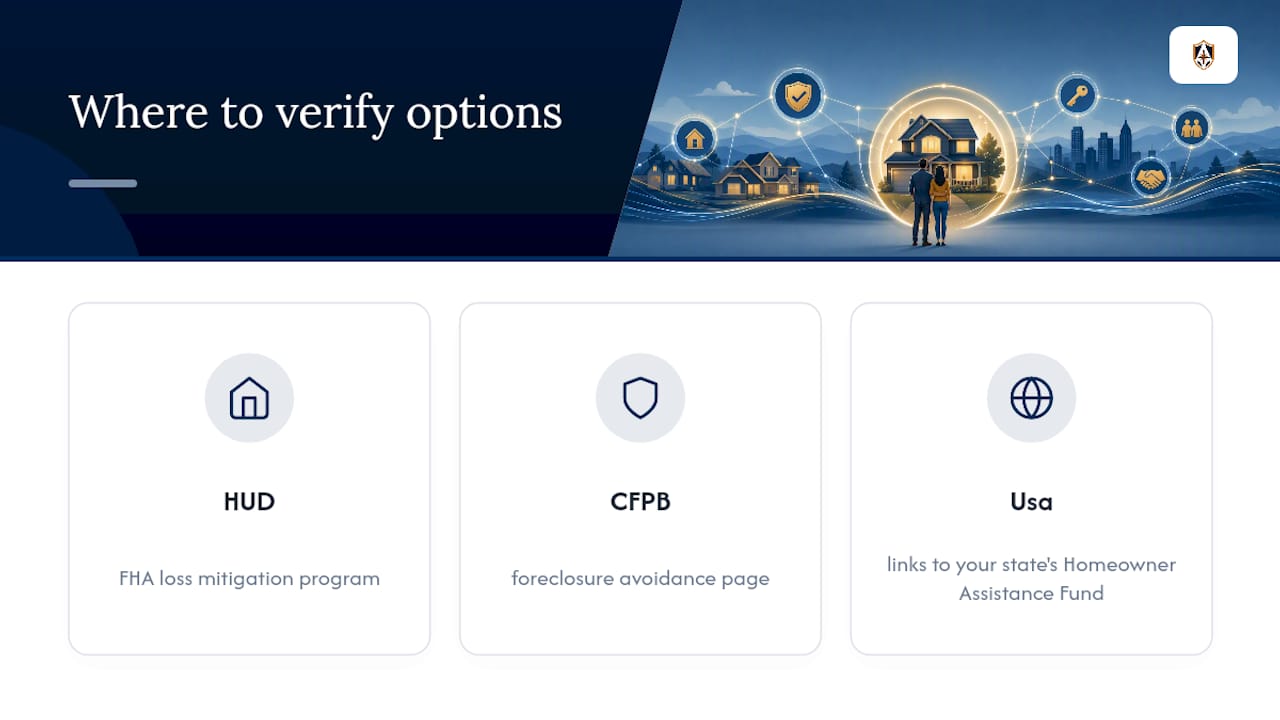
For official guidance, start with HUD’s FHA loss mitigation program, the CFPB’s foreclosure avoidance page, and Usa, which links to your state’s Homeowner Assistance Fund program.
Sources
FAQ
What is the fastest way to stop a foreclosure?
Call your servicer immediately and submit a complete loss mitigation application, since a complete application submitted early can pause certain servicer actions during evaluation. If a sale date is imminent, an attorney-filed bankruptcy triggers an automatic stay that halts the sale right away.
Can I refinance my home to stop foreclosure?
Refinancing can work if you’re not yet seriously delinquent and still qualify for new financing, but once you’ve missed several payments, most lenders will steer you toward a loan modification or partial claim instead. Talk to your servicer and a HUD-approved counselor to see which route actually fits your credit and income picture.
What are some ways to prevent foreclosure?
Options include forbearance, a repayment plan, loan modification, a partial claim or payment supplement, selling the home, a short sale, or a deed-in-lieu of foreclosure. A HUD-approved housing counselor can help you figure out which combination applies to your loan type and hardship.
How do I avoid foreclosure if I’m already behind on payments?
Contact your servicer’s loss mitigation department right away and ask about forbearance or a repayment plan while you gather income documents. If you’re too far behind for retention to make sense, explore a short sale or deed-in-lieu before a sale date is set, or consider a direct sale through a service like AAS Home Buyers if time is short.
Does state law change how much time I have before foreclosure?
Yes. Foreclosure timelines vary significantly depending on whether your state requires judicial foreclosure and how long the process typically takes, so check your state’s specific rules early rather than assuming a national average applies to you.