
Close in 1–2 Weeks or Net More: Sell a House Needing Repairs
Yes, you can sell a house that needs repairs. If speed matters most, an investor or cash sale (or a direct-purchase program) usually gets you to closing fastest. If maximizing your net proceeds matters more, targeted repairs followed by a retail listing typically nets more, though it takes longer and requires more upfront effort and cash.
TL;DR:
- Selling as-is to a cash buyer or investor offers the quickest closing, often within one to two weeks, but the offer will generally be 30% to 50% below the home’s after-repair value.
- Targeted repairs focused on safety and loan approval items can significantly expand the buyer pool, since lenders typically won’t fund homes with major safety or structural issues.
- Proper pricing starts with calculating the after-repair value and subtracting repair estimates plus a 10-20% buffer, as investors often pay 30% to 50% less than move-in ready comparables.
- Market honesty and transparency, including clear disclosures and pre-listing inspections, help accelerate offers and reduce the chance of negotiations stalling over repair scope.
- Using renovation financing options like FHA 203(k) can attract buyers willing to roll repairs into their mortgage, but this process can extend closing times by several weeks compared to cash sales.
Table of Contents
- Options for selling a house that needs repairs
- How to price a fixer-upper: practical formulas and examples
- Which repairs to prioritize before you sell
- How to market the property to the right kind of buyer
- Buyer financing that affects your sale: FHA 203(k) basics
- Pre-listing inspection, disclosures, and legal must-dos
- Step-by-step quick-sale checklist
- Timeline overview: how long each selling option actually takes
- Costs beyond repairs: fees, commissions, and holding costs
- Legal considerations and risks when selling a home in poor condition
- Negotiation strategies for homes that need work
- We build our approach around the idea that no two sellers have the same priorities. That’s why multiple options exist such as direct purchase, connections to investment partners, Retail Buyer Programs, and referrals to agents rather than pushing a single path. Each property’s repair impact is evaluated to help sellers decide whether targeted fixes or an as-is sale makes more sense for their situation.
- Getting a valuation and comparing your real options
- Sources
- FAQ
Options for selling a house that needs repairs
Your path depends on how much time, cash, and tolerance for hassle you have. Four approaches cover most situations.
- Sell as-is to a cash buyer or investor: fastest close, no repairs required, but the offer reflects a discount for the work and risk the buyer is taking on.
- Make targeted repairs, then list (wholetail): you fix safety and loan-qualifying issues only, then sell on the open market, balancing speed against a stronger price.
- Complete a full rehab before listing: makes sense when the numbers clearly support it and you have the cash and time to finish the work.
- Use a managed retail program or agent referral: a structured alternative that positions the home for retail buyers without you handling renovation or marketing yourself.
The first two options fit most sellers dealing with deferred maintenance. Full rehab only pays off when the after-repair value clearly clears your repair budget plus a margin. A Retail Buyer Program or vetted-agent referral sits in between: it aims for retail-level pricing while removing much of the coordination burden from the seller.
How to price a fixer-upper: practical formulas and examples
Pricing a property that needs work starts with the after-repair value, or ARV, which is what the home would sell for once fully updated. From there, you subtract what repairs will actually cost and add a buffer for the unexpected.
- Find the ARV using recent sales of comparable, move-in-ready homes nearby.
- Get contractor estimates for every major repair item, ideally three bids per project.
- Subtract total repair costs from the ARV.
- Subtract another 10% to 20% as a buffer for negotiation and cost overruns.
As an illustrative example: say a home’s ARV is $300,000 and repairs are estimated at $40,000.
Homes needing significant repairs often sell well below move-in-ready comparables. Retail buyers typically pay within a 15% to 30% discount off ARV, while investors often offer a 30% to 50% discount depending on repair severity, since retail buyers usually need financeable, livable conditions while investors price in renovation risk and profit margin.
Which repairs to prioritize before you sell
Not every repair pays off, and fixing the wrong things first wastes both time and money. Work through issues in order of what actually blocks a sale or a buyer’s loan.
- Safety and habitability first: active leaks, exposed wiring, and structural issues can scare off buyers and inspectors before anything else gets considered.
- Loan-qualifying items next: a failing roof or a dead HVAC system can stop a conventional or FHA loan from closing at all.
- Cosmetic work last: fresh paint, cleaning, and minor cosmetic touch-ups tend to deliver strong returns relative to their low cost.
Resolving major safety and habitability issues is often what expands the buyer pool enough to justify the cost, since lenders generally won’t fund a purchase until those problems are addressed. A cracked foundation or persistent moisture issue deserves its own conversation with a specialist; our guide to selling a house with foundation problems walks through that scenario in detail.
Pro Tip: Spend on what unlocks financing and safety first. Save cosmetic upgrades for last, since they cost little and buyers respond to them quickly during showings.
How to market the property to the right kind of buyer
A house that needs work attracts a narrower set of buyers than a move-in-ready listing, so your marketing has to speak directly to them.
- Write an honest listing: describe the condition plainly and highlight the ARV potential rather than hiding known issues, which speeds up serious offers.
- Decide between an agent and direct investor outreach: an agent can widen exposure to retail buyers and renovation-loan shoppers, while direct investor contact can move faster if speed outweighs price.
- Prepare your paperwork early: an inspection report, contractor bids, and permit history remove friction once offers start coming in.
Buyers considering a fixer-upper are often willing to move forward once repairs are estimated transparently and disclosed upfront, since unclear repair scope is one of the biggest reasons offers stall or fall through during negotiation.
Buyer financing that affects your sale: FHA 203(k) basics
Some buyers can finance repairs directly into their mortgage, which widens your pool beyond cash investors. The FHA 203(k) program lets buyers roll repair costs into a single mortgage, covering both the purchase and the renovation in one loan.
- Limited 203(k): covers nonstructural repairs up to $75,000, suited to cosmetic and moderate updates.
- Standard 203(k): requires a minimum of $5,000 in eligible improvements and covers major rehab work, including structural repairs.
- Mention financing options in your listing: noting that renovation loans apply to the property can attract buyers who would otherwise assume the home is cash-only.
A 203(k) loan lets a buyer finance both the purchase price and repairs in one mortgage, which means a home that would scare off a conventional buyer can still qualify for financing under the HUD 203(k) program.
Pre-listing inspection, disclosures, and legal must-dos
Before you list, decide whether a pre-listing inspection makes sense for your situation and understand what you’re legally required to tell buyers regardless of that choice.
- Disclose known material defects: this is a baseline legal obligation in most transactions, and selling as-is does not remove it.
- Follow federal lead-paint rules: homes built before 1978 require a specific disclosure regardless of the sale method.
- Get three contractor bids: multiple estimates give you credible evidence to support your price or negotiate repair credits.
Sellers remain required to disclose known material defects, and federal law requires a lead-based paint disclosure for homes built before 1978, with state-level disclosure rules varying beyond that federal minimum. Our pre-listing inspection guide covers when an inspection helps versus when it adds unnecessary disclosure exposure.
Step-by-step quick-sale checklist
Once you understand your options, moving quickly comes down to sequencing the right steps.
- Decide your priority: speed or net proceeds, since this determines which path you follow from here.
- Order an inspection or gather existing documentation on the home’s condition.
- Get three contractor bids on any major repair item you’re considering fixing or crediting.
- Pick your buyer channel: investor, agent-assisted retail, or a managed program.
- Set your price using the ARV-minus-repairs-minus-buffer formula.
- Prepare your disclosures and seller packet, including inspection results and bids.
- List or solicit offers, and request best-and-final terms once you have multiple interested buyers.
Pro Tip: Gather your contractor bids and inspection report before you set a price. Buyers negotiate harder when repair estimates come from you first instead of their own inspector.
Timeline overview: how long each selling option actually takes
Timelines vary widely depending on which path you choose, and setting realistic expectations upfront avoids frustration later.
A direct cash or investor sale is typically the fastest route, often closing within one to two weeks once you accept an offer, since there’s no financing contingency or repair negotiation to work through. A wholetail approach, where you make targeted repairs before listing, generally adds several weeks for the repair work itself on top of a normal listing timeline. A full rehab before listing takes the longest, often stretching into months depending on the scope of work and contractor availability. A retail listing without any repairs, marketed honestly as a fixer-upper, tends to sit longer on the market than a move-in-ready comparable, since it appeals to a narrower buyer pool.
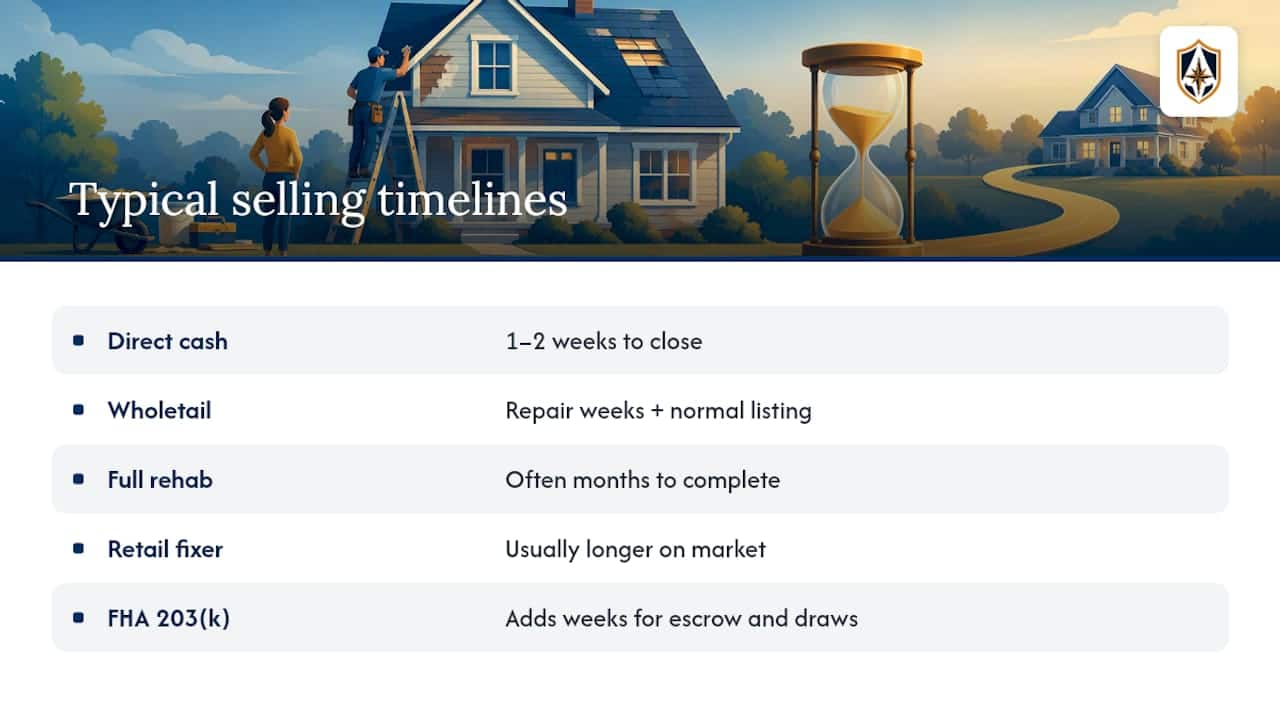
Buyer financing also affects timing. A buyer using an FHA 203(k) loan needs extra time for the renovation escrow and draw process required by the program, which typically adds weeks to a standard closing timeline compared to a conventional cash purchase. If your priority is closing quickly, a direct-purchase or investor channel removes most of these variables, since there’s no appraisal contingency tied to repair completion. If you have flexibility, a retail sale with targeted repairs often balances a reasonable timeline against a stronger final price. Whichever path you choose, communicating your timeline expectations early, to your agent, investor, or program contact, helps avoid surprises once you’re under contract.
Costs beyond repairs: fees, commissions, and holding costs
Repair costs are only part of the math. Several other costs shape what actually lands in your pocket at closing.
- Agent commissions: apply when you list with an agent, and are negotiated between you and your agent directly.
- Closing costs: typically include title fees, transfer taxes, and other transaction charges that vary by location.
- Holding costs: property taxes, insurance, utilities, and any mortgage payments continue to accrue for as long as the home sits unsold.
- Repair-related transaction friction: repair credits negotiated during the sale reduce your net proceeds just as directly as a lower sale price would.
A longer time on market means more months of holding costs stacking up, which is part of why speed and net proceeds pull against each other. A cash or investor sale minimizes holding costs by closing quickly, even though the offer itself reflects a discount. A retail sale after repairs can produce a stronger headline price, but that gain has to be weighed against commissions, months of holding costs, and the repair spending itself. Running the full math, not just the sale price, is the only way to compare these paths honestly. This comparison can be treated as a decision tree. Quantify repair costs, estimate ARV, and compare net proceeds across channels. before recommending a path.
Legal considerations and risks when selling a home in poor condition
Selling a property with known issues carries real legal exposure if disclosure obligations aren’t taken seriously.
Disclosure requirements exist specifically to protect both buyer and seller. Failing to disclose known defects creates risk of liability after closing, and disclosure remains a primary legal protection for sellers even in an as-is sale. Selling “as-is” changes the negotiation dynamic, not your legal disclosure duty: you still have to tell buyers about defects you know about, whether or not you plan to fix them.
Documentation matters here too. Keeping your inspection report, contractor bids, and any permit history on file gives you a paper trail if a dispute arises later. It also demonstrates good faith, showing you disclosed what you knew rather than concealed it. State disclosure laws vary in scope, so reviewing your state’s specific requirements, or working with an agent or attorney familiar with them, reduces the chance of a costly surprise after the sale closes.
Negotiation strategies for homes that need work
Buyers of a property needing repairs almost always come to the table with concerns about cost and risk, and your negotiation strategy should address both directly rather than getting defensive about them.
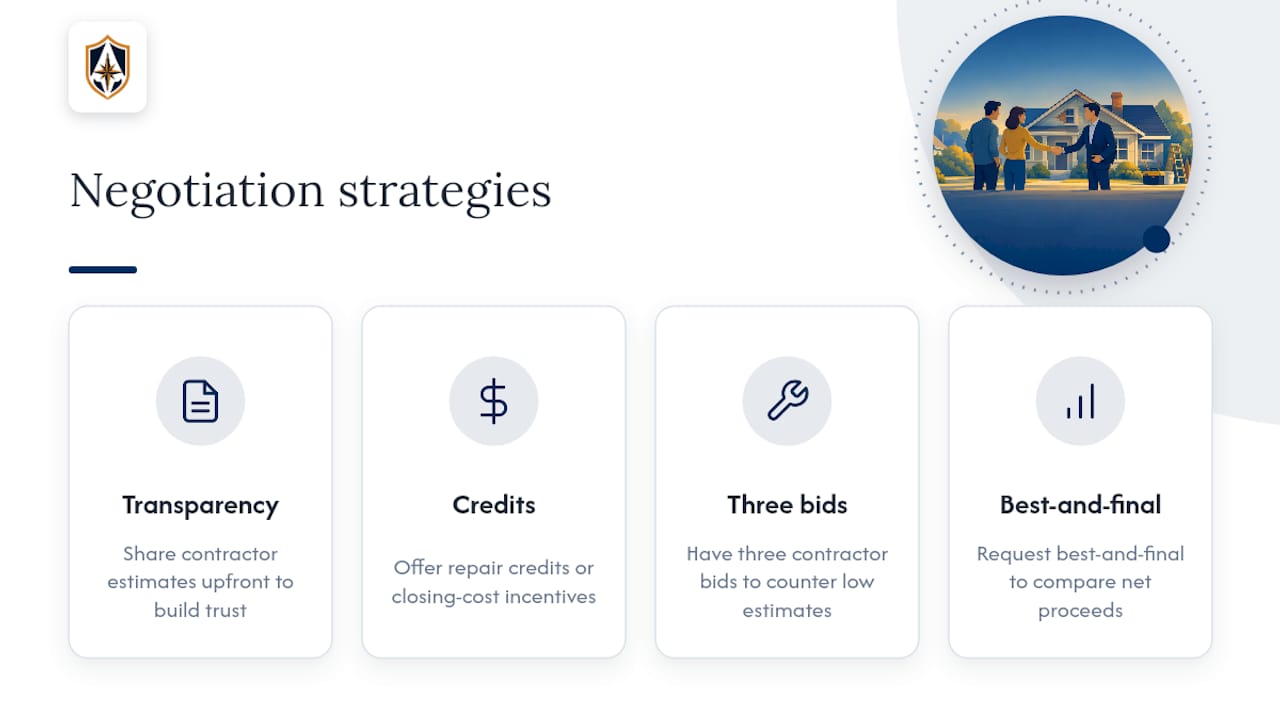
Transparency is your strongest tool. Buyers sometimes overestimate repair costs when they’re guessing, so sharing your own contractor estimates upfront builds trust and often narrows the gap between your price and their offer. Offering a repair credit or a closing-cost incentive can also be an effective compromise when you’re not willing to complete repairs yourself but still want to keep the sale moving. When a buyer raises a repair concern during negotiation, having three contractor bids in hand lets you counter a lowball estimate with credible numbers rather than guesswork on either side.
If you’re fielding multiple offers, especially from a mix of investors and retail buyers, requesting best-and-final terms once you have serious interest helps you compare net proceeds across very different offer structures instead of just comparing headline price. An investor offer with no contingencies might net you more after holding costs and repairs than a slightly higher retail offer that drags on for months.
We build our approach around the idea that no two sellers have the same priorities. That’s why multiple options exist such as direct purchase, connections to investment partners, Retail Buyer Programs, and referrals to agents rather than pushing a single path. Each property’s repair impact is evaluated to help sellers decide whether targeted fixes or an as-is sale makes more sense for their situation.
Getting a valuation and comparing your real options
Whichever path fits your situation, the first useful step is a clear look at what your home is actually worth in its current condition and what it could bring after repairs. The company offers a direct purchase, connections to vetted investment partners, a Retail Buyer Program for a more managed listing experience, and referrals through our agent network, all without upfront service fees.

- Direct purchase: a straightforward cash offer when speed is your priority.
- Retail Buyer Program: a managed path toward retail-level proceeds without handling renovation yourself.
- Agent referral: a connection to a vetted local agent when a traditional listing fits your goals better.
Request a transparent valuation and see how the numbers compare across these options before you commit to a direction. Start with our selling process overview to see what fits your situation.
Sources
For lender-level detail on renovation financing, see HUD’s 203(k) program page. For disclosure obligations, see NAR’s consumer guide to seller disclosures. For additional seller tactics, see this guide to selling a home that needs work.
- HUD — Single-Family Mortgage Programs: 203(k)
- NAR — Consumer guide: seller disclosures
- Should you buy a fixer-upper? — AmeriSave
- Realtor
FAQ
Can I sell my house even if it needs repairs?
Yes, homes needing repairs sell regularly through cash buyers, investors, and retail listings marketed honestly as fixer-uppers. Retail buyers typically pay within 15% to 30% below comparable move-in-ready homes, while investors often offer 30% to 50% below, depending on repair severity.
What devalues a house the most?
Safety and structural issues, such as a compromised foundation, active roof leaks, or outdated electrical systems, tend to devalue a home the most because they block financing and scare off buyers early. Deferred maintenance on major systems like HVAC also weighs heavily since it signals more hidden problems to come.
What repairs need to be done to sell a house?
At minimum, address safety and habitability issues first, such as active leaks, faulty wiring, or structural concerns, since these can prevent a sale outright. Loan-qualifying items like a failing roof or major system also often need attention before a buyer’s lender will approve financing.
What not to fix before selling your house?
Skip big-ticket, low-return projects like full kitchen remodels or major landscaping overhauls unless your market clearly rewards them. Cosmetic touches like fresh paint and thorough cleaning tend to offer a better return than expensive structural upgrades that buyers might redo anyway.