
230 Days to Auction? California Foreclosure Timeline & Options
Many California nonjudicial foreclosures reach the auction block in roughly 230 days from the first missed payment: about 120 days of pre-foreclosure limbo plus another 110 days of formal notices. Many take longer once loss mitigation, postponements, or bankruptcy enter the picture. If you’ve missed a payment, your best move right now is calling your servicer and a HUD-approved housing counselor before a Notice of Default ever gets recorded.
TL;DR:
- Most California foreclosures occur around 230 days from missed payments, with formal notices starting after 120 days of delinquency.
- Submitting loss mitigation applications early, ideally before the Notice of Default, can delay or prevent foreclosure proceedings altogether.
- The Homeowner Bill of Rights restricts foreclosures while applications are under review and guarantees home access to homeowners during the process.
- Selling the home before the trustee’s sale can preserve equity and avoid the negative impact of foreclosure on credit scores.
- Responding promptly to notices and maintaining organized documentation are crucial at each stage to maximize options and avoid loss.
Table of Contents
- California Foreclosure Timeline: Stage by Stage
- Your Rights Under California’s Homeowner Bill of Rights
- How to Slow or Stop Foreclosure at Each Stage
- What Happens After a Trustee Sale
- Loss Mitigation Options and How Each Affects Your Timeline
- How AAS Home Buyers Helps Homeowners Facing Foreclosure
- What We’d Tell a Family Member Facing This
- Sell Before the Sale Date and Keep Your Equity
- Sources
- FAQ
California Foreclosure Timeline: Stage by Stage
The foreclosure timeline California homeowners face breaks into four distinct phases, each governed by its own statutory clock. Understanding where you stand in that sequence tells you exactly how much runway you have left.
Pre-foreclosure (day 1 to day 120). Under federal mortgage servicing rules, your servicer generally cannot begin formal foreclosure until you’re more than 120 days past due. During this window, late fees accumulate and your servicer is required to attempt contact with you about loss mitigation options. This isn’t dead time. It’s the single best window to negotiate a workout, because a complete loss-mitigation application submitted here has the strongest chance of leading to a modification rather than a sale.
Notice of Default (day 121 and beyond). Once the 120-day mark passes, the servicer or trustee can record a Notice of Default (NOD) with the county recorder, which formally starts the nonjudicial foreclosure process. California law gives you a statutory three-month reinstatement period after that recording, meaning you can typically bring the loan current, plus fees, and stop the process entirely during that window, according to California Courts Self-Help. The NOD gets mailed to you and recorded publicly, so this is not a notice you can miss if you’re checking your mail and the county recorder’s site.
Notice of Sale (after the reinstatement period closes). Once the three-month cure period expires without resolution, the trustee can record and post a Notice of Sale (NOS). State law requires the NOS to be posted at the property, published in a local newspaper, and mailed to the borrower, with a minimum 20-day wait built in before the actual sale date. This is also the window where sale postponements become relevant, more on that below.
Trustee’s sale (auction day). At the sale, the property goes to the highest bidder, though the lender typically enters a credit bid based on the outstanding loan balance. If no outside bidder exceeds that amount, the lender takes the property back. Adding it all up, the minimum practical timeline runs about 230 days from that first missed payment, though real-world cases routinely stretch past that floor.
A few things can extend or interrupt this sequence:
- Judicial foreclosure is rare in California but possible when a lender wants a deficiency judgment; it runs through court and takes considerably longer than the nonjudicial path.
- Loss-mitigation review required by state law can pause the clock if you apply in time.
- Bankruptcy filings trigger an automatic stay that halts the sale, at least temporarily.
- Postponements tied to a listing agreement or signed purchase contract can add 45 days at a time, which we cover in detail below.
Most California homes are foreclosed nonjudicially through a deed of trust rather than through court, which is faster for the lender but comes with tradeoffs for the borrower that we’ll unpack in the consequences section.
Your Rights Under California’s Homeowner Bill of Rights
California’s Homeowner Bill of Rights (HBOR), built into the state’s foreclosure statutes, gives you real leverage over how and when this process moves. It’s not just a feel-good label. It changes what your servicer is legally allowed to do.
Before a servicer can even record an NOD, it must make good-faith attempts to contact you about your options, and it cannot engage in “dual tracking,” meaning it can’t foreclose while a complete loss-mitigation application is still under active review. If you submit that application 37 or more days before a scheduled sale date, the servicer must evaluate it and provide a written decision, and doing so can delay the sale, according to the DRE’s homeowner foreclosure guide.
Here’s what HBOR practically guarantees you:
- A single point of contact at your servicer once you request loss mitigation help.
- Written notice of any missing documents in your application, with a chance to fix it.
- A ban on foreclosure sale while your complete application is pending, provided you applied in time.
- The right to reinstate your loan up until five business days before the scheduled sale, in most cases.
Pro Tip: Submit your loss-mitigation paperwork as early as you can, not the week before a sale date. The 37-day rule is a floor, not a target. The earlier your file lands on your servicer’s desk, the more time everyone has to actually work the problem instead of racing the calendar.
Watch out for foreclosure rescue scams during this stretch. Companies charging upfront fees to “save your home” or asking you to sign over your deed are a recurring problem the California Department of Justice warns homeowners about repeatedly. Legitimate help is free. HUD-approved housing counselors don’t charge you to sit down and go through your options.
How to Slow or Stop Foreclosure at Each Stage
Your options narrow as the clock runs, so the sequence you act in matters as much as the actions themselves.
Before any formal notice arrives, call your servicer the moment you know you’ll miss a payment. Don’t wait for a letter. Request a loss-mitigation packet, start gathering your last two months of bank statements, recent tax returns, and a written hardship explanation, and schedule a free session with a HUD-approved counselor.
After an NOD is recorded, submit your complete loss-mitigation application immediately, since the clock on that 37-day evaluation window is now running against you. Calculate your reinstatement amount (the past-due payments, late fees, and any foreclosure costs incurred so far) and confirm it directly with your servicer in writing, since verbal quotes change.
In the days before a scheduled sale, reinstatement generally must happen at least five business days before the sale date. If you’re pursuing a postponement tied to a listing agreement or purchase contract, use certified mail or another legally accepted delivery method, never regular mail, since a late or invalid delivery can void your postponement entirely.
Keep these documents ready at every stage: your most recent mortgage statement, a payoff quote, two months of bank statements, your last two tax returns, and a signed hardship letter.
What Happens After a Trustee Sale
Once the trustee’s sale closes, the new owner (often the lender itself) can begin the process of regaining physical possession. That typically starts with a three-day notice to vacate, followed by an unlawful detainer lawsuit if the former owner doesn’t leave voluntarily. Our guide to possession after closing walks through how that timing typically plays out for sellers navigating a transition.
A few consequences that surprise a lot of homeowners:
- Redemption rights are limited or unavailable after a nonjudicial sale in California, unlike some other states where you can buy the home back for a period after auction.
- Deficiency judgments are generally barred following a nonjudicial sale on a purchase-money loan, though exceptions exist for cash-out refinances and certain second liens, according to Nolo’s overview of California foreclosure law. Confirm your specific exposure with an attorney rather than assuming either way.
- Your credit takes a significant hit, and a completed foreclosure can affect your ability to qualify for a new mortgage for several years.
Plan your relocation timeline as soon as a sale date is set, not after it happens. Waiting until the auction to think about where you’ll live next removes options you’d otherwise have.
Loss Mitigation Options and How Each Affects Your Timeline
Not every path leads to the auction. Each alternative interacts with the foreclosure timeline differently, and picking the wrong one for your calendar can cost you weeks you don’t have.
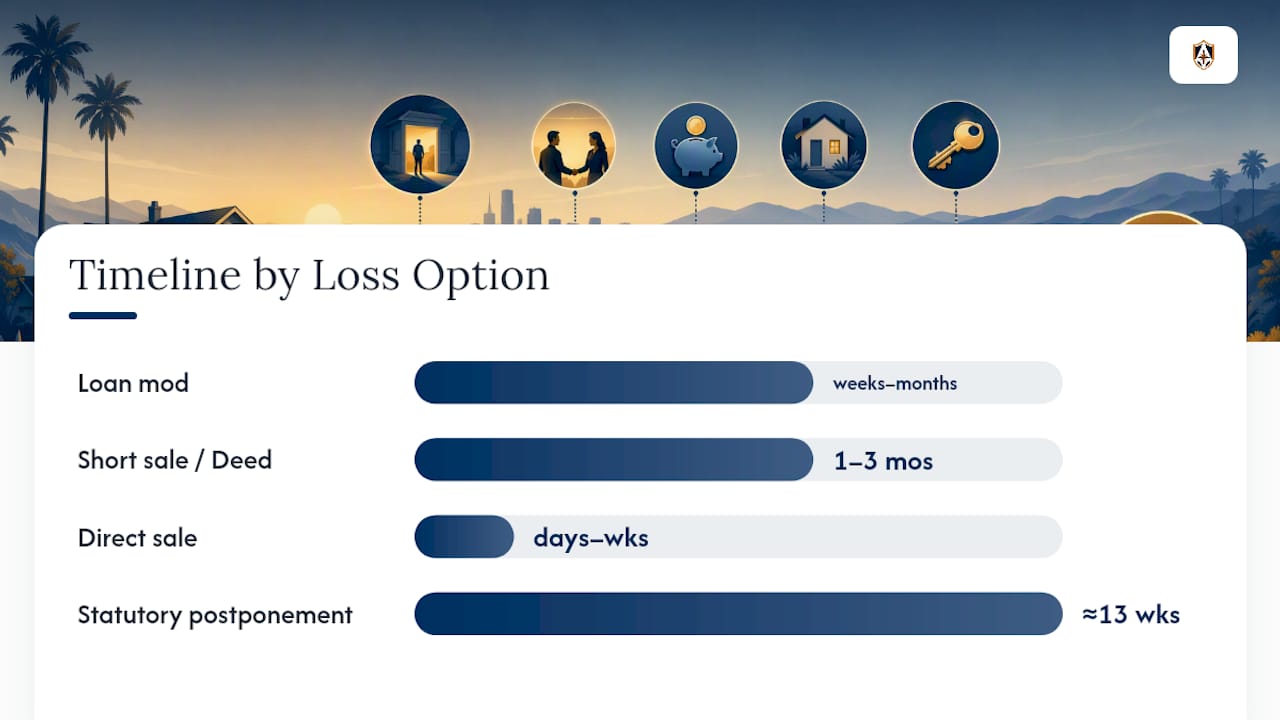
Loan modification or forbearance adjusts your payment terms or pauses payments temporarily. Processing typically takes several weeks to a few months, and a complete application submitted before an NOD is recorded gives you the most breathing room.
Short sale or deed in lieu of foreclosure both require lender approval and typically take one to three months to finalize, depending on how quickly your lender responds and whether a second lien holder needs to sign off too.
Selling the home outright before foreclosure is often the fastest lever available once an NOD is already recorded. Delivering a signed listing agreement from a licensed broker at least five business days before a scheduled sale can trigger a one-time 45-day postponement, and a signed purchase agreement delivered the same way can potentially add a second 45 days.
- Loan modification: weeks to months, best started before NOD.
- Short sale or deed in lieu: one to three months, lender dependent.
- Direct sale: can move in days to weeks with a cash buyer, and can unlock statutory postponements.
Pro Tip: If your home needs work before it can list, a quick, targeted cleanup, like a pre-listing house wash or a thorough pre-listing cleaning, can be the difference between a buyer walking or making an offer fast enough to matter.
For homeowners weighing these paths, our complete guide to home selling options breaks down how a direct sale, a managed listing, and an agent referral each fit different timelines and equity positions.
How AAS Home Buyers Helps Homeowners Facing Foreclosure
When the calendar is working against you, selling before the trustee’s sale often preserves more of your equity than waiting for the process to run its course. There are services that offer direct cash purchases, retail buyer programs with managed listing and marketing, and referrals to vetted local agents, giving homeowners facing foreclosure multiple options instead of one forced outcome.
A signed purchase agreement or listing agreement can also trigger the statutory postponement rights described earlier, which is exactly the kind of situation where moving quickly toward a sale does double duty: it buys legal time while working toward a closing. Our guide on selling your house before foreclosure walks through that process step by step, and our process page explains how AAS evaluates a property and structures an offer with transparent, data-driven pricing.
What We’d Tell a Family Member Facing This
If a payment gets missed, the first 72 hours matter most: call the servicer, ask about loss mitigation, and book a session with a HUD-approved counselor before anything gets recorded. After an NOD lands, that urgency doubles, since the reinstatement clock is now running. Homeowners who reach out early consistently have more options than those who wait for the next letter to decide for them. You have more paths available than the mail from your servicer suggests.
— AAS
Sell Before the Sale Date and Keep Your Equity
Waiting for a modification decision or a court date isn’t the only way to protect what you’ve built in your home. Some companies provide California homeowners facing foreclosure with faster alternatives such as direct cash offers that potentially close in days rather than months, without requiring repairs, showings, or financing delays typical of traditional listings.

A completed sale before your trustee’s sale date stops the foreclosure outright and lets you walk away with your equity instead of losing it to fees and a forced auction. Our guide on how to sell your house before foreclosure explains the specific steps, and our transparent three-step process shows exactly how AAS evaluates your home and structures an offer with no hidden fees. If you’re not sure which path fits your timeline, request a no-obligation valuation today and get real numbers before your reinstatement window closes.
Sources
- CFPB: How long will it take before I’ll face foreclosure if I can’t make my mortgage payments?
- Your rights in a nonjudicial foreclosure — California Courts Self-Help
- A Homeowner’s Guide to Foreclosure in California — DRE
FAQ
What Is the 120-Day Rule for Foreclosure?
Federal mortgage servicing rules generally prevent a servicer from starting formal foreclosure until a borrower is more than 120 days past due, giving homeowners a window to pursue loss mitigation before an NOD can be recorded.
How Far Behind on a Mortgage Before Foreclosure Starts in California?
Most servicers wait until you’re more than 120 days delinquent before recording a Notice of Default, though your specific servicer’s internal timeline can vary within that federal floor.
How Long Can I Stay in My House During Foreclosure?
It depends on how far the process has run. Between the 120-day pre-foreclosure window, the 90-day reinstatement period after an NOD, and the minimum 20-day posting before sale, many California homeowners have several months before a trustee’s sale, and possession typically continues until an eviction process begins afterward.
Who Gets Paid First After a Foreclosure Sale?
Sale proceeds go first to the foreclosing lender’s outstanding balance and costs, then to any junior lienholders in order of priority, with any remaining surplus going to the former homeowner.
Can I Sell My House During the Foreclosure Process?
Yes, and doing so can also trigger a statutory postponement of the sale date. Delivering a signed listing or purchase agreement at least five business days before the scheduled sale can add up to 45 additional days, giving you room to close a sale like the ones AAS Home Buyers arranges before the auction happens.