
Avoid a 10% Loss: How Cash Offers Work for Sellers
A cash offer is an all-cash purchase offer made without mortgage financing, which speeds up closing and reduces the risk of a sale falling through due to lender delays. Roughly 28 to 30% of home sales in the United States now involve cash buyers, according to market surveys, and sellers who accept one often trade a lower sale price for a faster, more certain closing.
TL;DR:
- Cash offers typically come in about 10% below the price of financed offers, especially in markets with fewer competing bids or distressed properties.
- Waived contingencies in cash deals, such as inspections and appraisals, increase speed and certainty but also shift risk onto sellers or buyers.
- Verifying proof of funds through independent sources is essential to prevent scams and ensure the legitimacy of a cash buyer.
- Cash sales usually close within 7 to 21 days due to the absence of lender delays, but legal protections like title insurance and escrow still apply.
- Accepting a cash offer makes sense mainly for sellers needing quick, certain closings, particularly in foreclosure, relocation, or inherited property situations.
Table of Contents
- What a cash offer is and the different forms it takes
- Step-by-step process: from offer to closing in a cash sale
- Why sellers favor cash offers and when to accept one
- Buyer perspective: advantages and trade-offs of paying cash
- How much lower cash offers typically are
- How sellers verify funds and spot scams or weak buyers
- Typical closing timeline and which settlement costs still apply
- Practical checklist and negotiation levers for sellers
- AAS perspective: how we protect sellers and what we recommend
- How AAS Home Buyers can help you sell with confidence
- Primary sources used
- Sources
- FAQ
What a cash offer is and the different forms it takes
Not every cash offer looks the same, and knowing who is behind it helps you understand what you’re actually being handed.
An individual all-cash buyer is someone purchasing a primary residence or second home without a loan, often a downsizing retiree or a relocating professional. An investor buying with cash usually plans to rent or resell the property, and may move faster but negotiate harder on price. An iBuyer is a company that purchases homes directly using an automated valuation model, often closing in days but at a valuation set by its own algorithm. An assignment-of-contract buyer signs a purchase agreement intending to sell that contract to another buyer before closing, which introduces a middleman you may never meet at the closing table.
These buyer types differ in which contingencies they keep or waive:
- Inspection contingency: Many cash buyers waive it entirely or shorten it to a few days, though a careful buyer will still inspect.
- Financing contingency: Removed by definition, since there’s no lender to satisfy.
- Appraisal contingency: Almost always waived, since no mortgage lender requires a valuation.
- Title contingency: Rarely waived. Even cash buyers expect clear, insurable title.
- Assignment clause: Present in many investor contracts, allowing the buyer to transfer the deal to a third party before closing.
Recognizing which of these apply to your offer tells you how much protection you’re actually giving up, and where risk might resurface later.
Step-by-step process: from offer to closing in a cash sale
A cash sale follows the same legal skeleton as a financed one, just with fewer parties and less waiting.
- Offer and contract: The buyer submits a purchase agreement stating the price, earnest money amount, closing date, and any contingencies that remain.
- Earnest money and escrow: The buyer deposits earnest money, typically 1% to 3% of the price, with a neutral third party such as a title or escrow company.
- Proof of funds verification: The seller or their agent requests a bank statement, brokerage statement, or letter from the buyer’s financial institution confirming available funds.
- Due diligence: The buyer conducts a title search and, if they choose, a home inspection. An appraisal is optional since no lender requires one.
- Settlement: The title or escrow company clears title, prepares closing documents, disburses funds according to the contract, and records the deed with the county.
The settlement agent, whether a title company, escrow company, or closing attorney, coordinates the paperwork and fund transfers regardless of whether financing is involved. That role doesn’t disappear in a cash deal, it just has less to reconcile.
Waived contingencies are what make cash closings fast, but they also shift risk onto whichever party gave up its protection. A seller who waives an inspection contingency accepts the home’s condition as found. A buyer who skips an appraisal accepts the price they offered, even if the home later proves to be worth less.
Pro Tip: Ask for proof of funds before you sign anything, not after. A buyer unwilling to provide it before the contract stage is unlikely to provide it after.
Why sellers favor cash offers and when to accept one
Sellers gravitate toward cash offers because they remove the two things most likely to derail a closing: a lender’s underwriting decision and a low appraisal. Cash offers close faster and are less likely to fall through since there’s no loan approval process standing between contract and settlement.
- Speed: Cash deals often close in one to three weeks instead of the month or more a mortgage typically requires.
- Certainty: No financing contingency means no risk of the deal collapsing because a lender denies the loan.
- As-is sales: Many cash buyers accept the property in its current condition, sparing the seller repair negotiations.
- Fewer moving parts: Without a lender in the mix, there’s one less party who can delay or derail the transaction.
Certain situations make these advantages worth more than they’d otherwise be. A seller facing foreclosure often cannot afford a 45-day closing window. Someone relocating for a new job or managing an inherited property may value a fast, hands-off sale over squeezing out the highest possible price. In those cases, certainty becomes the more valuable currency.
Buyer perspective: advantages and trade-offs of paying cash
Paying cash gives a buyer real leverage, along with real risk that a financed buyer doesn’t carry—making it helpful to use a hard money loan calculator to understand financing cost alternatives.
- No mortgage interest: Cash buyers avoid decades of interest payments, which changes the total cost of ownership significantly.
- Stronger negotiating position: Sellers often favor cash offers even when they’re not the highest bid, because certainty has value.
- Faster path to ownership: Without underwriting, a cash buyer can often close within two to three weeks.
- Liquidity trade-off: Tying up a large sum in one asset means less cash available for other needs or opportunities.
- Appraisal risk: Without a lender requiring a valuation, a cash buyer has no independent check on whether the price matches the home’s market value.
The appraisal gap is the trade-off buyers underestimate most. A financed buyer gets an outside opinion of value built into the process for free. A cash buyer who skips that step is relying entirely on their own judgment, or their agent’s, to avoid overpaying.
Pro Tip: Even without a lender requiring one, consider paying for an independent appraisal or a thorough inspection before closing. It’s a small cost against a large purchase, and structuring an appraisal gap clause can cap your downside if you’re bidding above list price.
How much lower cash offers typically are
Cash offers usually come in below what a financed buyer would pay for the same property, and the gap is bigger than most sellers expect.
A study out of UC San Diego found that all-cash buyers pay about 10% less on average than buyers using a mortgage, though the size of that discount varies by market and property condition. That figure represents an average across many transactions, not a fixed rule for every deal.
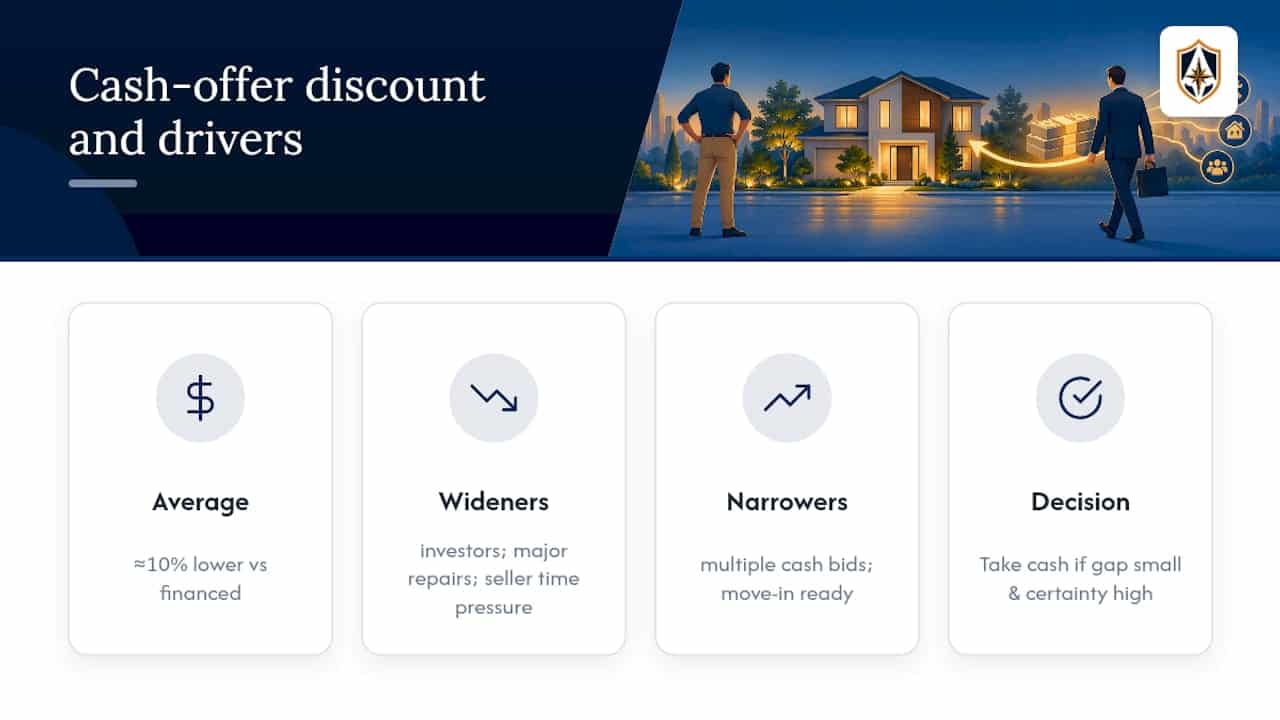
The discount tends to widen when the buyer is an investor rather than an individual, when the property needs significant repairs, or when the seller is under time pressure and has fewer competing offers. It tends to narrow in competitive markets where multiple cash buyers are bidding against each other, or when the home is in strong, move-in ready condition.
The decision framework is straightforward: if the price gap is small and the certainty is high, take the cash offer. If the gap is large and you can tolerate a longer closing, waiting for a financed offer at a higher price may net you more, provided that buyer’s loan actually closes.
How sellers verify funds and spot scams or weak buyers
Verifying a cash buyer’s funds is not optional, and it’s the single step most likely to save a seller from a wasted month.
- Valid proof of funds: A recent bank or brokerage statement, or a signed letter from the financial institution, showing funds available and roughly matching the offer amount.
- Confirm it independently: Call the bank or ask the escrow company to verify the document rather than taking it at face value.
- Watch for assignment clauses: A contract that lets the buyer transfer it to someone else before closing can mean the person you negotiated with isn’t the person who shows up at settlement.
- Be wary of pressure to skip escrow: A legitimate buyer has no reason to avoid placing earnest money with a neutral third party.
- Unverifiable documents are a red flag: Screenshots, unofficial letterhead, or funds held overseas with no clear transfer path all warrant extra scrutiny.
Involve a title company, escrow agent, or real estate attorney early, and require that earnest money sit in a proper escrow account rather than going directly to the buyer or seller. Reviewing a scam-spotting checklist before signing anything adds a useful second layer of caution.
Typical closing timeline and which settlement costs still apply
Cash sales typically close in 7 to 21 days, compared with 30 to 60 days for a financed purchase, since there’s no loan underwriting or lender-ordered appraisal to wait on.
- Title insurance: Still required in a cash sale to protect against ownership disputes or liens that surface after closing.
- Recording fees: The county charges a fee to record the new deed regardless of how the purchase was financed.
- Escrow and settlement fees: The title or escrow company charges for coordinating the closing, whether or not a lender is involved.
- Prorated property taxes and HOA dues: These are settled at closing in cash and financed sales alike.
Speed comes from removing lender-related steps, not from skipping legal protections. Title searches, escrow handling, and deed recording still happen in every cash sale.
One area sellers can influence directly is cost. The Consumer Financial Protection Bureau notes that shopping for title insurance and closing services can lead to real savings, since title services are often the largest line item in closing costs. A breakdown of what sellers still pay in a cash transaction is worth reviewing before you sign.
Practical checklist and negotiation levers for sellers
Before accepting any cash offer, run through a short checklist that catches most of the problems that derail these deals.
- Verify proof of funds independently through the bank or escrow company.
- Confirm the escrow holder is a licensed, neutral title or escrow company.
- Check the earnest money amount and whether it’s refundable under any remaining contingencies.
- Review remaining contingencies, including inspection and title.
- Confirm the closing date and whether it’s realistic given title and document timelines.
- Check for an assignment clause that would let the buyer transfer the contract.
- Review title status for existing liens, especially on inherited or reverse mortgage properties.
Negotiation levers worth using include a rent-back agreement if you need extra time to move, a larger and non-refundable earnest deposit to signal buyer commitment, and a short but real inspection window rather than none at all. Avoid signing any contract with an unexplained assignment clause or a buyer unwilling to escrow funds. Reviewing non-contingent offer trade-offs before you waive protections helps you document exactly what you’re giving up and why.
Pro Tip: Put every negotiated protection in writing inside the contract itself. A verbal promise about a rent-back period or an inspection allowance means nothing at closing if it isn’t on the page.
AAS perspective: how we protect sellers and what we recommend
We built AAS Home Buyers around the idea that a cash sale shouldn’t mean giving up transparency. We offer homeowners multiple paths, including a direct purchase, a connection to vetted investment partners, or our Retail Buyer Program, rather than pushing a single option regardless of fit.
Every valuation we provide is data-driven, and we charge no hidden fees. We emphasize escrowed earnest funds, clear timelines communicated up front, and straightforward answers to the verification questions this article covers. A seller comparing offers should ask the same questions of any buyer, not just of us.
— AAS
How AAS Home Buyers can help you sell with confidence

If you’ve decided a cash sale fits your situation, we offer more than one way to get there. Unlike a single flat cash bid, we give you options built around your specific property and timeline, without pushing you toward whichever route pays us the most.
- Direct Purchase by AAS Home Buyers: We buy your home directly, with a transparent, data-driven valuation and no hidden fees.
- Purchase by Vetted Investment Partners: When our direct offer isn’t the strongest fit, we connect you with investment partners we’ve screened ourselves.
- Retail Buyer Program: For sellers who want to list on the open market, we manage the listing and marketing to help you reach retail buyers.
- Realtor Referral Program: For sellers who’d rather work with a traditional agent, we connect you with a vetted local professional.
To get started, request a no-obligation quote and have basic documents ready: a copy of your deed, your most recent mortgage statement if applicable, and any details on liens or tenant occupancy. Visit our transparent home selling process to see exactly how each option works before you commit to one.
Primary sources used
The Consumer Financial Protection Bureau’s guidance on shopping for closing services supports the closing cost and title insurance claims. The UC San Diego study on cash buyer pricing supports the 10% discount figure, and market survey data on cash sale share adds broader context on how common these transactions are.
FAQ
How does a cash offer work?
A cash offer is a purchase agreement where the buyer pays the full price without a mortgage, which removes the lender approval step from the transaction. The buyer still places earnest money in escrow, verifies funds, and goes through title search and closing, just on a faster timeline.
What happens after a cash offer is accepted?
After acceptance, the buyer deposits earnest money into escrow and provides proof of funds if they haven’t already. The title company then runs a title search, the buyer may conduct an inspection, and the deal moves to settlement where the deed is recorded and funds are disbursed.
Is it better to accept a cash offer?
It depends on how much you value speed and certainty versus maximum price. A cash offer often makes sense when you need to close quickly, want to avoid repair negotiations, or are facing a time-sensitive situation like foreclosure, while a financed offer may net more money if you can afford to wait.
How much lower are cash offers?
Research from a UC San Diego study found that all-cash buyers pay about 10% less on average than mortgage-financed buyers, though the actual gap varies by market, property condition, and buyer type. Sellers under time pressure or with fewer competing offers tend to see larger discounts.