
Sell a House With Mold: 3 Seller Paths Backed by EPA
Yes, you can sell a house with mold, but you must disclose what you know about it. Sellers generally choose one of three paths: remediate the mold and list at full market value, disclose the problem and sell as-is with a price credit, or sell directly to a cash buyer who accepts the property as-is. Your equity, timeline, and the mold’s location usually decide which path fits.
TL;DR:
- Remediating small mold spots usually offers the best return, especially when repair costs are lower than the expected increase in sale price.
- Selling as-is or through a cash buyer is more realistic for extensive mold in HVAC systems or when moisture sources are structural or ongoing.
- Proper documentation including remediation reports, invoices, and clearance testing is crucial to comply with disclosure laws and defend against legal claims.
- FHA and VA loans frequently require mold removal before approval, making cash or as-is sales more common in these cases.
- The cost of mold remediation varies from a few hundred dollars for small spots to thousands for extensive contamination, depending on location and materials involved.
Table of Contents
- How to Sell a House With Mold: Three Paths That Work
- What Does Mold Remediation Cost, and How Long Does It Take?
- Do You Have to Disclose Mold When Selling a House?
- Will Mold Affect Your Financing Options as a Buyer?
- What Inspections and Documentation Should You Gather?
- How to Decide Which Path Fits Your Situation
- What AAS Home Buyers Sees When Sellers Call About Mold
- Get a Straight Answer on What Your Mold-Affected Home Is Worth
- Where to Verify This Guidance
- Sources
- FAQ
How to Sell a House With Mold: Three Paths That Work
The right path depends on how much cash you have on hand, how fast you need to close, and how visible the mold actually is to a buyer’s inspector. Every path listed below is legal and common. What separates them is risk tolerance and patience.
Path 1: Remediate, then list on the open market. You hire a remediation company, get clearance documentation, and sell through a real estate agent at or near market value. This works best when the mold is contained to one area and your equity can absorb the repair cost upfront.
- Pros: Maximizes sale price, opens the buyer pool to FHA and VA borrowers, avoids disclosure disputes after closing.
- Cons: Requires cash or a loan before you sell, can delay listing by two to six weeks, and hidden moisture problems sometimes surface mid-repair and add cost.
Path 2: Disclose and sell as-is, with a credit or price reduction. You list the home honestly, note the mold on your disclosure form, and either lower the asking price or offer a closing credit so the buyer can remediate after purchase.
- Pros: No upfront repair cost, faster to market than full remediation.
- Cons: Shrinks your buyer pool since many conventional and government-backed loans won’t close on a home with visible mold, and buyers often negotiate harder than the credit amount actually costs to fix.
Path 3: Sell to a cash buyer or investor. You skip repairs and listing prep entirely and sell directly, often to a company that buys homes in current condition, closing in one to three weeks.
- Pros: No remediation cost, no financing contingency risk, fastest close of the three paths.
- Cons: Offers reflect the property’s condition and typically land below full retail value.
A small bathroom ceiling spot points you toward remediation, since the fix is cheap relative to the value it protects. Mold running through HVAC ducts or found after chronic water intrusion, on the other hand, often makes the as-is or cash sale route the more realistic choice.
What Does Mold Remediation Cost, and How Long Does It Take?
Remediation cost and mold visibility drive nearly every decision in this process, so it helps to know the ranges before you commit to a path.
By the numbers: The EPA draws the line for do-it-yourself cleanup at roughly 10 square feet or less. Anything larger, or any mold inside HVAC systems, generally calls for a professional remediation crew.
Costs scale with square footage, location, and whether contaminated materials need to be replaced rather than cleaned.
- Small isolated spot (under 10 square feet, one wall or ceiling section): often a few hundred dollars if handled by a professional, less if you do it yourself following EPA protocol.
- Single room with drywall or flooring removal: costs climb once contractors have to cut out and replace materials, not just wipe surfaces.
- HVAC or duct contamination: among the more expensive scenarios, since ductwork often has to be cleaned or replaced throughout the system.
- Whole-house or black mold cases: the highest tier, driven by extensive material replacement, containment barriers, and required post-remediation testing.
The biggest cost driver usually isn’t the visible mold itself. It’s the moisture source behind it. A leaking pipe, failed grading, or a roof problem has to be fixed or the mold returns within months, which is why EPA guidance treats moisture control as the real job, not just surface cleaning. Timelines typically run one to two weeks for a contained job, but clearance testing to confirm the space is safe can add several more days to a couple of weeks depending on lab turnaround.
Remediation tends to pay off when the mold is localized and your projected sale price increase covers the repair cost with room to spare. It stops making financial sense when the moisture source is structural, ongoing, or tied to a foundation issue, since you’d be fixing the same problem repeatedly. In that scenario, homeowners dealing with related structural water damage often look at selling with foundation problems guidance for a comparable as-is strategy.
Do You Have to Disclose Mold When Selling a House?
Yes. Nearly every state treats known mold and its underlying moisture cause as a material defect that must appear on your seller disclosure form. The general legal principle is straightforward: if you know about it, you disclose it. What varies by state is the exact form language and how mold-specific the disclosure questions are.
Some states, including Wisconsin and California, ask about mold directly on the standard disclosure form. Others fold it into broader questions about water damage, roof leaks, or plumbing issues. Either way, vague language doesn’t protect you. Writing “some cosmetic staining” when you know it’s active mold growth is the kind of omission that leads to lawsuits after closing.
Common disclosure mistakes that create legal exposure:
- Checking “no” on a mold question because the visible mold was cleaned, without mentioning that it happened or what caused it.
- Failing to disclose a past leak or flood even though the mold from it was remediated years ago.
- Relying on a verbal disclosure to the buyer’s agent instead of putting it in writing on the form.
- Assuming a previous remediation report absolves you of mentioning the original problem.
Nondisclosure claims typically allege fraud, negligent misrepresentation, or breach of contract, and courts often side with buyers when there’s evidence the seller knew and didn’t say. Documentation is your best protection here: inspection reports, remediation invoices, and clearance certificates all show good faith and a clear paper trail. If your situation involves a past insurance claim, a contested inspection finding, or uncertainty about what your state’s form actually requires, a real estate attorney familiar with your state’s disclosure law is worth the consultation fee before you list.
Will Mold Affect Your Financing Options as a Buyer?
Your buyer’s financing type often determines whether mold kills the deal or just adjusts the price. Government-backed loans and cash offers sit at opposite ends of the flexibility spectrum, and knowing where your likely buyer falls changes how you should market the home.
- FHA and VA loans generally require the home to meet minimum property standards, and HUD guidance makes clear that visible mold is frequently a dealbreaker until it’s remediated. An FHA appraiser who spots mold during the inspection can halt the loan entirely.
- Conventional loans give appraisers and underwriters more discretion, but a mold finding still often triggers a lower appraised value or a lender-required repair before closing.
- Cash buyers and investors don’t answer to an underwriter, so mold rarely stops the deal. Their offers reflect the repair cost baked into the price instead.
This split explains why FHA and VA financing constraints push so many mold-affected listings toward cash buyers by default rather than by seller preference. If you’re marketing an as-is sale, focus outreach on investor networks and cash-buyer platforms rather than the retail buyer pool, since retail buyers relying on FHA or VA financing are the most likely to walk after inspection.
What Inspections and Documentation Should You Gather?
Buyers and lenders trust paper, not promises. Before you list or accept an offer, put together documentation that proves what you found and what you did about it.

Start with the scope of the problem itself. The EPA says a homeowner can typically handle cleanup for patches under 10 square feet without a contractor. Anything larger, or mold inside ductwork or wall cavities, calls for an IICRC-certified remediation professional whose report will carry weight with buyers in a way a DIY job never will.
Testing is where sellers often waste money. The EPA and CDC both advise against routine lab testing for visible mold; it doesn’t change your cleanup approach or your disclosure obligation. Testing earns its cost in two situations: confirming hidden contamination behind walls, or verifying clearance after professional remediation is complete.
- Get a written remediation report that states the affected square footage, the moisture source identified and fixed, and the materials removed or treated.
- Collect all receipts and invoices from the remediation contractor, including any HVAC cleaning if ducts were involved.
- Request post-remediation clearance testing if the job was large enough to warrant it, and keep the lab results with the file.
- Assemble everything into one packet you can hand to a buyer’s agent or attach to your disclosure form.
Pro Tip: Photograph the affected area before and after remediation, even if your contractor already does this. Buyers respond better to a seller who can show the problem and the fix than to one who just says it was handled.
How to Decide Which Path Fits Your Situation
Run through this checklist before you commit to a direction:
- Compare your remediation estimate to the expected price discount. If a $1,500 fix protects $15,000 in sale value, remediate. If the fix costs more than the discount a buyer would demand, sell as-is.
- Check your financing-driven buyer pool. If you expect FHA or VA buyers, remediation is close to mandatory. If you expect cash offers, it’s optional.
- Weigh your timeline against remediation duration. A one to two week fix is manageable if you’re not in a rush; a foreclosure deadline or job relocation usually isn’t.
Three scenarios illustrate how this plays out. A homeowner with a small bathroom ceiling spot under 10 square feet and no financing pressure should remediate and list, since the cost is low and the payoff in buyer pool and price is high. A seller who discovers mold in the crawlspace and HVAC system, with an unclear moisture source, is usually better served disclosing and selling as-is or pursuing a cash sale, since chasing the source could take months. A seller who finds visible black mold near the HVAC intake, tied to a known roof leak, faces the highest risk profile and should treat a documented cash sale or investor purchase as the safer route rather than gambling on a retail buyer’s inspection.
If you do list on the open market, negotiation tools like a seller credit, an escrowed repair holdback, or a remediation contingency written into the contract can keep a deal alive without forcing you to finish the work before closing. When the facts get complicated, whether it’s insurance history, a contested inspection, or a buyer threatening to walk, bringing in an attorney or an experienced agent protects your closing far more cheaply than losing the sale outright.
What AAS Home Buyers Sees When Sellers Call About Mold
Most sellers who contact AAS Home Buyers about a mold issue aren’t looking for a lecture on remediation math. They want a straight answer about what their home is worth right now, in its current condition, and how fast they can close. That’s the conversation we’re built for.
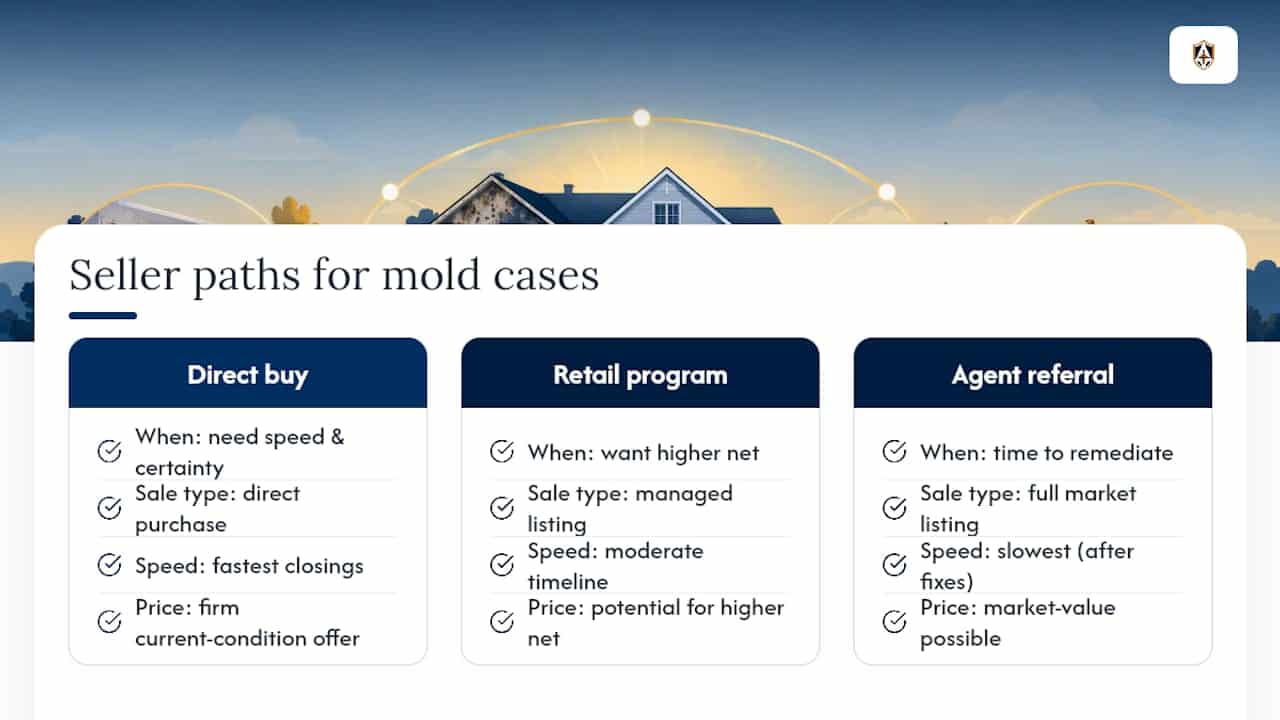
We offer three paths depending on what a seller actually needs: a direct purchase when speed and certainty matter most, a Retail Buyer Program when a managed listing could net more even with the mold disclosed, and a vetted agent referral when a seller wants full market exposure and has time to remediate first. None of these require you to guess which one fits. That’s what the valuation conversation is for.
For that first conversation, bring what you have: photos of the affected area, any remediation reports or receipts, and your honest recollection of when you first noticed it. We don’t need a polished case, just the facts, and we’ll walk you through pricing that reflects the property as it stands.
— AAS
Get a Straight Answer on What Your Mold-Affected Home Is Worth
If you’ve read this far, you already know remediation isn’t always worth the money or the wait. That gap is filled by companies offering a direct offer on your home as it sits today, with no repair list, no contractor bids, and no renegotiation after an FHA appraiser walks through and flags the same mold you already disclosed.

Reach out and we’ll walk the direct purchase process with you step by step. Expect a straightforward valuation based on your home’s actual condition, a request for whatever documentation you already have (photos, remediation invoices, disclosure notes), and a closing timeline measured in days rather than months. If you’d rather keep your options open, our Retail Buyer Program and agent referral network sit right alongside the direct-purchase path, so you’re never locked into one route before you know what your numbers look like. There are no upfront fees to find out. Start by requesting a no-obligation valuation and see which path actually makes sense for your equity and your timeline.
Where to Verify This Guidance
For the regulatory and health details behind this guide, go straight to the source. The EPA’s mold cleanup guidance and testing recommendations cover cleanup thresholds and when lab testing is worth the cost. The CDC’s mold and health overview explains documented health effects, and HUD’s housing guidance details how condition issues intersect with FHA and VA underwriting. For remediation standards and certified contractors, the IICRC is the industry reference point.
This article is general information, not a substitute for advice from a qualified lawyer. Consult a qualified legal professional about your own circumstances before acting on anything here.
Sources
FAQ
Can You Be Sued if You Sell a House With Mold?
Yes, if you knew about the mold and didn’t disclose it on your state’s seller disclosure form. Buyers can pursue claims for fraud or misrepresentation, and courts often favor buyers when documentation shows the seller had knowledge before closing.
Does a Realtor Have to Disclose if a House Has Mold?
A real estate agent generally has to disclose known material defects, including mold, once the seller has informed them or it’s otherwise apparent. Agents who knowingly withhold this information can face liability alongside the seller.
Does Mold Devalue a House?
Yes, visible or documented mold typically lowers appraised value and shrinks the buyer pool, particularly for FHA and VA financed purchases where HUD guidance often requires remediation before closing. The size of the discount depends on the mold’s extent and whether the moisture source has been fixed.
Do You Have to Disclose Mold Remediation When Selling a House?
Yes, even after successful remediation, most states require you to disclose that mold was previously present and was addressed. Buyers and their agents typically want to see the remediation report and any clearance testing as part of that disclosure.
Is It Better to Remediate Mold or Sell As-Is?
It depends on your equity, timeline, and the mold’s location. Small, contained mold problems usually justify remediation before listing, while extensive HVAC or structural contamination often makes an as-is sale or direct cash sale the more practical choice.