
Old Roof? Get a Written Inspection First and 3 Selling Paths
Yes, you can sell a house with an old roof. The condition of that roof determines which buyers, loans, and insurance policies stay on the table. Before you list, get a licensed roofer’s written inspection and a statement of remaining life. That single document shapes every decision that follows, from pricing to how you market the home.
TL;DR:
- Replacing an old roof before listing can attract full-risk FHA or VA financing, but typically recoups only 60 to 70 percent of the cost in sale price.
- Offering a certification or limited repairs allows buyers to secure financing without full replacement, reducing renegotiation risks during escrow.
- Selling as-is to cash buyers results in offers 15 to 30 percent below market value but guarantees a faster closing process with fewer contingencies.
- Using escrow holdbacks or 203(k) rehab loans can keep financed buyers engaged without immediate roof replacements, depending on lender requirements.
- Conducting a pre-listing roof inspection and obtaining documented condition reports help sellers control negotiations and prevent surprises during escrow.
Table of Contents
- Why Roof Condition Matters for Financing and Buyer Interest
- How Do You Know the Real Condition of Your Roof?
- What Are Your Realistic Options for Selling With an Old Roof?
- A Simple Checklist for Choosing Your Path
- Working With Agents, Contractors, and Lenders Without Losing Your Deal
- When a Direct Sale Actually Makes Sense
- How AAS Home Buyers Gives You More Than One Way Out
- Sources
- FAQ
Why Roof Condition Matters for Financing and Buyer Interest
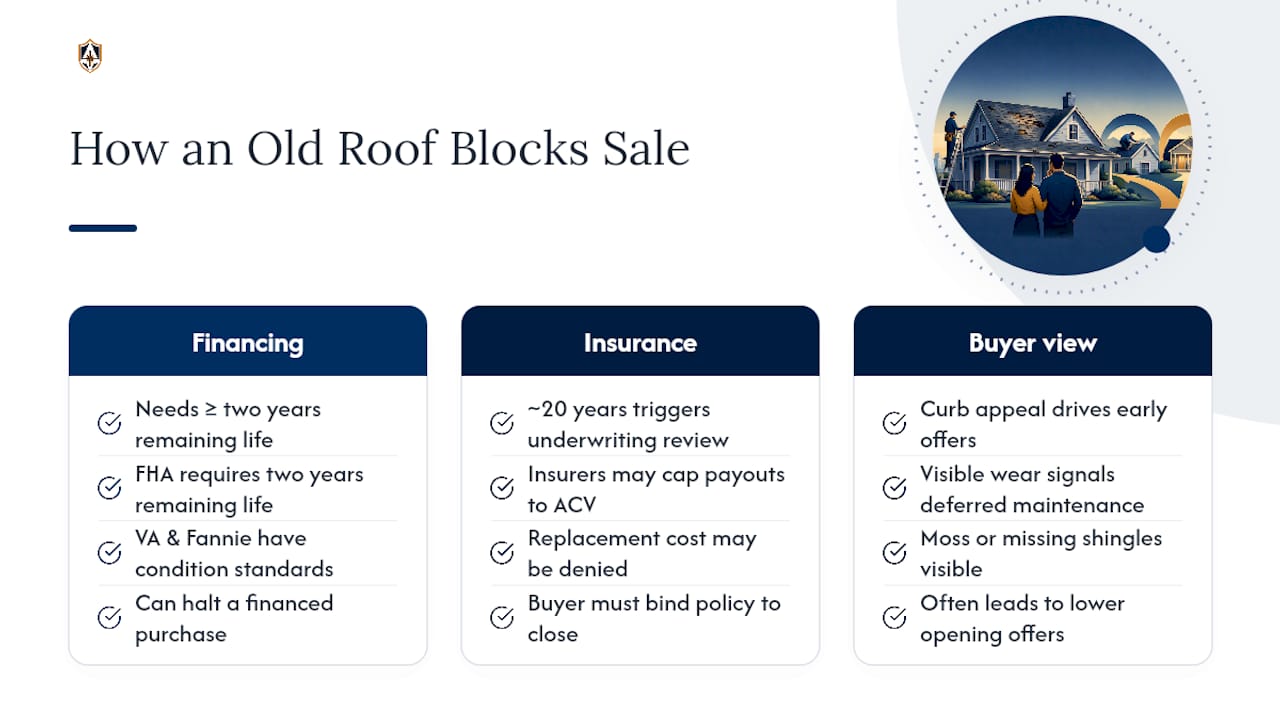
A roof nearing the end of its life can stall a sale long before you get to the closing table. FHA appraisals require at least two years of remaining roof life, and VA and Fannie Mae loans carry their own condition standards that can halt a financed purchase outright.
Insurance adds another layer. Once a roof passes roughly 20 years old, insurers often trigger underwriting reviews and may cap payouts at actual cash value instead of full replacement cost. A buyer who cannot bind a policy cannot close, no matter how much they love the house.
Then there’s the simple matter of first impressions. Curb appeal drives offers before a buyer ever steps inside, and a roof with visible wear, moss, or missing shingles signals deferred maintenance elsewhere. That perception often shows up as a lower opening offer, even from buyers who would otherwise be enthusiastic.
How Do You Know the Real Condition of Your Roof?
Guessing costs money. Start with a licensed roofer, not a general home inspector, and request a written statement of remaining useful life or a formal roof certification. These documents become your negotiating tools and your proof of good faith with buyers.
While the roofer is up there, ask for a straightforward answer on these red flags:
- Active leaks or water stains on interior ceilings
- Sagging deck lines or soft spots underfoot
- Exposed or deteriorated underlayment
- Missing, curled, or cracked shingles
- Granule loss visible in gutters
If the inspection points toward replacement, get at least one fixed-price contractor quote before you list. A range is not enough. Buyers and their agents will ask for a number, and having one ready keeps you in control of the conversation instead of reacting to their contractor’s estimate. Research on pre-listing inspections shows that documented condition reports reduce renegotiation after an offer is accepted, which protects your net proceeds.
What Are Your Realistic Options for Selling With an Old Roof?
Once you know the roof’s actual condition, six practical paths open up. Each one trades speed, cost, and buyer pool differently.
- Replace before listing. This unlocks the full financed buyer pool and removes appraisal risk entirely, but a new roof typically returns only 60 to 70 cents on the dollar in added sale price. Replacement makes sense mainly when the roof would otherwise block FHA or VA financing or cause major appraisal issues.
- Get a certification and make limited repairs. A 3 to 5 year roof certification often satisfies lenders and buyers without the cost of full replacement, and a written certification tends to reduce renegotiation during escrow.
- Offer a seller credit. You disclose the roof’s age, price the home accordingly, and let the buyer apply a credit toward replacement after closing. This keeps financed buyers engaged without you managing a contractor.
- Use an escrow holdback. The lender releases part of the sale proceeds only after repairs are completed, but many lenders require the holdback to equal 120% of the repair estimate unless you have a fixed-price contract locked in.
- Sell as-is to a cash buyer. This skips appraisals and financing contingencies entirely. Expect an offer discount in the range of 15 to 30 percent below full market value for major defects, offset by speed and certainty.
- Point buyers toward a 203(k) rehab loan. Limited 203(k) loans allow up to $75,000 in repair costs to be rolled into the mortgage, which keeps financed buyers in play without you touching the roof at all.
Pro Tip: Run the math on net proceeds, not sale price. A cash offer that closes in ten days without repair costs or agent commissions sometimes beats a higher financed offer once you subtract what replacement and carrying costs would have taken.
A Simple Checklist for Choosing Your Path
Work through these questions in order. Each answer narrows your options.
- How soon do you need to close? If you’re facing foreclosure, a job relocation, or an inherited property you can’t maintain, speed usually outweighs squeezing out every dollar.
- Do you have cash on hand for repairs? If not, replacement is off the table regardless of ROI, and you’re choosing between credit, holdback, or as-is.
- What does your local buyer pool look like? Markets heavy with first-time buyers using FHA or VA loans need roofs that meet minimum standards. Investor-heavy markets tolerate more deferred maintenance.
- Run the heuristic: if replacement costs less than the appraisal gap or insurance barrier it removes, replace it. If the cost exceeds what you’d recover in price and speed, offer a credit or sell as-is instead.
- Is a pre-listing inspection worth it? Almost always yes. It costs a few hundred dollars and prevents a buyer’s inspector from finding a surprise that blows up your escrow at week three.
Working With Agents, Contractors, and Lenders Without Losing Your Deal
Before you list, compile a simple document packet: the roofer’s inspection report, any contractor quotes, permits for prior repairs, dated photos of problem areas, and notes from your insurance agent on coverage status.
When interviewing agents or contractors, ask direct questions:
- Does the roof work come with a written warranty, and how long does it last?
- What’s the realistic timeline if a buyer requests repairs mid-escrow?
- Which buyer pool does this listing likely attract given the roof’s age?
Structure any credit, holdback, or warranty directly in the purchase contract language, not as a verbal side agreement. Vague terms are where deals fall apart during final walkthroughs.
When a Direct Sale Actually Makes Sense
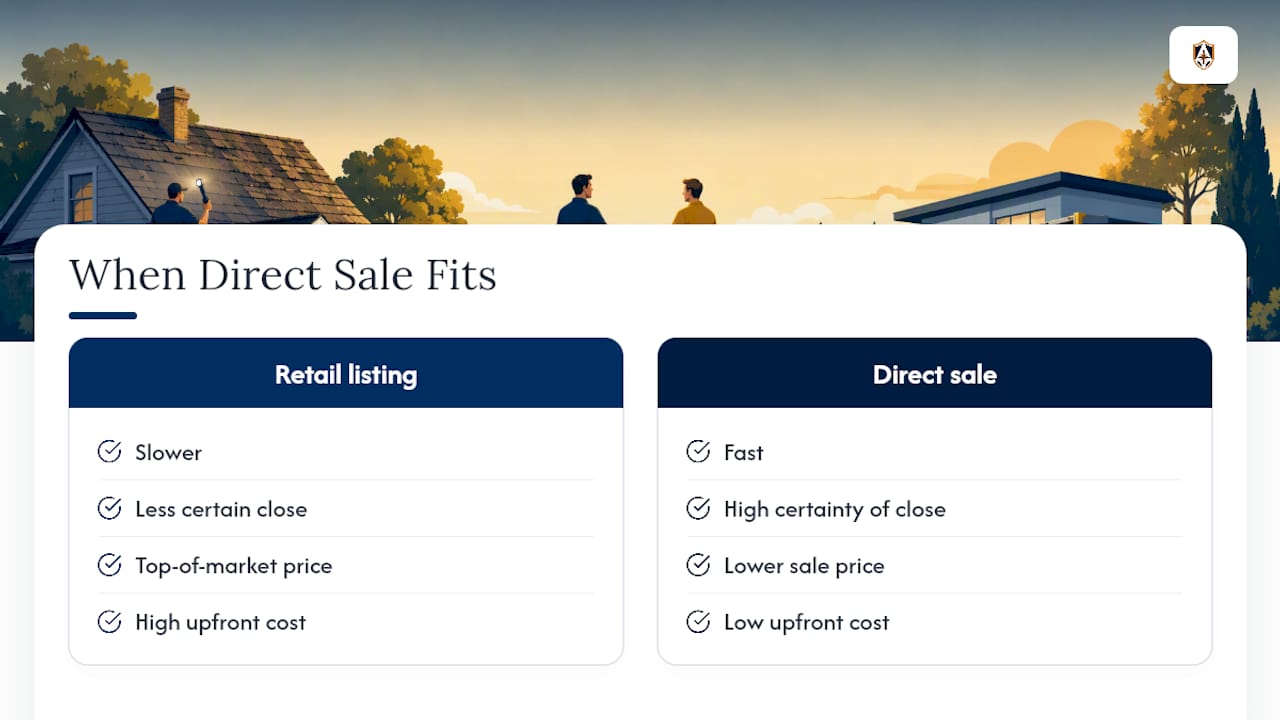
Not every seller has the cash, time, or appetite to manage a roof replacement mid-sale. If you’re weighing a full renovation against listing as-is, that same repair-versus-replace math shows up in other big-ticket decisions, like choosing between painting and replacing aging doors before a sale.
Speed and certainty come at a cost against top-of-market price, and that tradeoff is real, not a sales pitch. A seller facing foreclosure, a large inherited repair bill, or a tenant situation often values a guaranteed close date over an extra few thousand dollars. That’s why a buyer offering multiple paths, cash, a managed retail listing, or an agent referral, fits sellers whose timeline or repair budget rules out the traditional route.
— AAS
How AAS Home Buyers Gives You More Than One Way Out
Most sellers with an aging roof get boxed into two choices: spend money they don’t have or accept a lowball cash offer. AAS Home Buyers works differently by offering three distinct paths under one roof, so to speak, so you’re not stuck guessing which route fits your situation.

Whether your roof needs full replacement, a certification, or nothing more than an honest disclosure, AAS Home Buyers evaluates your property in its current condition and presents transparent, data-driven numbers for a direct cash purchase, a managed Retail Buyer Program listing, or a referral to a vetted local agent. There’s no pressure to pick the fastest option if top-dollar matters more to you, and no pressure to replace a roof you can’t afford to fix before closing. Review the transparent 3-step selling process to see exactly what happens from first contact to closing day, or start with a no-obligation property evaluation to see which path fits your timeline and budget.
Sources
Claims about FHA, VA, and Fannie Mae roof condition requirements, plus 203(k) rehab loan limits, come from LegalClarity’s overview of selling a house with a bad roof. Replacement ROI figures come from FastExpert’s analysis of pre-sale roof replacement, and as-is discount ranges come from Redfin’s roof replace-versus-sell comparison. Technical inspection standards reference USDA Rural Development’s roofing guidance.
- Can You Sell a House With a Bad Roof? Your Options – LegalClarity
- Should I replace my roof before selling? – FastExpert
- Should You Replace Your Roof or Sell As-Is? | Redfin
FAQ
Is It Hard to Sell a House With an Old Roof?
It’s harder than selling a home in good condition, but far from impossible. The main obstacles are lender appraisal rules and insurance underwriting, not buyer interest, so a written inspection and the right selling path usually solve most of the friction.
How Much Is a 20-Year-Old Roof Worth?
A 20-year-old roof typically carries little to no added value in an appraisal, since insurers often start closer scrutiny around that age and asphalt shingles usually near the end of their functional lifespan. The real number that matters is the cost to replace or certify it, not its original value.
Would You Buy a House With a 20-Year-Old Roof?
Many buyers will, provided the price reflects the roof’s remaining life and the seller discloses its condition honestly. Cash buyers and investors routinely purchase homes with aging roofs, while financed buyers often need a certification, credit, or 203(k) rehab loan to make the numbers work.
Are 100-Year-Old Houses Worth Buying?
A century-old house can be a solid purchase if its major systems, roof included, have documented maintenance history and recent inspections. Age alone isn’t the risk factor; undocumented repairs and deferred maintenance are what create real liability for buyers and sellers alike.
Can AAS Home Buyers Purchase a House With Roof Damage?
Yes. Some home buyers evaluate homes in any condition, including significant roof damage, offering options ranging from direct cash purchases to managed listings, so repairs are not always required before an offer.