
3 Ways to Sell a House With Code Violations and Avoid Lawsuits
You can usually sell a house with code violations, but the path you take determines your price, your buyer pool, and your legal exposure afterward. Sellers generally choose one of three routes: fix the violations before listing, sell as-is to a cash buyer or investor, or negotiate a price reduction or repair credit with a traditional buyer. Whichever route you choose, disclosing known violations upfront protects you from lawsuits and financial penalties after closing.
TL;DR:
- Fixing code violations before listing typically increases sale price and broadens the buyer pool but requires upfront costs and adds weeks or months to the timeline.
- Selling the home as-is to a cash buyer or investor offers the quickest closing but risks lower proceeds due to remediation costs being factored into their offer.
- Repairing violations can be essential if they involve safety issues like exposed wiring or active liens, which can block financing, title insurance, or both.
- Accurate documentation, including municipal records and contractor estimates, is crucial for transparency and to avoid delays at closing.
- Disclosing known violations upfront protects sellers legally and financially, especially since hidden issues often lead to post-sale lawsuits or penalties.
Table of Contents
- Comparing Your Options for a Code Violations House Sale
- How Do Code Violations Affect Financing and Title?
- Should You Fix It or Sell As-Is?
- Checklist: Preparing to Sell With Code Violations
- How AAS Home Buyers Handles Code Violation Properties
- Disclosure First, Strategy Second
- Get a Direct Path Forward From AAS Home Buyers
- Codes and Records Worth Checking
- Sources
- FAQ
Comparing Your Options for a Code Violations House Sale
Each path trades speed against proceeds, and the right one depends on how much cash and time you have.
Fixing violations before you list typically nets the highest sale price and opens your home to the widest buyer pool, including buyers using FHA or VA financing. The tradeoff is time. Pulling permits, scheduling inspections, and waiting for contractor availability can add weeks or months to your timeline, and you’re fronting repair costs before you see a dollar back.
Selling as-is to a cash buyer or investor is the fastest route and removes the repair burden entirely. Investors and cash buyers routinely purchase homes with violations, but they price in the remediation risk, meaning your offer reflects the cost and hassle of fixing the problem themselves. You give up some equity for speed and certainty.
Offering a price reduction or repair credit sits in the middle. You keep the traditional buyer pool while shifting repair responsibility to them at closing.
- Fix first: higher net proceeds, broader buyer pool, longer timeline, upfront cash needed
- Sell as-is: fastest close, lower proceeds, no repair work required from you
- Credit or price cut: moderate proceeds, but lender rules and escrow terms can complicate the deal
How Do Code Violations Affect Financing and Title?
Financing is often where a code violations house sale actually falls apart, not the negotiation table.
FHA and VA loans, along with many conventional mortgages, require the home to meet minimum property standards. If an appraiser flags an unpermitted addition, missing smoke detectors, or exposed wiring, the lender may require repairs before closing or reject the loan outright. Appraisers also tend to exclude unpermitted square footage from their valuation, which can shrink your buyer’s loan amount even if the space is livable and safe.
Title is the other choke point. Recorded code-enforcement liens typically must be paid at closing, and open violations can prevent a title company from issuing clean title insurance. That single detail eliminates a chunk of your buyer pool before you’ve even negotiated price.
- FHA/VA and renovation loans often require repairs or exclude unpermitted areas from valuation
- Recorded liens attach to the property and generally need resolution before closing
- Insurers may decline coverage or raise premiums on homes with unresolved electrical or structural violations
Electrical issues deserve extra attention. Overloaded circuits and unsafe DIY wiring are among the most common causes of violations flagged by lenders and insurers, and they’re rarely cheap to fix quietly. If your violation involves wiring, budget for a licensed electrician, not a patch job.
Should You Fix It or Sell As-Is?
Deciding whether to repair or sell as-is comes down to a simple cost comparison, plus a few situational factors that override the math.
- Get a real repair estimate. Ask a licensed contractor for a written quote, not a verbal guess. Compare that number against the price uplift a fixed-up home would realistically command in your market.
- Apply the half-uplift rule of thumb. If repair costs come in under half of the expected price increase, fixing usually pays off. If costs approach or exceed the uplift, selling as-is protects your equity better.
- Pull your municipal code enforcement records. Check for open permits, unresolved fines, or recorded liens. This affects both your legal exposure and your closing timeline.
- Weigh your timeline pressure. Foreclosure deadlines, probate court schedules, or a job relocation often make a cash sale the more sensible choice regardless of the repair math.
- Bring in a professional when the numbers or the law get complicated. A contractor confirms scope and cost; an attorney or an experienced agent confirms disclosure obligations and contract language.
Safety-related violations, like exposed wiring or a failing foundation, often force your hand. When a violation creates real danger or an active lien, fixing it (or pricing it in transparently) isn’t optional. It’s the only defensible move.
Pro Tip: Before you spend a dollar on repairs, call your local code enforcement office and ask whether the violation carries an active fine or lien. Some jurisdictions waive penalties once the issue is corrected, which changes your entire cost calculation.
Checklist: Preparing to Sell With Code Violations
A methodical approach here saves you from surprises at the closing table.
- Pull your property’s code enforcement history from the municipal portal or by requesting records directly. Confirm whether any permits are still open.
- Hire a licensed inspector to document the current condition of the home, separate from the city’s violation notice.
- Get contractor estimates for each violation, even if you plan to sell as-is. Buyers and their agents will ask, and having numbers ready builds trust.
- If you fix anything, pull the proper permits and schedule final inspections. Keep every receipt and sign-off; buyers’ attorneys will want to see them.
- Draft clear disclosure language with your agent or attorney that spells out who is responsible for what, and consider an escrow holdback for anything unresolved at closing.
Minor fixes like a smoke detector or a code-required handrail can close out in days. Structural issues, like foundation problems, or an active lien can take weeks to resolve properly, so build that time into your listing plan.
How AAS Home Buyers Handles Code Violation Properties
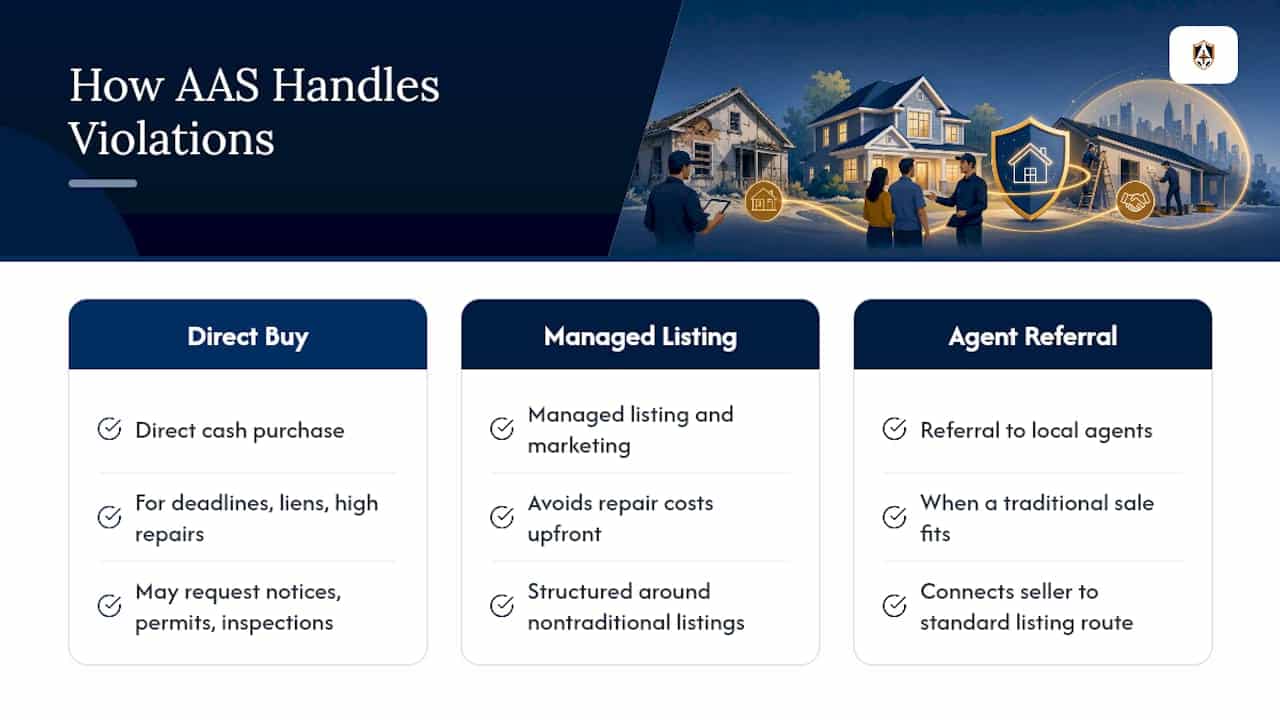
Some home buying services work directly with sellers facing exactly this problem, structuring their approach around the reality that not every property fits a traditional listing. They may offer three paths: a direct cash purchase for homes in their current condition, managed listing and marketing programs that avoid repair costs upfront, and referrals to local agents when a traditional sale makes sense.
A direct-buy path tends to fit best when a seller is facing a real deadline, an active lien, or repair costs that would eat too far into their equity. To move quickly, buyers may ask for whatever documentation exists, municipal violation notices, permit records, or inspection reports to give an accurate offer faster instead of guessing at repair scope. You can review the full range of selling options to see which fits your timeline and goals.
Disclosure First, Strategy Second
Transparency is the strongest legal and financial protection a seller has. Hiding a known violation doesn’t make it disappear. It just moves the risk from your negotiation table to a courtroom after closing.
That said, disclosure doesn’t mean you have to accept the lowest possible offer. Sometimes speed and certainty are worth more than squeezing out every dollar, especially if you’re facing foreclosure or a tight relocation deadline. Other times, your local market can absorb the cost of repairs and reward you with a stronger sale price. There’s no universal right answer here.
State disclosure rules vary, so talk to a real estate attorney or an experienced local agent before you finalize your listing strategy. The framework in this article gets you close, but your specific state’s forms and timelines matter.
— AAS
Get a Direct Path Forward From AAS Home Buyers
If repairs, permits, and buyer negotiations sound like more than you want to manage, AAS Home Buyers gives you a faster way through, without waiting on financing approvals that code violations tend to derail. We offer three concrete paths: a direct cash purchase for homes we buy as-is, our Retail Buyer Program for a managed listing without upfront repair spending, and referrals to vetted agents when a traditional sale fits your situation better.

To get an offer, we typically ask for basic property details and any documentation you already have, like inspection reports or city notices. Most sellers hear back within days, not weeks. Our three-step process walks through exactly what to expect, and you can also compare projected closing costs against a traditional sale before deciding. Start by requesting a no-obligation offer at AAS Home Buyers to see what your options actually look like.
Codes and Records Worth Checking
- International Code Council (I-Codes) for the model codes most jurisdictions adopt
- NFPA 70 for electrical safety standards referenced in most violation notices
- Your local code enforcement portal for permit history and lien records
- A licensed plumber’s guidance on plumbing code compliance if the violation involves pipes or fixtures
This article is general information, not a substitute for advice from a qualified lawyer. Consult a qualified legal professional about your own circumstances before acting on anything here.
Sources
- International Code Council (I-Codes)
- NFPA electrical standards (NFPA 70)
- Selling a House With an Open Code Violation in Florida | The Code Clinic
- Selling a House With Code Violations? Review Your Options – HomeLight
FAQ
Can You Sell a House With Code Violations in California?
Yes, California allows the sale of homes with code violations as long as sellers meet the state’s disclosure requirements, but unresolved liens or open permits can still slow down closing or limit your buyer pool.
Do Home Appraisers Look for Code Violations?
Appraisers routinely note visible code issues and often exclude unpermitted square footage from their valuation, which can reduce the loan amount a buyer qualifies for.
What Are the Most Common Code Violations?
The most frequent violations involve electrical wiring, missing smoke detectors, unpermitted additions, and plumbing that doesn’t meet current code, with overloaded circuits and DIY wiring among the most cited electrical issues.
What Happens if You Buy a House Not Up to Code?
The new owner typically inherits responsibility for fixing the violation and may face fines, insurance complications, or difficulty refinancing until the issue is resolved, which is why buyers and their lenders scrutinize these properties closely before closing.