
Avoid Losing Your Deposit: When to Make a Non-Contingent Offer
A non-contingent offer is a bid to buy a home with no conditions attached, which means you can’t back out over financing, inspection, or appraisal problems without losing your deposit. Sellers love it because it removes their risk of a failed closing. You take on that risk instead, and once your offer is accepted, it becomes a binding contract you’re legally obligated to complete.
TL;DR:
- Buyers waiving all contingencies must have sufficient proof of funds, stable finances, and market conditions favoring quick, unconditional deals.
- Non-contingent offers give sellers a high probability of closing but expose buyers to losses from appraisal gaps, hidden defects, or financing denials.
- In competitive markets with rapid sales, non-contingent bids can outperform higher contingent offers by offering certainty and speed to sellers.
- Buyers should run worst-case stress tests and consult legal or financial professionals before fully waiving contingencies to avoid costly failures.
- Alternatives like escrow holdbacks, escalation clauses, or fully underwritten pre-approvals can strengthen offers without risking full waiver pitfalls.
Table of Contents
- Non-Contingent vs. Contingent Offers: What Buyers Give Up
- Why Sellers Prefer Non-Contingent Offers (and What Buyers Gain)
- What Happens If You Can’t Close on a Non-Contingent Offer?
- When Does a Non-Contingent Offer Actually Make Sense?
- Ways to Compete Without Giving Up Every Protection
- How to Prepare a Strong Non-Contingent Offer
- Lower-Risk Alternatives to a Full Waiver
- How AAS Home Buyers Helps When Certainty Matters Most
- A Practical Rule of Thumb for Buyers Weighing This Decision
- Considering Your Options if a Non-Contingent Offer Isn’t Right for You
- Sources
- FAQ
Non-Contingent vs. Contingent Offers: What Buyers Give Up
A contingency clause is a condition written into a purchase agreement that lets you cancel the deal and keep your deposit if something specific goes wrong. Remove all of them, and you have a fully non-contingent bid. Remove some, and you’re working with a partial waiver, which is far more common than an all-or-nothing approach.
Here’s what buyers typically give up when they waive contingencies:
- Sale contingency: You’re no longer allowed to make your purchase depend on selling your current home first.
- Financing contingency: If your loan falls through, you can’t walk away and keep your earnest money.
- Inspection contingency: You accept the home’s condition as-is, defects and all, once you sign.
- Appraisal contingency: If the home appraises below your offer price, you’re still on the hook for the full amount.
- Title contingency: You proceed even if a title search turns up liens or ownership disputes.
A buyer with a large cash reserve might waive financing and appraisal but keep an inspection contingency for peace of mind. A move-up buyer selling their current home might drop the sale contingency but keep everything else. Full waivers are the exception, reserved for buyers with unusually strong balance sheets or a property they want at nearly any cost.
Why Sellers Prefer Non-Contingent Offers (and What Buyers Gain)
Sellers see a non-contingent offer as a deal that’s far less likely to collapse midstream. Every contingency is a potential exit ramp for the buyer, and every exit ramp is a chance the seller has to relist, renegotiate, or start over. Removing those ramps gives the seller confidence the transaction will actually close on schedule.
That confidence translates into real advantages for you as the buyer:
- You stand out in multiple-offer situations, sometimes decisively, even against a higher bid that carries contingencies.
- You often close faster, since there’s no waiting period for inspection negotiations or appraisal disputes.
- You gain negotiating leverage on price or terms, because sellers will frequently accept a slightly lower non-contingent offer over a higher contingent one.
In tight inventory markets, a clean, unconditional bid can beat a competing offer that’s several thousand dollars higher. Sellers are pricing in the cost of risk, not just the dollar amount on the page.
What Happens If You Can’t Close on a Non-Contingent Offer?
Waiving contingencies doesn’t just raise your odds of winning a bidding war. It rewrites who absorbs the financial damage if the deal goes sideways. Once you sign a non-contingent purchase agreement, you’re bound to close regardless of what you discover or what changes in your finances.
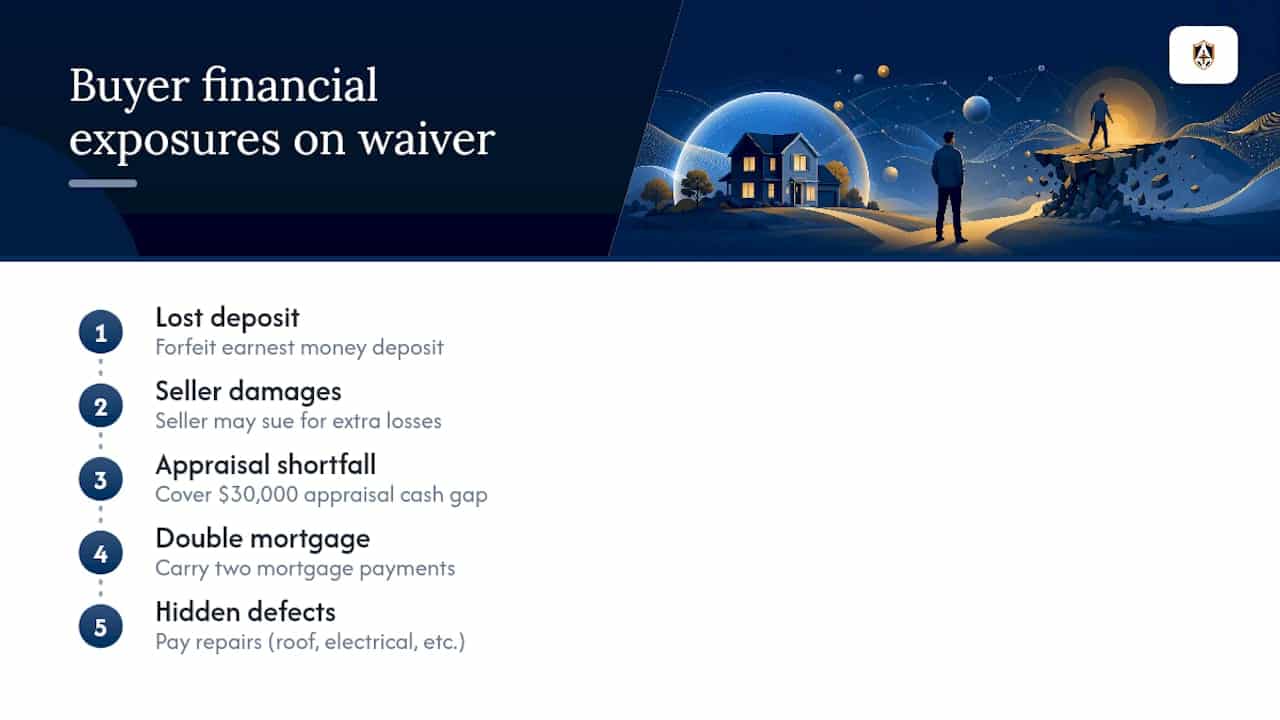
Beyond that, contract law generally allows sellers to pursue damages beyond the deposit if a buyer breaches a purchase agreement, particularly if the seller can show financial harm from a delayed or failed sale.
Three specific failure points cause most non-contingent disasters:
Appraisal shortfalls. If you waived the appraisal contingency and the home appraises $30,000 below your offer, you must cover that gap in cash. There’s no renegotiation clause to lean on.
Double mortgage exposure. If you waived your sale contingency and your current home takes longer to sell than expected, you could be carrying two mortgage payments simultaneously.
Hidden defects. Waiving inspection means you inherit whatever’s wrong with the property, from a failing roof to outdated electrical systems, with no legal recourse against the seller.
Waiving a financing contingency is especially dangerous because it can leave you contractually obligated to complete the purchase even if your lender denies the loan at the last minute. This is exactly the scenario where a real estate attorney earns their fee, reviewing the specific breach and remedy language in your contract before you sign anything.
Pro Tip: Before you waive anything, run a worst-case stress test over a typical realistic sale window. If that number makes you uncomfortable, you’re not ready for a full waiver.
When Does a Non-Contingent Offer Actually Make Sense?
A non-contingent strategy only works when your finances can survive the worst version of the scenario above, not the best one. That means looking honestly at three areas before you get emotionally attached to a property.
- Proof of funds and reserves. You need documented liquid assets, not projected equity, covering the purchase plus a cushion for unexpected repairs or a slow home sale.
- Usable equity, not paper equity. If you’re relying on your current home’s value to fund the next one, calculate what’s left after realtor commissions, closing costs, and a realistic sale timeline, not the optimistic Zillow estimate.
- Debt-to-income headroom. Lenders will evaluate whether you can carry two mortgages at once during underwriting. If your ratios are already tight, a dual-payment period could disqualify you from financing entirely, even temporarily.
Beyond your own balance sheet, look at the market itself. Multiple competing offers, homes selling in single-digit days on market, and bidding wars pushing well above asking price are the conditions where a non-contingent bid earns its keep. In a slower market with more inventory, the risk usually isn’t worth the marginal competitive edge.
Ways to Compete Without Giving Up Every Protection
You don’t have to choose between a full waiver and losing the house. Several tools let you look strong on paper while keeping meaningful protection in place.
- Bridge loans and HELOCs. These let you access your current home’s equity to fund a new purchase before the old one sells, letting you drop the sale contingency without a double-payment gap. The tradeoff is added interest costs and underwriting requirements that assume you can carry both properties temporarily.
- Fully underwritten pre-approval. A basic pre-approval letter is a soft promise. A fully underwritten approval means a lender has already verified your income, assets, and credit, leaving only the property itself to clear underwriting. Sellers treat this almost like cash.
- Larger earnest money deposits. Bumping your deposit from 1% to 3% or higher signals seriousness without touching your contingencies at all.
- Escalation clauses. These automatically raise your offer above competing bids up to a ceiling you set, so you don’t have to guess the winning number.
- Appraisal-gap clauses. You agree in advance to cover a defined gap between the appraised value and your offer price, in cash, capping your exposure instead of eliminating the appraisal contingency altogether. Our appraisal-gap clause guide walks through a real dollar example.
- Rent-back and kick-out clauses. A rent-back lets sellers stay temporarily after closing, useful when their timeline is the sticking point. A kick-out clause lets a seller keep marketing the home while giving your contingent offer a set window to remove conditions before they accept something else.
How to Prepare a Strong Non-Contingent Offer
Getting the paperwork right matters as much as the decision itself. Before you submit anything, assemble these items and confirm these terms.
- Gather your financial documentation. This includes proof of funds, a fully underwritten pre-approval letter, recent bank statements, and any relevant title documents on your current property. Our partner’s document checklist for a quick sale covers most of what lenders and sellers expect to see.
- Confirm your earnest money instructions. Know exactly how much you’re depositing, where it goes, and under what conditions it’s returned or forfeited.
- Decide on an appraisal-gap ceiling. Set a specific dollar figure you can cover in cash if the appraisal comes in low, rather than leaving that number undefined.
- Lock down your closing timeline. Confirm it’s realistic given your financing and any rent-back terms you’ve negotiated.
- Call your lender, your buyer’s agent, and a real estate attorney, in that order, before you sign. Each one is checking a different kind of risk, and skipping any of them is how buyers end up surprised by contract language they never fully understood.
Lower-Risk Alternatives to a Full Waiver
If a complete waiver feels too aggressive, several middle-ground options keep your offer competitive without exposing you to every possible risk.
- Shortened contingency periods. Instead of removing an inspection contingency entirely, cut the window from 10 days to 3 or 4, showing urgency without giving up the protection.
- Conditional waivers. Waive the right to cancel over minor issues while keeping protection against major structural or safety defects.
- Kick-out clause negotiation, particularly useful when you still need to sell your current home but want your offer taken seriously in the meantime.
Choosing between a price increase and a fully non-contingent structure often comes down to math: a higher offer with contingencies intact can sometimes beat a lower non-contingent bid, and it costs you nothing in risk exposure.
How AAS Home Buyers Helps When Certainty Matters Most
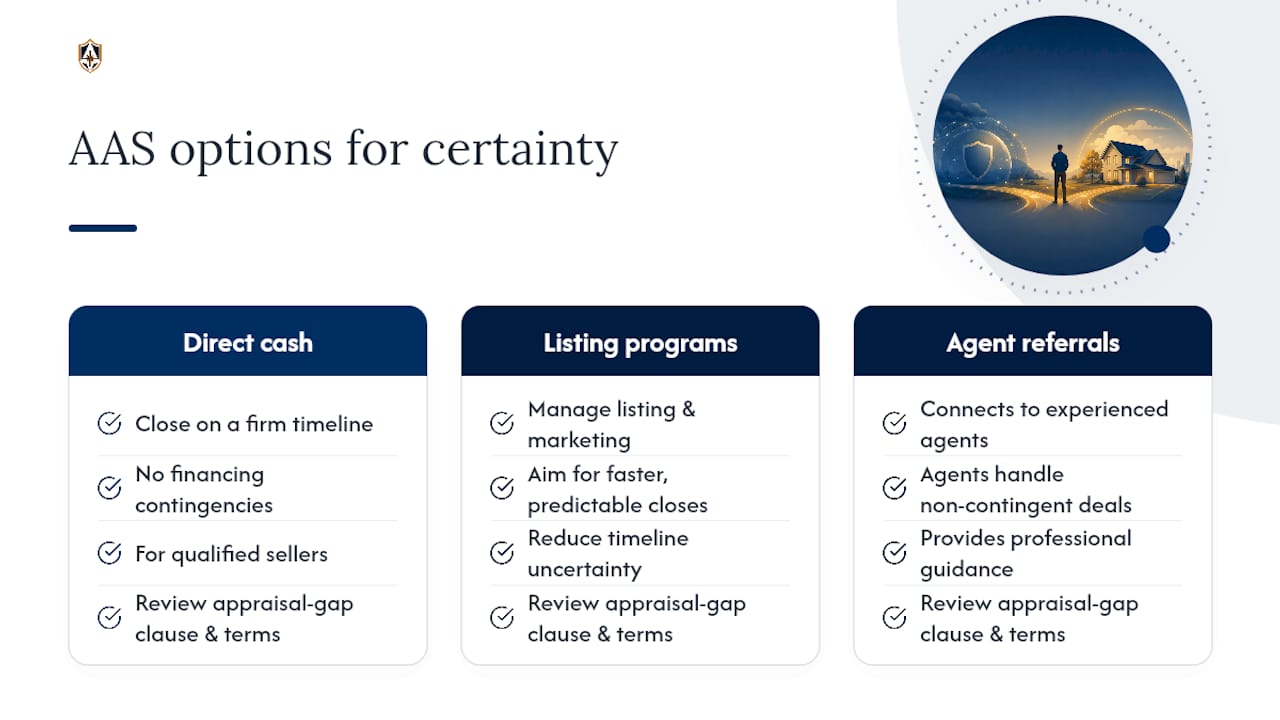
If waiving contingencies feels too risky but you still need speed or certainty, some home-buying services offer paths that don’t require you to gamble your deposit. For example, direct cash purchase options let qualified sellers close on a firm timeline without financing contingencies slowing things down. Programs managing listing and marketing can also aim for faster, more predictable closes, while agent referrals connect you with professionals experienced in these situations. Review the appraisal-gap clause example and our terms and disclaimer for the specifics before deciding which path fits your situation.
A Practical Rule of Thumb for Buyers Weighing This Decision
Compete aggressively when you can afford to, not when you feel pressured to. That’s the whole rule, and most buyers who regret a non-contingent offer ignored it under pressure from a hot market or a house they’d already fallen in love with.
Picture two buyers on the same $600,000 home. One has $200,000 in home equity, six months of reserves, and no urgency to move. The first buyer can survive a non-contingent offer going wrong. The second buyer is one appraisal shortfall away from a financial crisis, and no amount of market pressure changes that math.
— AAS
Considering Your Options if a Non-Contingent Offer Isn’t Right for You
Not every buyer should compete this way, and if a full waiver doesn’t fit your financial picture, that’s not a failure. It’s a reason to look at alternative paths to the same goal. If you’re on the selling side of this equation and want certainty without the wait, some services give options beyond traditional listings. Direct cash purchase paths skip financing contingencies, as the buyer does not need a lender’s approval to close. Other programs handle listing and marketing for sellers seeking broader exposure but still valuing a predictable process, and agent referral networks connect sellers with vetted professionals when a traditional sale is the better fit.

Whether you’re facing foreclosure, managing an inherited property, or just want to avoid the uncertainty of a buyer walking away over an inspection issue, our transparent 3-step process shows exactly what to expect before you commit to anything. Get a no-obligation cash offer today and see how quickly certainty can happen when you’re the one selling, not the one gambling on a waiver.
Sources
- Understanding a Non-Contingent Offer in Real Estate — Scarinci Hollenbeck
- Cancellation — Legal Information Institute, Cornell Law School
- How to beat a contingent offer: strategies that work — LegalClarity
- Contingency clause — Investopedia
FAQ
Can a Buyer Back Out of a Non-Contingent Offer?
Only in very limited circumstances, such as seller fraud or a title defect discovered after signing; otherwise, backing out typically means forfeiting your earnest money and possibly facing further legal liability for breach of contract.
Can You Put an Offer on a House That Has a Contingent Offer?
Yes. A home under a contingent offer can often still accept backup offers, and many contracts include a kick-out clause that lets the seller move forward with a stronger backup bid if the original buyer can’t remove their contingencies in time.
Do Sellers Not Like Contingent Offers?
Sellers generally prefer offers with fewer contingencies because each one represents a way the deal could fall apart, which is why non-contingent bids often win even against higher contingent offers.
What’s the Difference Between Contingent and Non-Contingent?
A contingent offer includes conditions, like financing, inspection, or appraisal, that let the buyer cancel and keep their deposit if something goes wrong; a non-contingent offer removes those conditions, which makes it more attractive to sellers but shifts nearly all the closing risk onto the buyer.