
Appraisal vs CMA: Which Valuation Controls a U.S. Home Sale?
A CMA is a real estate agent’s market-based pricing estimate; an appraisal is a formal, state-licensed valuation guided by USPAP that lenders and courts rely on. CMAs are usually free and can often be ready quickly. Appraisals cost several hundred dollars and typically take several days to a couple of weeks, but they are the number that governs financed sales.
TL;DR:
- CMAs are quick, free estimates based on recent comparable sales, but they lack the standardization and legal backing of formal appraisals.
- Appraisals, required by lenders, cost several hundred dollars and involve a physical inspection and documented adjustments following strict USPAP standards.
- In stable markets, CMA and appraisal values often align, but in thin markets or unusual properties, appraisals may come in below the CMA, risking deal cancellation.
- Buyers and sellers should anticipate that lenders will order an appraisal and prepare supporting documentation for upgrades or repairs to avoid valuation shortfalls.
- When a low appraisal threatens a sale, options include renegotiating, increasing down payment, requesting a review, or exploring alternative sale programs offered by AAS Home Buyers.
Table of Contents
- CMA vs Appraisal: A Side-by-Side Comparison
- How Do Real Estate Agents Build a CMA?
- What Makes an Appraisal Different From a CMA?
- When Appraisal and CMA Numbers Don’t Match
- What Should Sellers and Buyers Do Next?
- How AAS Home Buyers Helps When the Appraisal Falls Short
- Our Take on Protecting Your Equity Through the Valuation Process
- Sources
- FAQ
CMA vs Appraisal: A Side-by-Side Comparison
The two tools answer different questions for different audiences. A CMA tells a seller “what will this house likely sell for,” while an appraisal tells a lender “what is this specific property actually worth, backed by documentation that would hold up in court.” Once financing enters the picture, the appraisal takes over as the number everyone works around.
- Purpose: CMA guides pricing and negotiation strategy; appraisal supports loan underwriting or legal proceedings.
- Preparer: A real estate agent builds the CMA; a state-licensed appraiser completes the appraisal.
- Legal standing: CMAs carry no mandated format or legal weight; appraisals follow USPAP standards and hold up in lending, probate, and divorce cases.
- Typical cost: CMAs are usually free from your agent; appraisals commonly cost several hundred dollars or more.
- Turnaround: CMAs can be ready within a day; appraisals typically take a few days to two weeks depending on local demand, according to Zillow.
How Do Real Estate Agents Build a CMA?
An agent builds a comparative market analysis by pulling active, pending, sold, and expired listings from the MLS and narrowing them to properties that resemble yours in size, age, and location. Bankrate recommends using an appropriate number of comparable sales to build a reliable estimate, as too few comps skews the picture and too many dilutes relevance.
From there, the agent adjusts. A comp with a renovated kitchen might get a downward adjustment; a comp without a garage gets bumped up. This is judgment, not formula, and it’s shaped by the agent’s read on your specific block, school zone, or HOA. Nothing legally requires a standardized method, and no licensing body reviews the finished document. That flexibility is also the weak point: a CMA can be as sharp as the agent preparing it, or as soft as their optimism about your listing price.
Before you trust a CMA, ask a few pointed questions:
- How many comps did you pull, and how recent are the sale dates?
- What adjustments did you make, and why?
- Are you comparing active listings (asking prices) or closed sales (actual prices)?
- Does this account for anything unusual about my property?
Pro Tip: Ask your agent for the comparable-sales addendum used in the CMA, not just the summary number. Seeing the raw comps lets you judge whether the estimate is grounded or generous.
What Makes an Appraisal Different From a CMA?
An appraisal is a documented opinion of value performed by a professional licensed at the state level, governed by the Uniform Standards of Professional Appraisal Practice. The Appraisal Foundation sets those standards and the qualification requirements appraisers must meet before they can sign a report a lender will accept.
The process starts with a physical site visit, where the appraiser inspects the property’s condition, square footage, and features. From there, the Appraisal Institute explains that appraisers reconcile multiple approaches to value, primarily the sales-comparison approach, with cost and income approaches used when relevant, then document every adjustment and the reasoning behind it. That paper trail is what makes the report defensible in a lending decision or a courtroom, unlike a CMA’s informal summary.
- Who orders and pays: Lenders order the appraisal, but the buyer typically pays for it as part of closing costs.
- Typical cost: Commonly several hundred dollars, per Zillow’s consumer guidance.
- Typical timeline: A few days to two weeks, depending on appraiser availability and property complexity.
One clarification worth repeating: an appraisal is not a home inspection. It evaluates value, not the condition of your wiring or roof, though visible defects can affect the number.
Appraisers are held to a documented standard that CMAs never have to meet: USPAP requires evidence and reconciliation behind every adjustment, which is exactly why the CFPB points to licensed appraisals as a standard part of mortgage underwriting.
When Appraisal and CMA Numbers Don’t Match
In active, well-comped neighborhoods, a solid CMA and a subsequent appraisal often land close together. Both are pulling from similar recent sales, and a good agent’s adjustments frequently mirror what a licensed appraiser would conclude independently. The trouble starts in thinner markets, on unusual properties, or when an agent leans optimistic to win a listing.
When the appraisal comes in below the contract price, the lender will only finance against the appraised value, not the number you and the buyer agreed on. That gap becomes everyone’s problem at once.
- Renegotiate the price down to match the appraisal, which protects the buyer’s loan-to-value ratio.
- Have the buyer bring more cash to cover the difference between the appraised value and the loan amount.
- Request an appraisal review or reconsideration of value, particularly if the appraiser missed comps or overlooked upgrades.
- Invoke an appraisal contingency, if the contract includes one, to walk away without penalty.
A meaningful mismatch between a CMA and a lender-ordered appraisal commonly triggers one of these paths, or in worse cases, a canceled deal. Watch for warning signs before you’re mid-contract: a CMA built on fewer than four comps, comps pulled from outside your immediate area, or an agent who quotes a number noticeably higher than every other estimate you’ve seen.
What Should Sellers and Buyers Do Next?
Your next move depends on which situation you’re in.
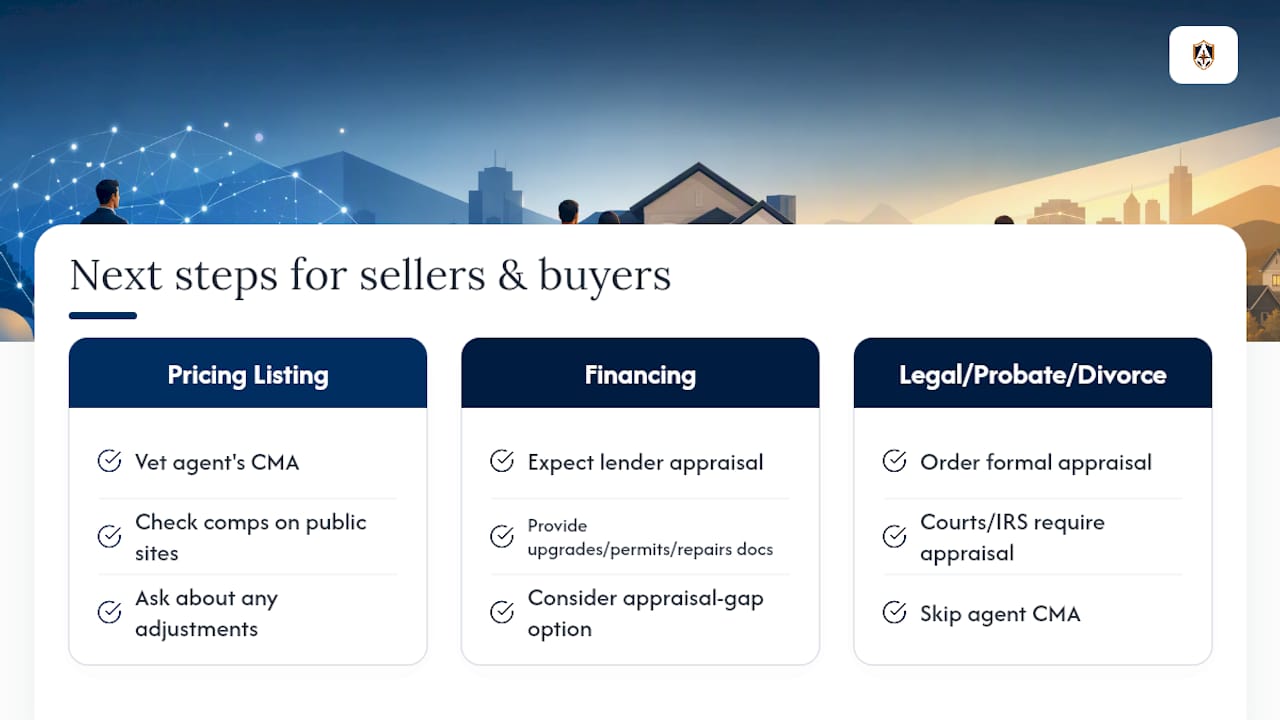
Pricing a listing: Vet your agent’s CMA by checking a few comps yourself on public listing sites, and don’t hesitate to ask why a specific adjustment was made.
Financing a purchase or sale: Expect a lender-ordered appraisal regardless of what the CMA said, and gather documentation on any upgrades, permits, or repairs that could support a higher appraised value. Reviewing an appraisal gap coverage option before you sign a contract gives you a plan if the number comes in short.
Legal, probate, or divorce matters: Skip the CMA entirely and order a formal appraisal, since courts and the IRS generally won’t accept an agent’s estimate as valid documentation.
Before any of these conversations, gather your property tax records, past inspection reports, and a list of improvements with dates and costs.
Pro Tip: Keep a simple folder, digital or paper, with permits and receipts for every major repair or upgrade. Appraisers can’t credit work they can’t verify.
How AAS Home Buyers Helps When the Appraisal Falls Short
When an appraisal comes in below contract and the deal is at risk, AAS Home Buyers gives you options beyond renegotiating and hoping the buyer stays. We offer direct cash purchases that bypass lender appraisals entirely, a Retail Buyer Program with managed listing and marketing for sellers who want broader market exposure, and referrals to vetted local agents when a traditional sale still makes sense.
Every option comes with a transparent, data-driven valuation so you know where you stand before you commit to a path. If you’re weighing your choices after a low appraisal or working against a tight timeline, our guide to home selling options walks through each route in plain terms.

Our Take on Protecting Your Equity Through the Valuation Process
We’ve seen how a single low appraisal can unravel a deal a seller spent months preparing for. Our position is simple: understand which valuation governs your situation before you’re negotiating under pressure, not after. Transparent, data-driven pricing protects your equity far better than an optimistic number that collapses at underwriting. If you want a second opinion on where your home stands, start with our process or reach out to talk through your specific market.
— AAS
Sources
- Consumer Financial Protection Bureau (CFPB)
- The Appraisal Foundation
- Appraisal Institute
- How to find real estate comps | Bankrate
- Home appraisal vs CMA: What’s the difference? | Zillow
FAQ
Is a CMA as Good as an Appraisal?
No. A CMA can be accurate for pricing purposes in an active market, but it lacks the formal methodology, licensing oversight, and legal standing that make an appraisal acceptable to lenders and courts.
What Shows Up in an Appraisal but Not a CMA?
An appraisal includes a physical site inspection, documented adjustments under USPAP, and reconciliation across multiple valuation approaches, none of which a CMA is required to include.
Is a CMA Required to Sell a House?
No, a CMA isn’t legally required. It’s a common practice tool agents use to help set a listing price, but you can sell a home without one.
What Are the Limitations of a CMA in Real Estate?
A CMA has no mandated standard, isn’t performed by a licensed appraiser, and relies on agent judgment that can skew optimistic, especially with thin comps or an unusual property.