
How to Sell Your Arizona Home With Flexibility and Speed
For most Arizona homeowners, the best selling route combines speed, price protection, and minimal hassle. AAS Home Buyers delivers exactly that through three paths: a direct cash purchase, a managed Retail Buyer Program, or a referral to a vetted local agent. Your situation determines which fits best.
Three-option snapshot:
- Direct cash purchase: Fastest close (often 7–14 days), no repairs required, lower net proceeds. Best for urgent timelines, inherited properties, or homes needing major work.
- Retail Buyer Program: AAS manages the listing and marketing to attract retail buyers, targeting higher net proceeds with moderate timelines. Best for sellers who want market exposure without managing the process themselves.
- MLS agent referral: Highest potential net proceeds, longest timeline (30–90 days), requires preparation and showings. Best for sellers with time and a move-in-ready home.
Quick directional guidance:
- Urgent sale or distressed property? Request a direct cash offer.
- Want maximum equity with less effort? Ask about the Retail Buyer Program.
- Selling remotely or from out of state? A managed program or vetted agent referral centralizes your documentation and closing logistics.
Key Takeaways
Arizona homeowners get the best outcome by matching their selling route to their timeline, property condition, and capacity to manage the process.
| Point | Details |
|---|---|
| Fastest route | A direct cash purchase closes very quickly, often within about a week, with no repairs or commissions required. |
| Highest-net route | The Retail Buyer Program or a vetted MLS agent referral targets maximum proceeds for market-ready homes. |
| Remote sellers | A managed program centralizes documentation, inspections, and closing so out-of-state sellers don’t coordinate alone. |
| Disclosure is mandatory | Complete the SPDS truthfully; “as-is” clauses do not excuse disclosure of known material defects under Arizona law. |
| AAS Home Buyers | Offers all three routes with data-driven valuations, no hidden fees, and a vetted agent network for Arizona sellers. |
Table of Contents
- What does selling a house in Arizona actually cost?
- How do you choose the right selling option?
- What are the key steps from offer to closing?
- How do Arizona market conditions affect your sale?
- How should you prepare your home before listing?
- What marketing works best for Arizona home sales?
- How do you negotiate effectively as an Arizona seller?
- What we see with Arizona sellers, and how we help
- AAS Home Buyers offers three clear paths for Arizona sellers
- Sources
- FAQ
What does selling a house in Arizona actually cost?
Costs vary by route. Add pre-listing repairs, staging, and carrying costs during a 30–90 day marketing period, and the total outlay can be significant.
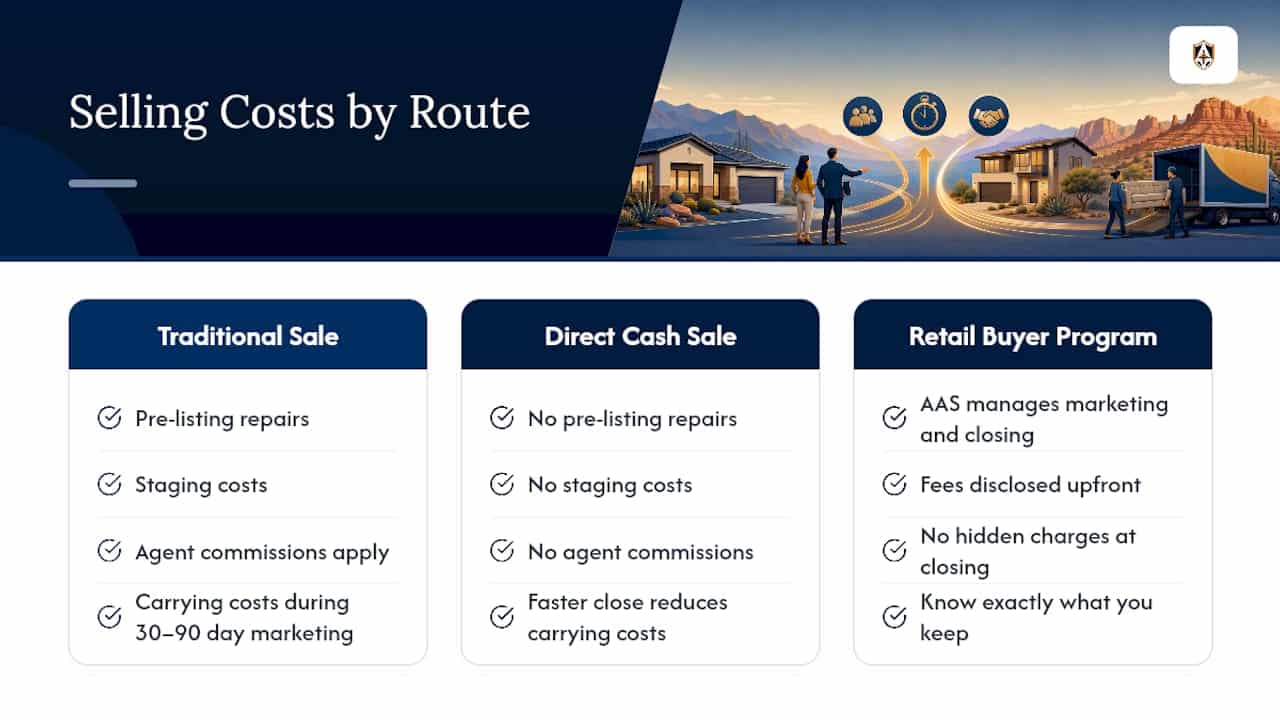
A direct cash sale removes most of those line items. No agent commissions, no repair costs, and a faster close reduces carrying costs. The tradeoff is a lower gross offer, though for many sellers the net difference is smaller than expected once repair and commission costs are subtracted from a retail price.
The Retail Buyer Program sits between the two: AAS manages marketing and closing coordination, with fees disclosed upfront so you know exactly what you keep. No hidden charges appear at the closing table.
How do you choose the right selling option?
Ask yourself three questions before committing to a path:
- How quickly do you need to close? If you’re facing foreclosure, a job relocation, or an inherited property with carrying costs, speed outweighs price.
- What condition is the property in? Homes needing significant repairs rarely net more through a retail listing once repair costs and renegotiations are factored in.
- How much can you manage remotely? Out-of-state sellers benefit from a single accountable contact who handles inspections, disclosures, and escrow coordination.
Pro Tip: Before choosing, ask any buyer or program to show you a written net proceeds estimate that accounts for commissions, repairs, and closing costs — not just the gross offer price.
Arizona sellers also carry a legal obligation regardless of route. The Arizona Seller Disclosure Requirements standard requires disclosure of all known material defects. Omitting known issues — foundation movement, prior flooding, unpermitted additions — can lead to fraud or misrepresentation claims after closing.
What are the key steps from offer to closing?
The process follows the same core milestones whether you choose cash, retail, or MLS:
- Valuation and offer: AAS evaluates your property using data-driven pricing and presents a written offer or program recommendation, typically within 24–48 hours.
- Inspection and due diligence: Cash purchases may involve a brief inspection period (3–7 days). Retail and MLS paths include a standard Arizona inspection contingency, usually 10 days.
- Disclosure completion: You complete the AAR Seller’s Property Disclosure Statement (SPDS), which documents known material facts about the property. Complete it truthfully — it is your primary protection against post-closing disputes.
- Escrow opens: A licensed Arizona escrow company holds funds and coordinates title search, lien clearance, and final documents.
- Closing: You sign, title transfers, and proceeds are disbursed. Cash closings can complete in as few as 7 days; retail and MLS closings typically run 30–45 days.
If you are selling unplatted land or a parcel outside a recorded subdivision, A.R.S. § 33-422 requires a separate affidavit of disclosure, and buyers receive a five-day rescission right after receiving it.
How do Arizona market conditions affect your sale?
Arizona’s housing market follows seasonal patterns that affect both price and days on market. Spring (March through May) consistently produces the highest buyer activity and the strongest offers. Summer heat slows foot traffic, particularly in the Phoenix metro. Fall brings a secondary activity window, while December and January are the slowest months for retail listings.
For sellers using the Retail Buyer Program or an MLS agent referral, timing your listing for late February through April gives you the best exposure. For cash sales, seasonality matters less because investor demand stays relatively steady year-round.
How should you prepare your home before listing?
Preparation directly affects both offer price and time on market. For retail and MLS paths, focus on:
- Curb appeal: Arizona buyers respond to clean desert landscaping, fresh exterior paint, and functioning irrigation.
- Interior condition: Deep clean, declutter, and address any deferred maintenance visible to buyers (leaky faucets, cracked tiles, HVAC filters).
- Disclosure documentation: Gather permits for any additions or improvements, HVAC service records, and receipts for major repairs. Sellers who document repairs and permits reduce post-closing dispute risk and close faster.
For cash sales, preparation is minimal. AAS evaluates properties in any condition, so you do not need to invest in repairs before requesting an offer.
What marketing works best for Arizona home sales?
Effective marketing for a retail or MLS listing in Arizona relies on professional photography, accurate MLS data entry, and targeted digital exposure. Arizona buyers search heavily on Zillow, Realtor.com, and local brokerage sites, so MLS syndication is non-negotiable.
For higher-end properties, video walkthroughs and drone photography of lot size and surroundings perform well. Pricing at or just below a round-number threshold (e.g., $399,000 rather than $405,000) captures more search results and tends to generate more initial showings.
AAS’s Retail Buyer Program handles this marketing layer for you, which is particularly useful for out-of-state sellers who cannot coordinate photography and showings in person.
How do you negotiate effectively as an Arizona seller?
In a balanced or buyer-favoring market, your strongest negotiating position comes from preparation, not pressure. Price your home accurately from the start using comparable sales data. Overpricing and then reducing signals weakness and invites lower offers.
When reviewing offers, evaluate the full package: purchase price, financing contingency (or cash), inspection period length, and requested closing date. A slightly lower cash offer with no financing contingency and a 10-day close often nets more than a higher financed offer that carries appraisal and loan approval risk.
Arizona disclosure laws are clear that “as-is” language does not eliminate your duty to disclose known defects. Sellers who disclose proactively and price accordingly face fewer renegotiations after inspection, which protects both timeline and final proceeds.
What we see with Arizona sellers, and how we help
Most Arizona sellers who contact AAS Home Buyers fall into one of three situations: an urgent timeline (foreclosure, divorce, relocation), an inherited property they’ve never occupied, or an out-of-state owner who cannot manage a traditional listing. Each situation maps cleanly to one of our three programs.
What we’ve found consistently is that sellers who try to force a retail listing on a property that needs significant work, or who attempt to manage a remote sale without centralized support, lose both time and money. The Retail Buyer Program exists specifically to close that gap: it gives you market exposure and a managed process without requiring you to coordinate every step from another state.
Our valuations are data-driven and presented in writing before you commit to anything. Fees are disclosed upfront. We do not add charges at the closing table that weren’t in the original offer summary. For sellers who prefer a traditional MLS path, our vetted agent referral network connects you with local professionals focused on protecting your equity.
Pro Tip: Complete the SPDS thoroughly and keep copies of all repair records, permits, and invoices. Arizona courts expect sellers to disclose known material defects, and thorough documentation is your best protection if a dispute arises after closing.
Selling “as-is” does not exempt you from disclosure. Arizona law is explicit: known defects must be disclosed regardless of how the contract is structured. We guide every seller through this requirement so nothing is missed.
AAS Home Buyers offers three clear paths for Arizona sellers
Three selling situations, three programs, one point of contact. That’s the practical advantage AAS Home Buyers offers Arizona homeowners who need a flexible, data-driven sale.

Direct cash purchase fits sellers who need speed or have a property in poor condition. You request an offer, AAS evaluates the property, and you can close in as few as 7 days with no repairs and no commissions.
Retail Buyer Program fits sellers who want retail-level proceeds without managing the process. AAS handles valuation, marketing, and closing coordination. Fees are disclosed in writing before you sign anything, and the transparent 3-step process keeps you informed at every milestone.
Vetted agent referral fits sellers with time and a market-ready property who want maximum net proceeds through an MLS listing. AAS connects you with a local agent from its vetted network at no referral cost to you.
All fee and service terms are published on the AAS terms page. To request a valuation or cash offer, visit AAS Home Buyers and submit your property details. You’ll hear back within 24–48 hours.
Sources
Review these official resources before signing any contract, and keep copies of all disclosure forms and repair records.
- WHEN IN DOUBT – DISCLOSE!
- Arizona Seller Disclosure Requirements | Abate Law
- 33-422 – Land divisions; recording; disclosure affidavit
- Arizona Real Estate Disclosure Laws: What Sellers and Buyers Should Know in 2025 – Gottlieb Law
This article is general information, not a substitute for advice from a qualified financial advisor. Consult a qualified financial professional about your own circumstances before acting on anything here.
FAQ
What is the fastest way to sell a house in Arizona?
A direct cash purchase closes very quickly, often within about a week, with no repairs, no showings, and no agent commissions. AAS Home Buyers evaluates your property and presents a written cash offer within 24–48 hours.
Do I have to disclose defects if I sell “as-is”?
Yes. Arizona law requires sellers to disclose all known material defects regardless of “as-is” language in the contract. Omitting known issues can lead to fraud or misrepresentation claims after closing.
What is the SPDS and do I need to complete it?
The Seller’s Property Disclosure Statement (SPDS) is the standard Arizona form documenting known facts about your property’s condition. Completing it truthfully is your primary legal protection against post-closing disputes.
When is the best time to list a home in Arizona?
Spring, specifically March through May, produces the highest buyer activity and strongest offers in Arizona’s market. Cash sales are less affected by seasonality since investor demand stays relatively steady year-round.
Can I sell my Arizona home from out of state?
Yes. A managed Retail Buyer Program or vetted agent referral centralizes all communication, inspections, and closing logistics, making a remote home sale practical without requiring you to be present for every step.