
7–21 Day Home Pricing Strategy That Doubles Buyer Visibility
If your local market has more than 30 days of inventory or prices have swung more than 5% month to month, dynamic pricing tends to outperform. If your market is stable, a data-backed price at or near fair market value, tested for 7 to 21 days, is your best starting move. Either way, your first action is the same: request a comparative market analysis focused on the last 30 days of activity, not last quarter’s averages.
TL;DR:
- Pricing within 30 days of recent market activity ensures a more accurate starting point, especially in dynamic markets with over 5% monthly swings.
- Starting with a CMA that includes recent comparables, condition adjustments, and trend charts helps set a defensible list price aligned with buyer search behavior.
- Charm pricing below certain thresholds can increase visibility and final sale prices in lower tiers, but can harm higher-end listings by reducing search reach.
- Dynamic pricing only shows clear advantages if local inventory exceeds 30 days and price volatility is above 5%, otherwise static pricing may be more effective.
- Sellers should track key signals during the initial testing window and be prepared to adjust the price within a 7 to 21-day timeframe based on buyer interest metrics.
Table of Contents
- Home Pricing Strategy Basics: The Four Approaches and Who Should Use Each
- How to Set Your Initial Listing Price: A Step-by-Step Checklist
- Why Round Numbers and Charm Pricing Change Who Sees Your Listing
- Dynamic Pricing vs. Static Pricing: Which One Fits Your Market
- What a Strong CMA Looks Like and Questions Every Seller Should Ask
- When to Change Your Price: Timeline and Warning Signs
- Pricing Mistakes That Quietly Cost Sellers Money
- How AAS Home Buyers Supports Sellers Through the Pricing Decision
- Legal Considerations and Disclosures That Affect Your Price
- A Coaching Note on Staying Data-Driven Under Pressure
- Get a Pricing Benchmark or Explore Your Selling Options Today
- Sources
- FAQ
Home Pricing Strategy Basics: The Four Approaches and Who Should Use Each
Every home pricing strategy comes back to what real estate agents call the pricing pyramid: you price below market, at market, or above market, and each choice pulls a different buyer pool. Price below market and you widen the pool dramatically, often triggering multiple offers within days. Price above market and you narrow it to buyers who either love the home enough to stretch or haven’t done their homework yet.
A comparative market analysis, or CMA, is the baseline tool for finding “market” in the first place. It pulls recent comparable sales, adjusts for square footage, condition, and features, and lands on a defensible number. Everything else is a decision about where to position relative to that number.
- List-low, invite competition: Priced under recent comps to generate multiple offers and a bidding war, common in tight seller’s markets.
- List-at-market, sell steady: Matches the CMA closely, appeals to the broadest realistic buyer pool, and tends to produce a predictable timeline.
- List-high, chase the ceiling: Priced above comps for sellers with no urgency, banking on a buyer who values something the comps don’t capture.
- List-and-test, stay flexible: Starts near market value with a plan to adjust based on real showing and offer data within a set window.
Your goals dictate which lane fits. A seller facing a tight relocation window wants speed and predictability, not a ceiling test. A seller with equity to spare and no deadline can afford to price for value and wait. There’s no universally “correct” number here, only the number that matches your timeline and your tolerance for risk.
How to Set Your Initial Listing Price: A Step-by-Step Checklist
Pricing a house to sell starts with data, not instinct. Here’s the sequence that keeps emotion out of the equation and gives you a number you can defend to buyers, appraisers, and your own nerves.
- Pull comps from the last 30 days, not the last quarter. Older sold data can lag a shifting market by weeks, so ask your agent for the most recent closings and active listings in your immediate area.
- Adjust for condition and features with real numbers, not gut feel. A renovated kitchen might add $15,000 to $30,000 depending on your market; a dated HVAC system or visible foundation issue can subtract more than sellers expect.
- Choose a pricing frame that matches how buyers search. Most portals filter in $25,000 increments at lower price points, so a price that lands just inside a search bucket gets seen by more buyers than one that spills just outside it.
- Set a 7 to 21 day testing window before you commit to holding firm. This gives the market enough time to respond without letting a stale price sit unnoticed for months.
- Assign clear signals and clear owners. Decide in advance who tracks showings, saves, and offer activity, whether that’s your listing agent, you, or a representative from a company like AAS Home Buyers, and what threshold triggers a conversation about adjusting price.
Pro Tip: Ask your agent to show you the CMA broken down by sale date, not just by square footage and beds. A comp that closed eight weeks ago in a market moving 1% a month tells you less than one that closed last week.
Skipping the adjustment step is where most sellers lose money without realizing it. A $500,000 home with an unpermitted addition or a leaking roof isn’t a $500,000 home on paper anymore, even if the comps down the street say otherwise.

Why Round Numbers and Charm Pricing Change Who Sees Your Listing
Buyers filter search results by round-number ranges, and a listing priced just above a threshold effectively disappears from a huge slice of the audience that would otherwise see it. Price a home at $401,000 instead of $399,000, and you’ve likely cut it out of every search capped at $400,000, according to Inman’s coverage of portal search behavior. At lower price tiers, those search brackets often move in $25,000 increments, which means a few thousand dollars in list price can swing your visibility by a wide margin.
This is where charm pricing, the old habit of pricing a home at $399,900 instead of $400,000, gets more complicated than it looks. A study of 62,000 sales in Chatham County found charm pricing showed up in 41% of listings, and it raised final sale prices by nearly 4% in the lowest price quintile, according to RISMedia’s analysis of the pricing trick sellers keep using.
- Under $350,000: Charm pricing tends to help. It signals affordability and can lift final price.
- $350,000 to $1.1 million: Charm pricing tends to hurt. It can undercut your own comp positioning.
- Above $1.1 million: Round, clean numbers read as confident and intentional to buyers evaluating a major purchase.
The practical rule: pick the threshold that puts you in the search bucket you want, then decide whether a charm price or a clean number serves your specific price tier. Moving a listing from $399,000 to $400,000 can, according to Inman’s coaching analysis, roughly double the audience that sees it over a 90-day window simply by shifting which search filters catch it.
Dynamic Pricing vs. Static Pricing: Which One Fits Your Market
Static pricing means you set a number and hold it until closing, adjusting only if the market forces your hand. Dynamic pricing treats the list price as a signal you actively manage, repricing on a short cycle based on real demand data. Neither is inherently better. The right choice depends on how active your specific submarket is.
A 2026 analysis of 40,000 MLS listings found dynamic pricing produced a 4.2% sale price premium and an 18% reduction in days on market, but only in submarkets that met specific conditions, according to Realtigence’s MLS data study. The threshold that mattered: local inventory above 30 days of supply and monthly price volatility exceeding 5%. Below that activity level, dynamic pricing showed no meaningful advantage over holding a well-researched static price.
If your market clears that threshold, here’s how to run dynamic pricing without signaling desperation:
- Set a monitoring cadence upfront. Review showing requests, portal saves, and inquiry volume every 48 hours to 7 days, not daily, which can look reactive to agents and buyers watching listing history.
- Name a single decision maker. Whether that’s you, your listing agent, or a valuation partner, one person should own the call to reprice so adjustments stay disciplined instead of panicked.
- Build in a guardrail against early cuts. Don’t touch the price before your initial 7 to 21 day test window closes; a cut on day three reads as a mistake, not a strategy.
- Recognize where static pricing still wins. Thin markets with few comparable sales and luxury properties with unique features rarely have enough transaction volume to justify constant repricing, and frequent changes there tend to spook rather than attract buyers.
What a Strong CMA Looks Like and Questions Every Seller Should Ask
A comparative market analysis worth trusting includes more than a list of nearby sale prices. It should show mapped comps within a reasonable radius, line-item adjustments for square footage and condition differences, and a chart of pricing trends over the past several months, not just a snapshot.
Before you accept an agent’s number, ask these questions directly:
- How recent are these comps? A CMA built on data older than 30 to 60 days may miss a shift already happening on the ground, since sold data typically lags the market by weeks.
- What indicators show current momentum, not just past sales? Ask about active listing counts, pending sales, and price-per-square-foot trends over the trailing 30 days.
- How many truly comparable sales support this number? A CMA built on two or three loosely similar homes carries far less weight than one built on eight or ten close matches.
- What happens if I get a second opinion that disagrees? A wide gap between two agents’ CMAs, say more than 5%, usually means one is leaning on stale data or optimistic assumptions worth pressure-testing.
When estimates diverge and you want a fast, objective benchmark, a cash-offer valuation from a qualified home buying service can give you a concrete number to compare against agent projections, useful especially for sellers weighing speed against maximum price. The NAR consumer guide on home pricing is clear that agents provide evidence, but the seller keeps final say on the number that goes on the listing.
When to Change Your Price: Timeline and Warning Signs
Run your first 7 to 21 days as a live test, not a waiting game. During that window, track four signals: portal saves, showing requests, days on market, and offer count. Saves and showings are your leading indicators, telling you how buyers feel before an offer ever arrives. Offer count and DOM are lagging indicators, confirming what already happened.
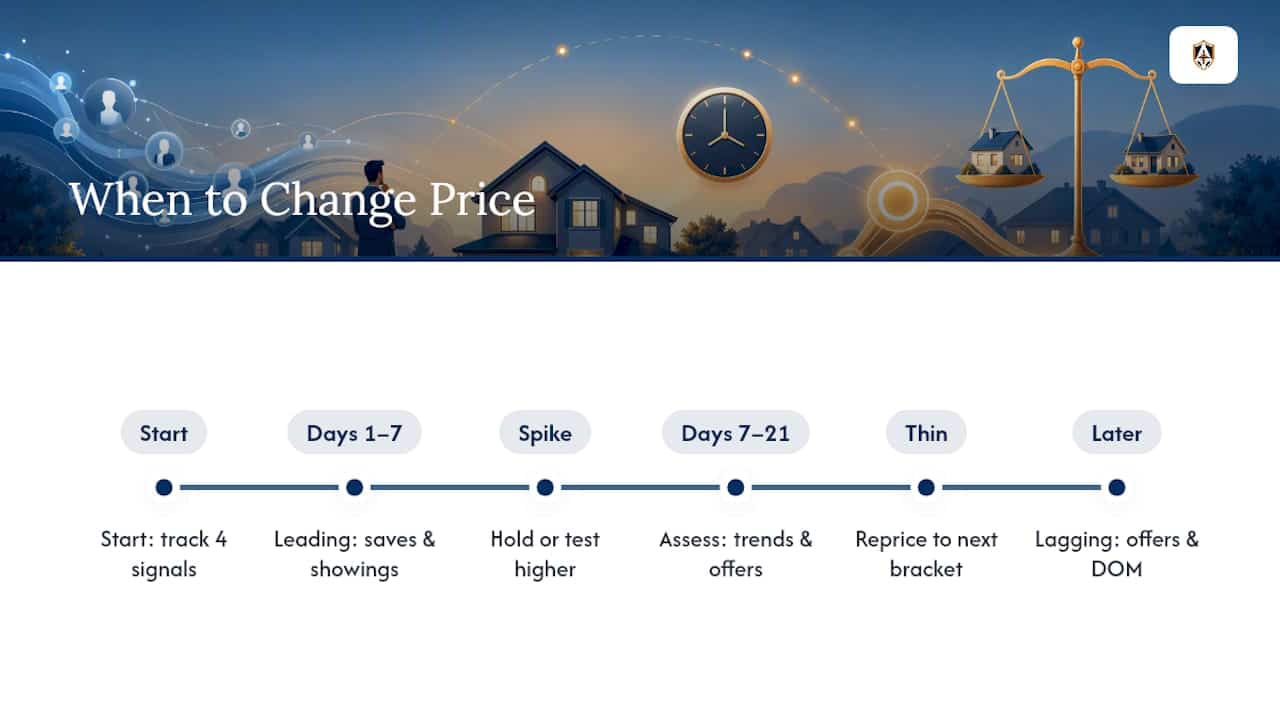
If showings are strong but offers aren’t coming, your price is likely fine and buyers need more time. If both showings and saves are thin after two weeks, that’s your signal to move, and the move should count. A $5,000 trim rarely changes anything if it keeps you in the same search bracket; drop enough to land in the next bucket down, whether that’s crossing a $25,000 line at lower price points or a larger threshold higher up.
On the flip side, a sudden spike in showings or a bidding scenario in the first week can justify holding firm or even testing a higher number if you haven’t accepted an offer yet. When you do reprice, frame it to buyers and agents as a response to specific market data, not a concession. “Adjusted based on 30-day local sales activity” reads very differently than silence followed by a sudden cut.
Pricing Mistakes That Quietly Cost Sellers Money
Emotional overpricing tops the list. Sellers anchor themselves to what they paid, what they spent on renovations, or what a neighbor claimed to get, rather than what current data supports. An objective CMA check, refreshed with 30-day activity, corrects this faster than any conversation about feelings, and Investopedia’s analysis of emotional pricing bias backs this up directly.
Other common errors: leaning on comps or index data that’s months old instead of local 30-day momentum, making token $1,000 to $2,000 price tweaks that don’t move you into a new search bracket, and listing without a pre-agreed testing window, which leaves everyone guessing when a price change is actually warranted.
How AAS Home Buyers Supports Sellers Through the Pricing Decision
AAS Home Buyers gives sellers more than one path to act on a pricing strategy. Through direct cash purchases, the Retail Buyer Program with managed listing and marketing, and referrals to vetted local agents, sellers get a transparent valuation and a real comparison point against agent CMAs. This matters most for sellers juggling speed against maximum price, or those handling complex situations like inherited property, major repairs, foreclosure timelines, or tenant issues where a standard listing approach adds friction. The three-step process is built to give sellers options rather than a single forced path.
Legal Considerations and Disclosures That Affect Your Price
Pricing decisions don’t happen in a vacuum separate from disclosure law. Every state requires sellers to disclose known material defects, things like a leaking roof, foundation cracks, past water damage, or pest infestations, and failing to disclose them can expose you to liability well after closing, even if you’ve already priced the home to reflect a discount for its condition.
If you’re pricing a home lower specifically because of a known issue, put that reasoning in writing where your disclosure forms require it. A price that seems to account for a problem informally, without documentation, doesn’t protect you if a buyer later claims they weren’t told. This connects directly to pricing strategy: a home with unresolved repair issues priced as if it were in good condition isn’t just an ethical problem, it’s a legal one that can unravel a sale during inspection or trigger a lawsuit after closing.
Special situations carry their own rules. Homes in probate, pre-foreclosure, or with tenant occupancy often have state-specific disclosure or timeline requirements that affect both what you can legally ask and how quickly you can close. If your home has additions or modifications, such as an accessory dwelling unit, confirm they’re permitted before you price in their added value, since unpermitted ADU conversions can complicate both appraisal and disclosure obligations. Sellers working through a reverse mortgage face additional payoff and timing considerations that can shape both price and closing structure, covered in more detail by specialty resources for reverse mortgage sales. When in doubt, a real estate attorney or your agent’s broker can confirm what your state requires before the listing goes live.
A Coaching Note on Staying Data-Driven Under Pressure
Pricing gets emotional fast, and the sellers who do best are the ones who treat their CMA as a compass, not a suggestion. Run the checklist. Test the market for real. If you want a second, objective number before you commit, a home buying service can help you compare options.
— AAS
Get a Pricing Benchmark or Explore Your Selling Options Today
Whichever pricing strategy you land on, certain home buying services can provide a faster way to act on it than waiting on a single agent’s opinion. Where a traditional listing locks you into one number and one timeline, options like direct cash purchases, managed retail programs, or vetted agent referrals can allow you to pressure-test your CMA against a real offer without committing to months on the market.

If speed matters more than chasing a ceiling, our guide on how to sell a house fast walks through how competitive pricing and timing work together. If you’re still comparing paths, our complete guide to home selling options breaks down cash offers, the Retail Buyer Program, and agent referrals side by side. Ready for a number you can compare against your agent’s CMA? Request a personalized valuation through our transparent three-step process and see where you actually stand before you commit to a list price.
Sources
- How To Price For The Search Range, Not Homeseller Preference | Inman Real Estate News
- The Pricing Trick Sellers (and Agents) Keep Using—Even Though It Might Be Costing Them — RISMedia
FAQ
What Is the 3-3-3 Rule for Home Buying?
It’s a useful reference for understanding how much your buyer pool can realistically afford at your list price.
What Are the Four Types of Pricing Strategies for Homes?
The main approaches are pricing below market to spark competition, pricing at market based on a CMA, pricing above market for sellers with no urgency, and dynamic pricing, which adjusts the number based on live demand signals in active submarkets.
What Salary Do You Need to Afford a $1,000,000 House?
Affordability depends heavily on interest rate, down payment, and existing debt, but many lenders use rough guidelines based on income and down payment to determine qualification for a conventional mortgage on homes around the million-dollar mark.
Should I Get a Second Opinion If My Agent’s Price Estimate Feels Off?
Yes. If a CMA feels disconnected from what you’re seeing in local listings, request a second agent opinion or a direct valuation from a company like AAS Home Buyers to benchmark the number before you commit to a list price.