
Sellers: Keep Earnest Money With a Contract Checklist or Cash Sale
Earnest money is the buyer’s good-faith deposit, and sellers only keep it when the buyer breaches the contract or misses agreed deadlines. In every other scenario, the funds sit in escrow and get credited to the buyer at closing. Before you accept an offer, confirm who holds the deposit, when it is due, and what the release instructions say, because those details decide whether the money is ever yours to claim.
TL;DR:
- Earnest money deposits typically range from 1% to 3% of the purchase price, varying by local market norms and buyer strategy.
- The deposit remains in escrow until closing and is credited toward the buyer’s costs unless the buyer defaults, in which case it may be forfeited to the seller.
- Sellers can retain earnest money if the buyer fails to deliver the deposit on time, breaches the contract, or if the contract specifies the deposit as non-refundable after certain milestones.
- Disputes over earnest money require documented breach notices and formal demands to escrow agents, with delays common until a mutual release or court order is obtained.
- Structures like direct purchase programs or vetted investment buyers offer faster, more predictable alternatives that eliminate deposit disputes and contingency delays.
Table of Contents
- What earnest money is, how much sellers typically see, and who holds it
- How earnest money is applied at closing and how that affects seller proceeds
- When a seller can keep earnest money: buyer defaults, missed deposit deadlines, and contract remedies
- Common buyer contingencies that affect refundability
- Contract checklist sellers should verify before accepting an offer
- How AAS Home Buyers and seller options change earnest-money dynamics
- Practical seller perspective: when fighting for the deposit makes sense
- AAS Home Buyers: an alternative for sellers who want certainty
- FAQ
- Sources
What earnest money is, how much sellers typically see, and who holds it
Earnest money is a buyer’s good-faith deposit that shows a serious intent to purchase. It is different from a down payment, which applies directly to the home’s purchase price at closing, and different from a non-refundable due-diligence or option fee, which some contracts use to buy the buyer time to inspect or research the property regardless of outcome.
Deposit size varies by market and contract. Industry guidance commonly cites a range of 1% to 10% of the purchase price, though many local markets settle into a narrower 1% to 3% norm. Some offers include a fixed dollar amount instead of a percentage, particularly in competitive markets where buyers want to signal strength without tying the deposit to price.
Buyers typically pay by certified check or wire transfer rather than personal check, since escrow holders need cleared funds they can account for.
- Title companies hold deposits in many transactions and manage disbursement under the purchase agreement.
- Real estate attorneys hold funds in states where attorney-involved closings are standard.
- Brokerage trust accounts sometimes serve as the holder when a listing agent’s firm manages the deposit directly.
Who holds the deposit matters to you as a seller because it determines how quickly funds move, what paperwork triggers a release, and whether a dispute gets resolved by a simple written demand or a slower legal process. Escrow and title companies handle deposits differently, so it is worth understanding the distinction before you sign.
How earnest money is applied at closing and how that affects seller proceeds
At closing, the deposit is almost always credited toward the buyer’s down payment or closing costs, not paid to you as an extra sum on top of the purchase price. Settlement accounting applies the deposit first against the buyer’s financial obligations, then issues any remaining balance back to the buyer if the deposit exceeded what was owed.
- The deposit reduces the cash the buyer needs to bring to the table, it does not add to what you receive.
- If the deposit is larger than the buyer’s remaining obligations, the surplus returns to the buyer, not to you.
- Your proceeds are calculated from the sale price minus your own costs and payoffs, independent of how the deposit gets applied on the buyer’s side.
There is one exception worth noting. If the buyer defaults and the contract designates the deposit as forfeited to you, that money becomes compensation for the failed transaction rather than a credit toward a purchase that never closes. In that case, and only that case, the deposit can functionally increase what you walk away with, though it rarely matches what you would have earned from a completed sale.
When a seller can keep earnest money: buyer defaults, missed deposit deadlines, and contract remedies
A handful of specific situations generally allow you to retain the deposit, and each depends on exact contract language.
- The buyer fails to deliver the deposit by the deadline stated in the contract.
- The buyer withdraws from the deal after contingency deadlines have already passed without an approved extension.
- The buyer materially breaches the contract, such as refusing to close without a valid contingency excuse.
- The offer itself designates part or all of the deposit as non-refundable once a certain milestone passes.
Contract language determines how enforceable your claim is. Watch for default remedy clauses, “time is of the essence” provisions that make deadlines strict rather than flexible, and language addressing attorney fees or mandatory mediation before either party can sue. Standard contract forms typically spell out a demand process: you submit a written demand to the escrow agent, and if the buyer does not formally object within the contract’s specified window, the agent may disburse the funds to you, minus any unpaid expenses.
The practical steps follow a logical order. Document the breach in writing, notify both the escrow holder and the buyer of your claim, then submit a formal demand to the escrow agent rather than trying to resolve it informally. Only escalate to mediation or court if the buyer objects or the escrow agent requires a mutual release before acting, since mediation often resolves these disputes faster and more cheaply than litigation.
Pro Tip: Expect delay even with a strong contractual claim. Escrow agents commonly hold funds until they receive a signed release or a court order, so budget time into your plans rather than assuming a quick payout.
Common buyer contingencies that affect refundability
Contingencies are contract conditions that let a buyer exit the deal and reclaim the deposit under specific circumstances. Understanding each one helps you set deadlines that protect your position as a seller.
- Inspection contingency: gives the buyer a window to inspect the property and request repairs or a price adjustment, with a deadline after which the contingency typically expires.
- Appraisal contingency: protects the buyer if the lender’s appraisal comes in below the purchase price, often allowing renegotiation or withdrawal.
- Financing contingency: covers a buyer who makes a genuine, documented effort to secure a loan but is denied, as opposed to a buyer who simply changes their mind.
- Home-sale contingency: lets a buyer make an offer contingent on selling their current home, though sellers often negotiate a kick-out clause that lets them keep marketing the property and accept a backup offer.
Once a contingency deadline passes without the buyer formally exercising it, that protection generally disappears, and a later withdrawal can convert what would have been a refundable deposit into a forfeited one.
Contract checklist sellers should verify before accepting an offer
A few minutes reviewing the contract before you sign can save weeks of dispute later.
- Confirm the named escrow holder, whether funds go into a protected trust account, and how deposit receipts are documented.
- Check the exact deposit amount, whether it is paid in stages, and the precise deadline for each payment.
- Look for non-refundable language and distinguish it clearly from any separate option or due-diligence fee.
- Verify whether “time is of the essence” language applies, since it makes deadlines strict rather than negotiable.
- Confirm the dispute-resolution process and whether a written mutual release is required before the escrow agent can disburse funds.
Purchase contracts vary by state and by the specific form a brokerage uses, so reading the actual language matters more than relying on general assumptions about how deposits work.
Pro Tip: Keep copies of every deposit receipt, deadline notice, and written communication with the buyer and escrow agent. If a dispute arises, a clear paper trail is often the difference between a fast resolution and a drawn-out argument.
How AAS Home Buyers and seller options change earnest-money dynamics
Not every seller wants to navigate deposit disputes or wait through contingency periods to find out whether a deal will close.
- A Direct Purchase through a home buying service can simplify the transaction, since cash offers often involve fewer financing and appraisal contingencies tied to deposit risk.
- Purchase by vetted investment partners connects you with buyers who move through closing on a predictable timeline, reducing the uncertainty that drives most earnest-money disputes.
- Programs offering retail buyer options and realtor referrals provide structured alternatives when you want professional guidance without committing to a single sale method upfront.
If you want to understand how a cash sale changes your closing costs compared with a conventional buyer, this breakdown walks through the differences.
Practical seller perspective: when fighting for the deposit makes sense
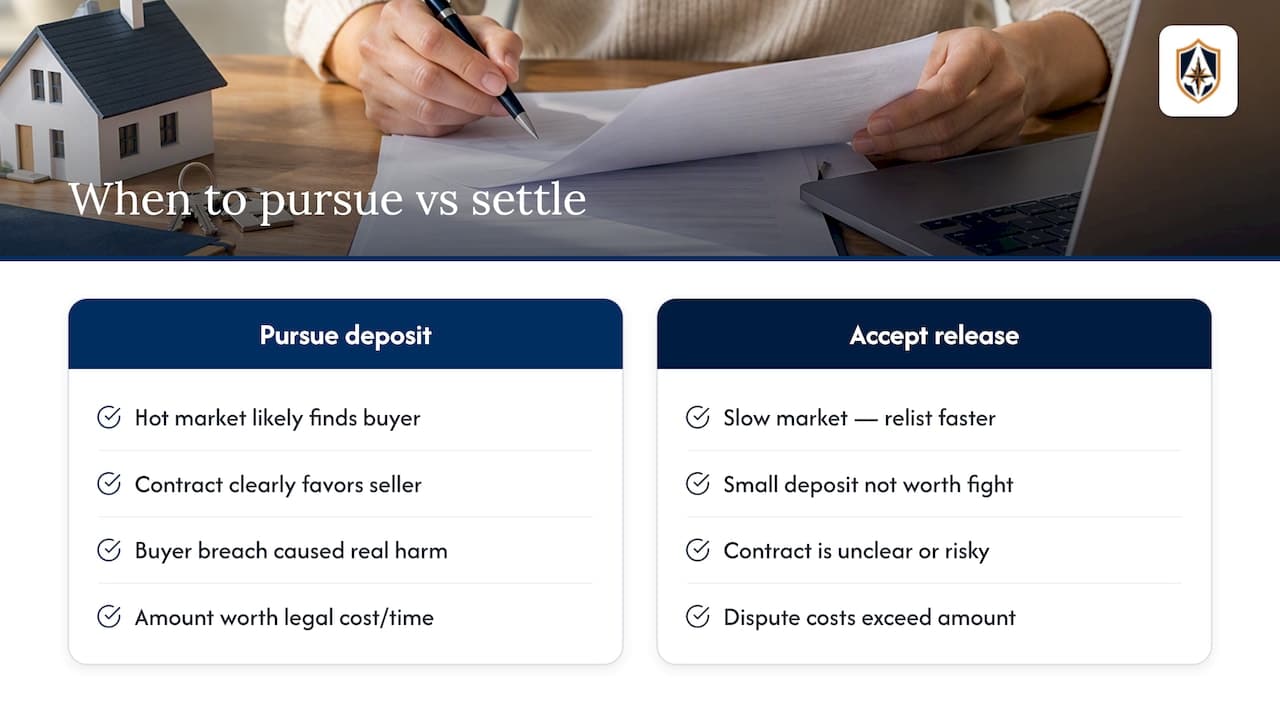
Pursuing a disputed deposit makes sense when the contract clearly favors you, the buyer’s breach caused real financial harm, and the amount at stake is worth more than the time and cost of mediation or court.
In a slow market, a small deposit, or a situation where you need to move quickly, accepting a written release and relisting is often the faster and less stressful path. A hot market tends to favor pursuing the claim, since a new buyer will likely appear soon regardless of the outcome. A slow market tends to favor settling, since every week spent disputing a few hundred dollars is a week your home sits unsold.
— AAS
AAS Home Buyers: an alternative for sellers who want certainty
If deposit disputes, contingency timelines, and escrow back-and-forth sound like more friction than you want, there is a more direct path. AAS Home Buyers offers a Direct Purchase option with transparent, data-driven valuations and no hidden fees, so you are not left waiting on a buyer’s financing or appraisal contingency to find out if your sale will actually close.

For sellers who still want a traditional listing but with structured support, retail buyer and realtor referral programs connect you with vetted options tailored to your property and timeline. You can review how each path works, including typical timelines and what to expect at closing, on the AAS Home Buyers process page. If you are ready to compare your options, visit AAS Home Buyers to get started.
FAQ
How much is earnest money on a $400,000 house?
Using the commonly cited 1% to 3% range, earnest money deposits typically range from 1% to 3% of the purchase price. The exact amount depends on local market norms and what the buyer and seller negotiate in the offer.
Do sellers get earnest money right away?
No, sellers do not receive earnest money right away in a normal transaction, since the funds stay in escrow until closing or until a dispute is resolved. The deposit is generally credited to the buyer’s costs at closing rather than paid out to the seller immediately.
Is 1% earnest money normal?
Yes, a 1% deposit falls within the commonly cited 1% to 10% range and sits at the lower end of what many markets consider customary. Some competitive markets push deposits higher to strengthen an offer, but 1% is not unusual.
How much is earnest money on a $600,000 house?
Applying the same 1% to 3% range, earnest money deposits typically range from 1% to 3% of the purchase price. Market conditions and the buyer’s strategy for standing out among other offers can push that figure toward the higher end.
Sources
- Consumer Guide: Escrow and Earnest Money
- TREC consumer protection notice and sample contract language (earnest money)
- The three biggest mistakes in mediating a residential purchase dispute