
Protect Net Proceeds as a Home Seller From Lowball Cash Offers
A lowball cash offer is a purchase bid set noticeably below your home’s fair market value, often used to test how motivated you are to sell quickly. Before responding, pause and request proof of funds. Investopedia’s definition of lowballing confirms this is a common opening tactic, and cash alone doesn’t guarantee stronger net proceeds, so verification matters more than the word “cash” on the offer.
TL;DR:
- Proof of funds verification is essential, requiring direct confirmation from banks and detailed assessment of the buyer’s entity to avoid scams.
- A lowball cash offer typically involves at least 10% below list price, but context like property condition and seller urgency can justify larger discounts.
- Buyers lowball for strategic reasons such as speed, investor costs, or testing seller flexibility, making documentation like earnest money deposits and proof-of-funds crucial for assessment.
- Evaluating a lowball offer should include net proceeds calculation, contract terms review, and consideration of timing, repair costs, and seller priorities before responding.
- Patterns of lowballing, especially in cash investor markets, can influence local sale prices and appraisal data, so sellers should base decisions on recent verified comparables.
Table of Contents
- What makes an offer a lowball offer
- Why buyers make lowball cash offers
- How to evaluate a lowball cash offer step by step
- How to respond with scripts, counters, and timing
- Scams and red flags specific to cash offers
- When a lower cash offer still makes sense
- Legal implications and protections for sellers
- Psychological tactics behind lowball offers
- Impact of lowball offers on market valuation trends
- How AAS Home Buyers approaches low cash offers and seller protection
- How AAS Home Buyers can help you move forward
- Sources
- FAQ
What makes an offer a lowball offer
There’s no official legal line that separates a lowball offer from a fair one, but sellers and agents use rough benchmarks. An offer roughly 10% below list price is commonly described as lowball, while anything 15% or more below asking is often considered a steep lowball, depending on local demand, according to the mechanics Investopedia outlines for lowballing. These percentages shift with context. A slow market, an outdated kitchen, or a seller who needs to close in two weeks can all justify a wider gap between asking price and a credible offer.
Consider a home listed at $300,000:
- A 5% reduction puts the offer at $285,000, which is within normal negotiating range in most markets.
- A 10% reduction lands at $270,000, often the point where sellers start asking hard questions.
- A 20% reduction drops to $240,000, a level that usually signals either a distressed-property angle or an aggressive opening bid.
None of these numbers tell you whether the offer is reasonable on its own. You need to know why the buyer landed there, and whether your property’s condition or your timeline explains the gap.
Why buyers make lowball cash offers
Cash buyers lowball for reasons that range from practical to purely tactical, and telling the two apart changes how you respond.
- Investors often price in repair costs, holding costs, and resale risk before they ever make an offer, so a bid that looks low may reflect a genuine as-is purchase strategy.
- Buyers who skip financing contingencies can close faster, and some use that speed as leverage to justify a lower number.
- Some offers are pure anchoring: a starting bid designed to see how much room a seller gives away without pushing back.
- Others are probing for urgency, hoping a seller who needs to move quickly will accept less rather than wait.
Serious buyers tend to show it. Look for a sizable earnest money deposit, a clean and verifiable proof-of-funds letter, a named buyer entity (an LLC or an individual, clearly identified), and a realistic closing timeline. A buyer who resists naming their entity or won’t produce documentation is giving you useful information before you even discuss price.
How to evaluate a lowball cash offer step by step
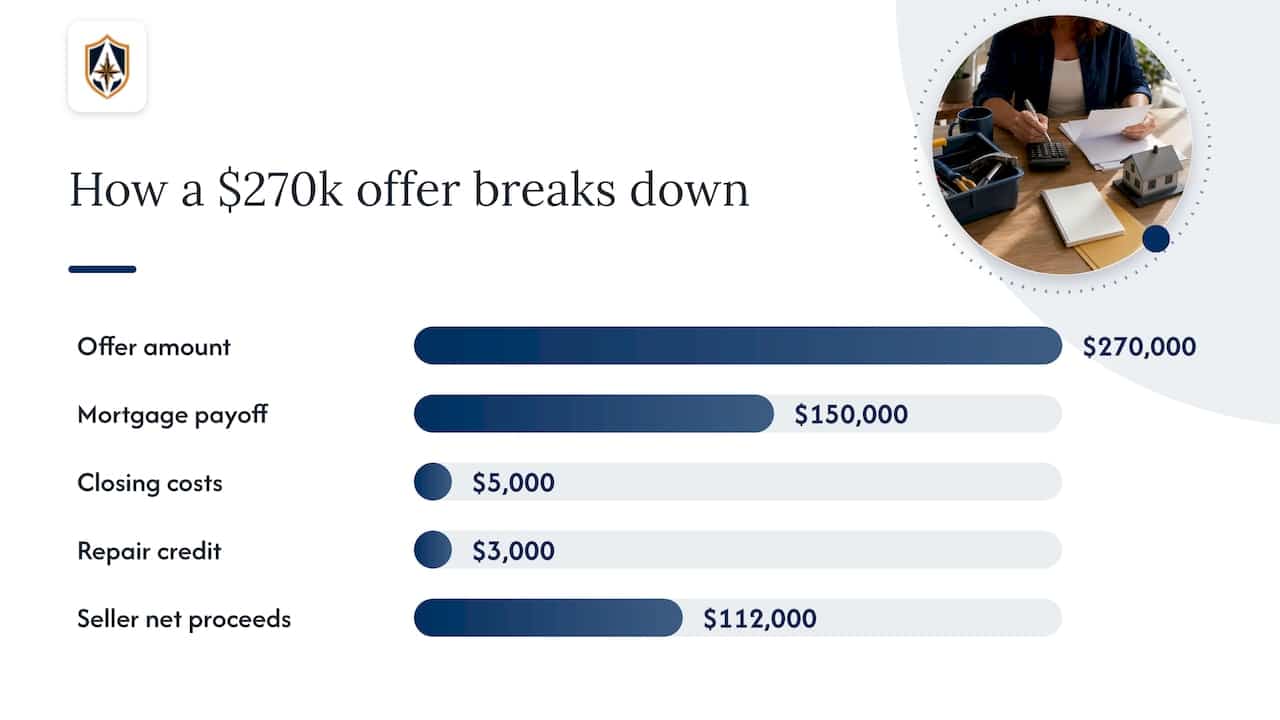
Treat every cash offer as a math problem first and a negotiation second. Cash purchases make up roughly 30% of recent home sales according to NAR’s Realtors Confidence Index, which means verification should be routine, not an accusation.
Statistic: Around 30% of buyers used all-cash financing in a recent NAR survey, so a cash offer alone says little about whether it’s a good one.
- Verify proof of funds. Ask for a bank statement or bank-issued letter dated within the last 30 days, and confirm it directly with the issuing bank or the buyer’s escrow agent rather than trusting the document alone.
- Confirm the buyer entity. Know whether you’re dealing with an individual or an LLC, and ask how long that entity has been purchasing property.
- Calculate net proceeds, not just price. Start with the offer, subtract your mortgage payoff, any commissions owed, closing costs, repair allowances, and requested concessions. A tool for calculating net proceeds can walk through this line by line.
- Run the numbers on a real example. Say a buyer offers $270,000 on a home with a $150,000 mortgage payoff, $5,000 in closing costs, and a $3,000 repair credit request. Net proceeds come to $270,000 minus $150,000 minus $5,000 minus $3,000, or $112,000.
- Check contract terms, including deposit size, inspection windows, contingencies, and what happens if the buyer walks away.
- Insist on title and settlement verification. Never wire funds based on emailed instructions alone. The CFPB’s guidance on closing scams recommends calling the title company using a previously verified number before sending any money.
Skipping any one of these steps is how sellers end up discovering, after the fact, that a “clean” cash offer cost them more than a lower-priced one with fewer strings attached.
How to respond with scripts, counters, and timing
Your first move after receiving a lowball offer should be measured, not emotional. Acknowledge the offer, ask for proof of funds and a written buyer valuation, and set a short deadline, 48 to 72 hours works well, for your decision.
- Price counter: “Thank you for your offer. Based on recent comparable sales, we’re countering at [price]. We’re open to discussing terms that work for both sides.”
- Terms counter: Ask for a larger earnest money deposit, a shortened inspection period, or a faster closing date in exchange for holding firm on price.
- Best-and-final template: “We’ve received multiple offers and are asking for best-and-final terms by [date and time]. Please include proof of funds with your response.”
- Polite rejection: “We appreciate your interest but have decided to move forward with another offer that better fits our needs.” Send this in writing, by e-mail or through your agent, so there’s a record.
Non-price levers often matter more than they seem. Requiring a bigger deposit, demanding a neutral title or escrow company instead of one the buyer suggests, and shortening contingency windows all reduce your risk without you budging on price.
Pro Tip: Always get buyer valuation and repair-scope claims in writing before you counter. Verbal justifications for a low offer tend to soften once they’re documented.
Scams and red flags specific to cash offers
Cash deals move fast, and that speed is exactly what scammers rely on. The FTC’s guidance on wiring money notes that pressure to act quickly is the central tactic behind most wire fraud, which makes a deliberate pause your strongest defense.
- Fake proof of funds: A bank letter means little until you call the issuing bank directly to confirm it’s real and current.
- Wiring diversion scams: If instructions change by e-mail at the last minute, treat it as a red flag and verify by phone using a number you already had, not one from the suspicious message, as the CFPB warns in its closing scam guidance.
- Upfront fee requests: Legitimate buyers never ask you to pay a “processing” or “release” fee to receive or finalize an offer.
- Referral pressure: If a buyer insists on a specific title or settlement company, ask whether a referral arrangement is involved, since RESPA rules restrict certain kickback practices.
Statistic: The FTC identifies wire transfers as one of the highest-loss payment methods scammers use, largely because transfers are difficult to reverse once sent.
A quick scam-check guide for sellers covers the same red flags in more detail if you want a reference while you’re reviewing an active offer.
When a lower cash offer still makes sense
Sometimes a lower but certain cash offer genuinely beats a higher, uncertain listing price. The decision usually comes down to timeline, repair cost, and what waiting actually costs you.
- A homeowner facing foreclosure with 30 days before auction may have no realistic path to a traditional sale, making a verified cash offer the only workable option.
- A property with major structural issues, foundation problems or extensive water damage, might cost more to repair than the gap between the cash offer and a hypothetical market-ready sale price.
- An inherited home tied up in probate, with carrying costs piling up each month, can make a faster close worth more than chasing top dollar.
Before accepting, ask yourself three questions: How long can you realistically wait for a better offer? Can you afford the repairs a traditional buyer would demand? What does another month of mortgage, taxes, and insurance cost you while you wait? If the answers point toward urgency or high carrying costs, a verified lower cash offer can be the financially sound choice rather than a compromise.
Legal implications and protections for sellers
Accepting or rejecting a cash offer carries real contract obligations once signatures are involved, so it pays to understand your protections before you sign anything. A signed purchase agreement is binding, which means contingencies, deposit terms, and deadlines need to be clear before you commit, not negotiated after the fact.
Sellers have the right to request an independent valuation, recent comparable sales, and a written repair scope before accepting any offer, cash or otherwise, according to NAR’s guidance on seller concessions. There’s no obligation to accept an offer sight unseen or without reviewing these materials.
A cash offer removes the lender’s role from the transaction, but it does not remove the need for enforceable deadlines, clear deposit language, and defined remedies if the buyer backs out, a point NAR’s broader contract guidance reinforces. If a buyer’s contract is vague on any of these points, that’s a request you’re entitled to make before signing, and a real estate attorney can review the language for a modest fee well before closing.
Psychological tactics behind lowball offers
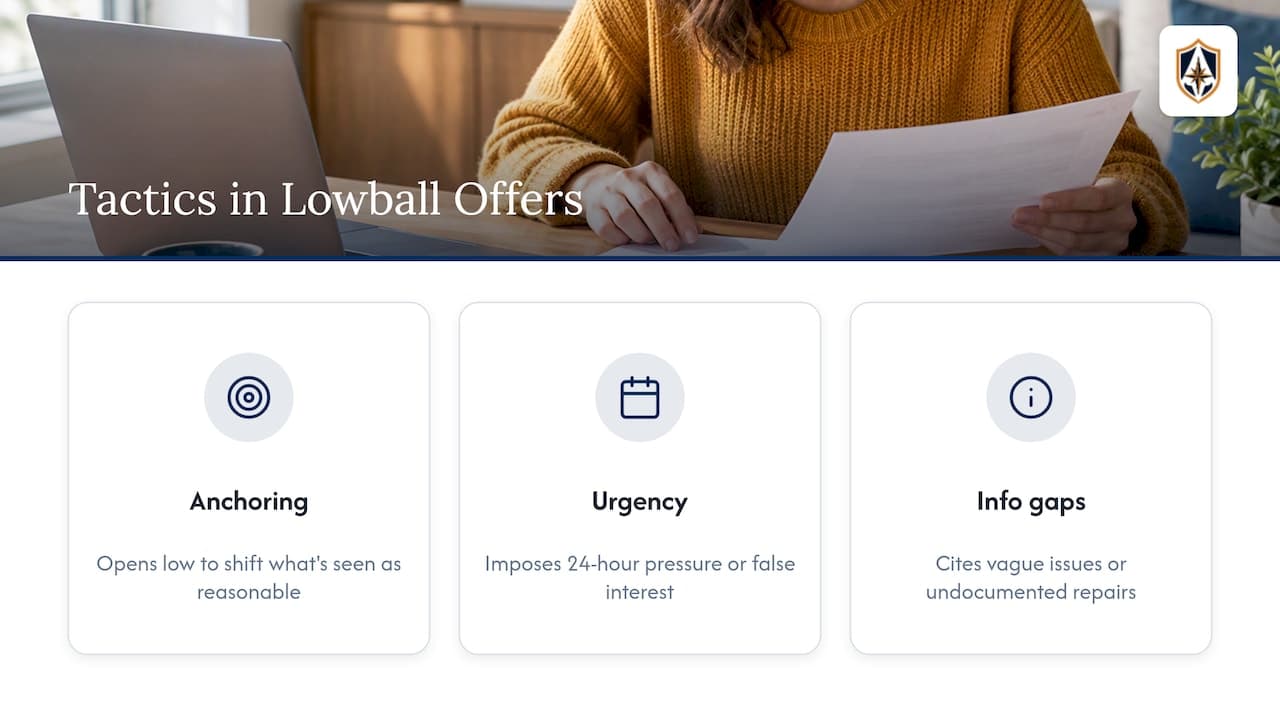
Lowball offers often work because they’re built around predictable seller psychology rather than market math. Anchoring is the most common tactic: a buyer opens low specifically to shift your sense of what’s reasonable, hoping you negotiate from their number instead of your own.
Urgency is the second lever. A buyer who implies the offer expires in 24 hours, or references other interested parties without proof, is trying to shorten the time you’d otherwise spend verifying documents or comparing offers. The FTC’s consumer guidance notes that pressure to act fast is the main tactic behind many money-related scams, and the same principle applies to lowball negotiating.
A third tactic plays on information gaps. If a buyer references vague “issues” with your property without specifics, or cites a repair estimate with no documentation, they’re hoping you’ll discount the home mentally before you’ve confirmed anything. Recognizing these patterns doesn’t mean every low offer is manipulative, but it does mean you should separate the number from the narrative around it and evaluate each on its own.
Impact of lowball offers on market valuation trends
A single lowball offer doesn’t move your home’s value, but patterns of them can shift how a market behaves. When a large share of buyers in a given area are cash investors testing discounts, comparable sales data can start to reflect those lower closed prices, especially in neighborhoods with a high concentration of distressed or investor-driven sales.
This matters most in markets where appraisers and agents pull comps from recent closings. If several below-market cash sales close in your area, the next appraisal might lean lower even for a well-maintained home, creating a ripple effect that has nothing to do with your property’s actual condition. Since cash purchases account for roughly 30% of transactions nationally according to NAR’s most recent confidence index, their influence on local comps is worth watching, particularly if you’re deciding between a quick cash sale and a traditional listing. Pulling your own recent comparable sales before you negotiate gives you a factual anchor that doesn’t depend on what any single buyer claims your home is worth.
How AAS Home Buyers approaches low cash offers and seller protection
This company was built around the idea that no single selling method fits every homeowner, which is why options include direct cash purchases, a retail buyer program with managed listing support, and connections to vetted local agents rather than pushing one outcome.
All valuations provided are transparent and documented, with no hidden fees built into the number. If a cash offer doesn’t align with a seller’s timeline or equity goals, alternative options may be recommended, whether a traditional listing or another path. Protecting seller proceeds is prioritized over closing any specific type of deal.
— AAS
How AAS Home Buyers can help you move forward
If you’re weighing a cash offer against other paths, you don’t have to choose between speed and getting a fair number. AAS Home Buyers offers a few distinct routes depending on what matters most to you right now.

- One option is a direct purchase that can provide a documented cash offer with no repairs or showings required.
- Another option includes a retail buyer program that lists your home with managed support if you want to pursue top dollar.
- The program also offers connections to vetted local agents for homeowners preferring a traditional sale.
You can review how each option works and request a transparent valuation to see where your numbers land before committing to anything. Whatever you decide, verify every document a buyer sends you, and have a real estate attorney review any contract before you sign. A second set of eyes on the fine print costs little compared to what a bad closing can cost you.
Sources
- Buying a home? Beware of mortgage closing scams (CFPB)
- Realtors Confidence Index (September 2025) — NAR
- What to know before you wire money (FTC)
- Lowballing definition and explanation (Investopedia)
FAQ
Should you respond to lowball offers?
Yes, a brief, professional response keeps the door open without obligating you to accept anything. Ask for proof of funds and a written valuation before you counter, since that information tells you whether the offer deserves serious negotiation.
What is a reasonable lowball offer?
Offers roughly 10% below list price are commonly described as lowball in normal market conditions, while 15% or more below asking is considered a steeper lowball, according to the negotiating patterns Investopedia outlines. Local market conditions, property condition, and seller urgency all shift what counts as reasonable.
Is it okay to offer $100,000 below asking price?
Whether that gap is reasonable depends entirely on the home’s list price and condition rather than the dollar figure itself.
How much less can you offer with a cash offer?
There’s no fixed percentage tied to paying cash specifically, since a cash offer’s value depends on verified funds, timeline, and contract terms rather than financing alone. Sellers should calculate net proceeds for any offer, cash or financed, before deciding how much of a discount makes sense.