
Owners & Heirs: Keep More Cash When You Sell a Reverse Mortgage Home
Yes, you can sell a home with a reverse mortgage at any time. Sale proceeds pay off the loan at closing, and you (or your heirs) keep whatever equity remains above the payoff amount. HECM loans carry no prepayment penalty, so there’s no cost to selling early. If the loan balance somehow exceeds the home’s value, FHA insurance and the loan’s non-recourse structure limit what you owe beyond the property itself.
TL;DR:
- Sellers with a reverse mortgage should request a fresh payoff estimate close to the actual closing date to avoid surprises from interest accrual and accrued advances.
- The sale process includes paying off the loan principal, interest, mortgage insurance, and servicer advances, which can significantly reduce net proceeds depending on the home’s sale price.
- Heirs have about six months to sell or pay off the loan after a due-and-payable notice, with extensions available if they actively market the property.
- If the home’s sale price is less than the loan balance, FHA insurance covers the shortfall, and heirs can satisfy the debt by paying 95% of the current appraised value.
- Selling within HUD’s timelines and coordinating payoff details in writing helps preserve estate value and avoid foreclosure risks.
Table of Contents
- Understanding the Reverse Mortgage Home Sale Payoff Process
- Reverse Mortgage Sale Timelines: Deadlines Owners and Heirs Face
- A Step-by-Step Checklist for Selling With a Reverse Mortgage
- Calculating Net Proceeds When You Sell a House With a Reverse Mortgage
- When the Reverse Mortgage Balance Exceeds Home Value
- What Heirs Should Do First After a Reverse Mortgage Borrower Dies
- Practical Selling Options When You Have a Reverse Mortgage
- Tax Implications of Selling a Home With a Reverse Mortgage
- How Selling Affects Eligibility for Government Benefits
- AAS Field Perspective: Common Pitfalls and What We Advise
- Selling a Reverse Mortgage Property? Here’s How AAS Home Buyers Helps
- Where to Verify the Rules Yourself
- Sources
- FAQ
Understanding the Reverse Mortgage Home Sale Payoff Process
A reverse mortgage is a lien against your home, not a debt you carry separately. When you sell, escrow orders a payoff demand from your loan servicer dated to your expected closing day. That figure isn’t just the original loan balance. It includes:
- The outstanding principal you’ve drawn over the life of the loan
- Accrued interest, which compounds and grows the total the longer the loan runs
- Mortgage insurance premiums tied to the FHA-insured HECM program
- Any servicer advances, such as property tax or insurance payments the lender made on your behalf
HECM loans have no prepayment penalty, so paying it off through a sale costs you nothing extra beyond the amount owed. The CFPB confirms that sale proceeds must repay the loan, and anything above the balance belongs to you. Because payoffs shift daily as interest accrues, request one dated to your actual closing rather than relying on an old statement.
Reverse Mortgage Sale Timelines: Deadlines Owners and Heirs Face
Certain events trigger a “due and payable” status on a reverse mortgage: selling the home, moving out for more than 12 consecutive months, or the borrower’s death. Once that happens, a clock starts.
- The servicer sends a due-and-payable notice, and heirs typically have about 30 days to respond with their intended plan.
- HUD guidance gives heirs roughly six months to sell the home or repay the loan after that notice.
- Two 90-day extensions are available if the estate can show it’s actively marketing the property.
- Missing these windows lets interest keep accruing and raises the risk the servicer initiates foreclosure.
Staying on schedule protects equity. Every month of delay adds accrued interest to the payoff, which shrinks whatever surplus is left for the seller or the estate.
A Step-by-Step Checklist for Selling With a Reverse Mortgage
Selling a reverse mortgage property follows the same broad path as any home sale, with a few extra coordination steps layered in.
- Contact your loan servicer first. Request a written payoff demand tied to your anticipated closing date, not a generic statement.
- Tell your agent and escrow or title company about the reverse mortgage. They’ll build the payoff request into the closing timeline automatically.
- Choose your sale path based on equity and urgency. A traditional listing often nets more over time; a cash offer closes faster when a HUD deadline is looming.
- Set your list price only after you know the payoff estimate, so you understand your realistic net proceeds before you accept an offer.
- Clear any delinquencies on property taxes, homeowners insurance, or HOA dues before closing, since unpaid amounts often show up as servicer advances added to the payoff.
- At closing, confirm escrow pays the servicer first. Verify in writing that remaining funds disburse to you or the estate afterward.
Pro Tip: Order your payoff demand the day you accept an offer, not the day before closing. Payoffs recalculate as interest accrues, and a stale figure can throw off your entire closing statement.
Calculating Net Proceeds When You Sell a House With a Reverse Mortgage
What you actually pocket from a reverse mortgage home sale depends on several deductions stacked against your sale price.
- The date-specific reverse mortgage payoff (principal, interest, insurance, advances)
- Any other liens on the property, such as a tax lien or judgment
- Real estate commissions, typically the largest single line item after the payoff
- Closing costs, including title fees and transfer taxes
- Repairs negotiated during inspection
- Unpaid property taxes, insurance, or HOA dues the servicer already advanced
Quick example: A home sells for $380,000. The date-specific payoff comes to $210,000. After subtracting the payoff and selling costs, the seller nets roughly $143,400, before any repair credits or lien payoffs.
Accrued interest and recent servicer advances can shift that payoff figure meaningfully between the time you list and the time you close, which is exactly why a stale payoff estimate causes so many closing surprises. Always ask for a fresh figure once you have a firm closing date. Our guide on calculating net proceeds from a home sale breaks down each deduction in more detail.
When the Reverse Mortgage Balance Exceeds Home Value
A HECM is a non-recourse loan. FHA mortgage insurance covers the shortfall if the loan balance ends up higher than what the home is worth, meaning you or your heirs never owe more than the property’s value, regardless of the loan balance on paper.
Heirs who want to keep the home rather than sell it have an option worth knowing:
- Under the 95% rule, heirs can satisfy the loan by paying 95% of the home’s current appraised value, even if the balance owed is higher
- A cash sale often closes faster than a traditional listing, which matters when HUD’s clock is running
- A deed in lieu of foreclosure avoids a drawn-out sale process entirely, though it forfeits any remaining equity
- Listing traditionally can maximize proceeds but takes longer and carries holding costs during marketing
The right choice usually comes down to a tradeoff between speed and maximizing what’s left over, especially when considering aging in place remodeling in Bucks County for post-sale housing options.
What Heirs Should Do First After a Reverse Mortgage Borrower Dies
Heirs face a short window to act, and the first moves matter most.
- Locate the loan servicer and all loan paperwork, then respond to the due-and-payable notice promptly rather than letting it sit.
- Gather legal documentation, such as a will or letters testamentary, so escrow and title companies recognize your authority to sell on the estate’s behalf.
- Compare a fast cash sale against a traditional listing, and request a HUD timeline extension in writing if the property is actively being marketed.
Executors managing an inherited property often benefit from a guide built specifically for selling an inherited house through probate, since probate paperwork adds its own layer to the reverse mortgage payoff process.
Practical Selling Options When You Have a Reverse Mortgage
Sellers with a reverse mortgage usually care about one of three things: speed, convenience, or squeezing out maximum proceeds. Services are structured around priorities such as speed, convenience, and maximizing proceeds. Options include direct cash purchase for sellers with urgent deadlines or accruing payoffs; a managed listing and marketing service for sellers seeking to maximize sale price without handling logistics themselves; and agent referrals for sellers seeking full market exposure and local representation.
Whichever route you choose, consider asking for:
- A transparent valuation before committing to a price
- A written timeline showing how payoff coordination fits into the closing schedule
- Clear fee disclosure with no hidden costs buried in the closing statement
Pro Tip: Get payoff handling in writing from whoever you sell to. A written commitment that escrow pays the servicer directly, before any funds reach you, prevents disputes at the closing table.
Tax Implications of Selling a Home With a Reverse Mortgage
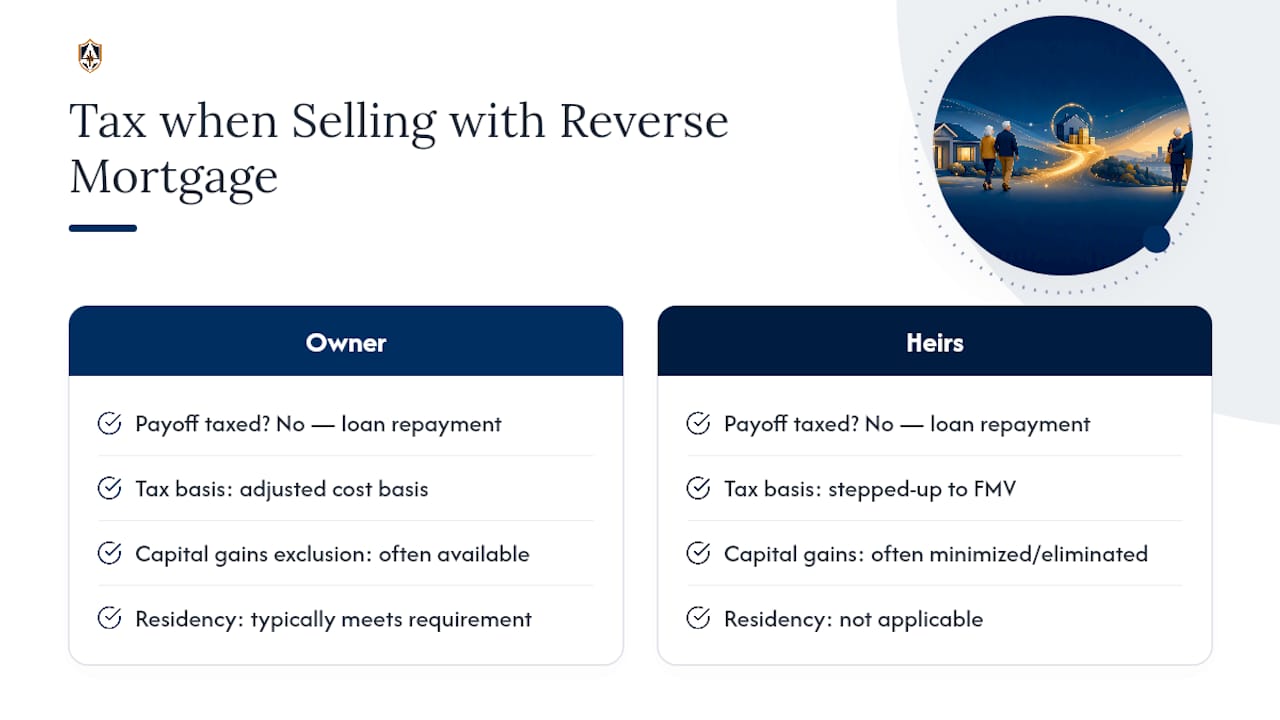
Selling doesn’t create a tax event by itself. The reverse mortgage payoff isn’t taxable income because it’s loan repayment, not a gain. What matters for taxes is the difference between your sale price and your home’s adjusted cost basis, the same calculation that applies to any home sale.
Most owner-occupied home sales qualify for the capital gains exclusion available on a primary residence, which shelters a significant portion of gain for single filers and a larger amount for married couples filing jointly, provided ownership and residency requirements are met. Reverse mortgage borrowers, who are required to occupy the home as their primary residence to keep the loan in good standing, typically meet that residency test without extra effort.
Heirs face a different calculation. Inherited property generally receives a stepped-up basis to fair market value at the date of death, which often minimizes or eliminates capital gains tax on a prompt sale. That’s one more reason selling within HUD’s timeline, rather than letting the property sit, tends to work in an estate’s favor financially as well as procedurally.
None of this replaces guidance from a tax professional familiar with your specific filing situation, especially if the home was a rental at any point or the estate involves multiple heirs. But the core point holds: a reverse mortgage payoff itself doesn’t generate a tax bill, and your gain calculation works the same way it would for any other home sale.
How Selling Affects Eligibility for Government Benefits
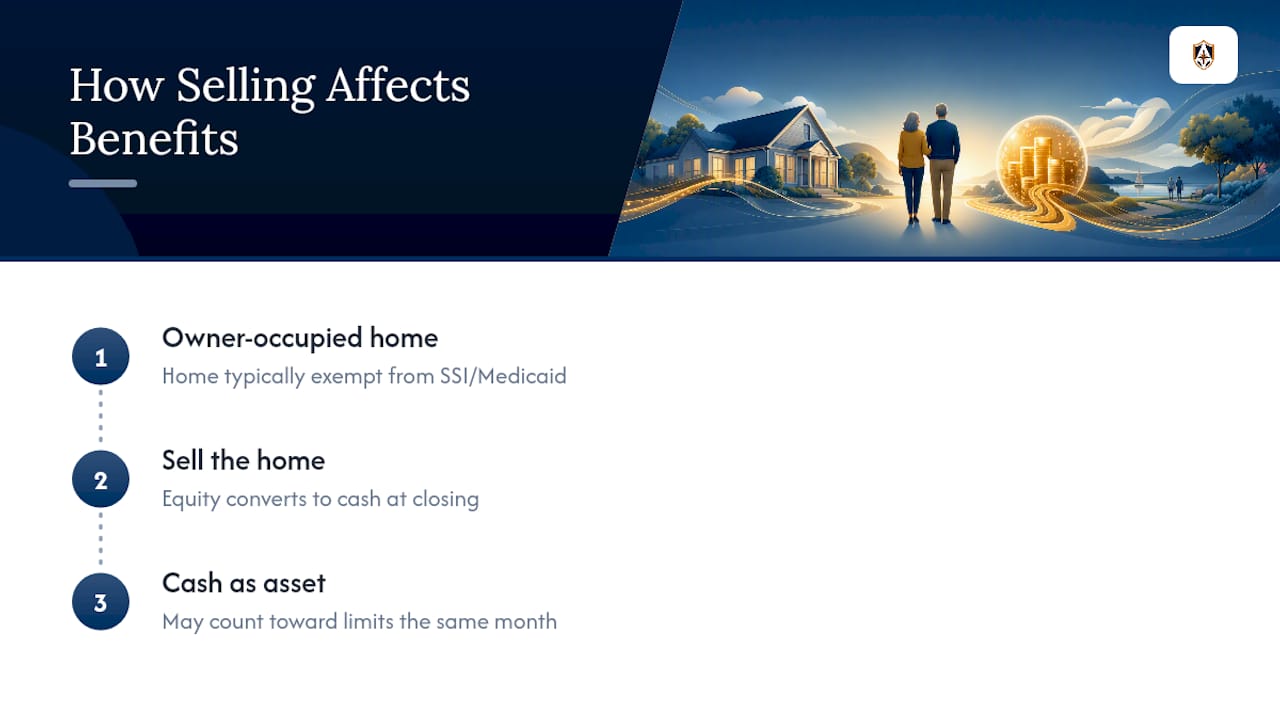
Selling a home with a reverse mortgage can affect need-based benefit eligibility, even though the sale itself isn’t taxable income. Programs like Supplemental Security Income and Medicaid impose strict asset limits, and cash sitting in your bank account after closing counts as a countable resource in ways your home equity did not while you owned the property.
A home you live in is typically exempt from Medicaid and SSI asset tests. Once you sell and convert that equity to cash, the picture changes. Proceeds sitting in a checking or savings account can push you over program asset thresholds within the same month you receive them, potentially suspending benefits until you spend down or reinvest those funds appropriately.
This matters most for older sellers already receiving Medicaid long-term care benefits or SSI. If you’re in that position, talk to a benefits counselor or elder law attorney before you close, not after. Some options, like certain annuities or exempt trusts, can help preserve eligibility, but they need to be set up correctly and often before funds change hands. Heirs distributing estate proceeds should ask the same question if they’re personally receiving need-based benefits themselves.
AAS Field Perspective: Common Pitfalls and What We Advise
The costliest mistakes we see aren’t complicated: sellers who request a payoff too late, owners who don’t disclose a tax or HOA delinquency upfront, or families who pick a sale path that doesn’t match their actual timeline. Our advice stays consistent. Order the payoff early, weigh a cash offer seriously when HUD’s clock is tight, and confirm wiring instructions with escrow before you ever get near a closing table.
— AAS
Selling a Reverse Mortgage Property? Here’s How AAS Home Buyers Helps
AAS Home Buyers gives reverse mortgage sellers something the payoff clock doesn’t always allow for elsewhere: a choice between speed and maximum sale price, made with full visibility into how the numbers work.

If a HUD deadline or accruing interest balance means every week counts, our direct cash purchase option can close on your timeline without waiting on buyer financing or a drawn-out listing period. If you have more runway and want to maximize what you walk away with, the Retail Buyer Program handles listing and marketing while keeping you informed at every step, and our vetted agent referrals connect you with local representation when full market exposure matters most. Whichever path fits, we provide a transparent, data-driven valuation and put fee disclosures and payoff coordination in writing before you commit to anything. Visit our transparent 3-step home selling process to see how offers, timelines, and payoff handling work together, or start with a no-obligation valuation to see what your reverse mortgage payoff and net proceeds could look like today.
Where to Verify the Rules Yourself
Servicer rules and HUD timelines can change, so it’s worth confirming details with primary sources directly. The CFPB’s guidance on selling with a reverse mortgage and HUD’s HECM FAQ page cover payoff and timeline rules directly. A HUD-approved housing counselor or your loan servicer remains your best contact for questions specific to your loan.
Sources
- What happens if I have a reverse mortgage and I want to sell my home? | Consumer Financial Protection Bureau
- CFPB reverse mortgage discussion guide (HECM details)
FAQ
Is It Hard to Sell a House That Has a Reverse Mortgage?
No. The process mirrors a standard home sale, with one added step: escrow requests a payoff demand from your servicer and pays the loan directly at closing before you receive any remaining funds.
How Does a Reverse Mortgage Work if You Sell the House?
Sale proceeds go toward paying off the loan balance first, and any amount above what you owe belongs to you or your heirs. If the sale price falls short of the balance, FHA insurance covers the gap.
What Happens to a House With a Reverse Mortgage When the Owner Dies?
The loan becomes due and payable, and heirs must sell, repay, or otherwise satisfy the loan within HUD’s timeline to keep the property from going into foreclosure.
What Is the 6 Month Rule for Reverse Mortgages?
HUD generally allows heirs about six months after the borrower’s death to sell the home or repay the loan, with up to two 90-day extensions available if the estate is actively marketing the property.