
Selling a House in the U.S.? See If $250k/$500k Keeps You Tax Free
Most homeowners selling their primary residence won’t owe federal tax at all. Single filers can exclude up to $250,000 of gain, and married couples filing jointly can exclude up to $500,000, as long as they meet the two years of ownership and two years of use within the five years before the sale.[250,000 exclusion, 500,000 exclusion]. Your next move: calculate your adjusted basis and check whether you’ll receive a Form 1099-S at closing.
TL;DR:
- Only homeowners meeting the ownership and use tests within the last five years can fully exclude gains up to $250,000 or $500,000 for singles or couples respectively.
- If the gain exceeds the exclusion limit or a Form 1099-S is issued, the sale must be reported on Schedule D and Form 8949, even if no tax is owed on the gain.
- Adjusted basis calculations must include capital improvements and deduct certain costs; failing to do so can lead to overpaying taxes.
- Rental, inherited, or business-use properties complicate the exclusion, requiring proper allocation and possibly triggering depreciation recapture.
- Homowners should gather purchase, improvement, and depreciation records beforehand to accurately determine taxable gain and avoid costly mistakes.
Table of Contents
- Who Qualifies for the Home Sale Tax Exclusion?
- How Do You Calculate Your Taxable Gain?
- When Do You Need to Report the Home Sale to the IRS?
- What Tax Rules Apply to Inherited Homes, Rentals, and Divorce?
- Three Real Scenarios: Do You Owe Tax or Not?
- What Mistakes Cost Homeowners the Most at Tax Time?
- How AAS Home Buyers Helps Sellers Plan for Tax Outcomes
- Get a Transparent Home Sale Estimate From AAS Home Buyers
- Where to Verify These Tax Rules Yourself
- Sources
- FAQ
Who Qualifies for the Home Sale Tax Exclusion?
The IRS ties your eligibility to two separate tests, and both need a “yes” before you can claim the full exclusion. The ownership test asks whether you owned the home for at least 24 months out of the five years ending on the sale date. The use test asks whether you actually lived in it as your main home for that same 24-month stretch.[ownership and use tests] These two years don’t need to be one continuous block. You could have lived in the house for 14 months, moved out for a stretch, and moved back for another 10, and still satisfy the ownership and use tests, as long as the total reaches 24 months within the five year window.
There’s a catch that trips up frequent sellers: you generally can’t claim this exclusion more than once in a two-year period. If you sold another home and excluded gain on it within the last 24 months, you’re typically disqualified from claiming it again, even if the current sale otherwise qualifies.
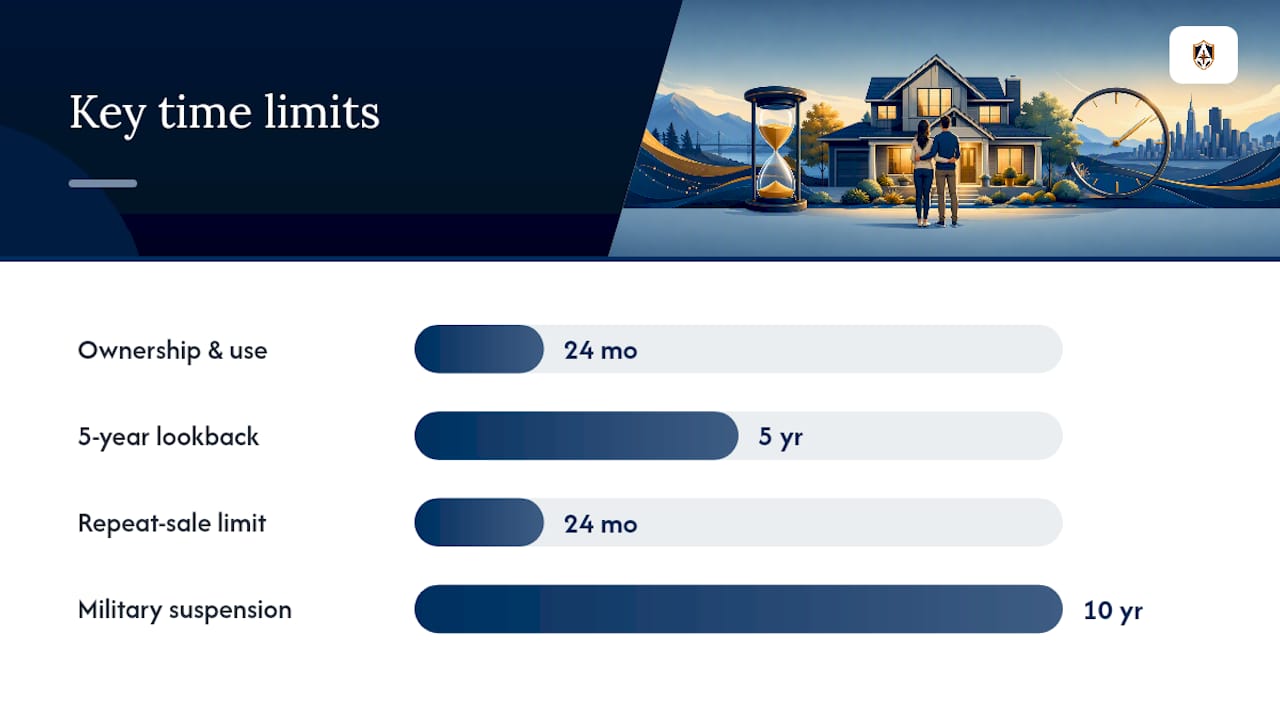
Married couples get treated somewhat flexibly. To claim the full $500,000 exclusion, both spouses need to meet the use test (both lived there), but only one spouse needs to meet the ownership test.[500,000 exclusion]. That distinction matters for couples where one spouse owned the home before the marriage.
A handful of exceptions let you claim a partial exclusion even when you fall short of the full two years:[partial exclusion for qualifying events]
- Active duty military or foreign service members can suspend the five-year test period for up to 10 years of qualifying service.
- A job relocation, a health condition, or an unforeseeable event can qualify you for a reduced exclusion based on how much of the two-year requirement you actually met.
- Divorce, death of a spouse, and multiple births from a single pregnancy are among the specific circumstances the IRS recognizes for partial relief.
One more clarifying point: this exclusion only applies to your principal residence under Section 121 of the tax code. A vacation home, a rental property you never lived in, or a house you bought purely as an investment doesn’t qualify, regardless of how long you’ve held it.
How Do You Calculate Your Taxable Gain?
Your taxable gain comes down to one formula: amount realized minus adjusted basis. Getting each number right is where most homeowners either overpay or underreport, usually by accident.
Amount realized is more than just your sale price. It includes the selling price agreed with the buyer, any debt the buyer assumed, the fair market value of any property or services received, minus selling expenses such as commissions, legal fees, and title insurance.[amount realized definition]
Adjusted basis starts with what you originally paid for the home, then gets adjusted up or down over your years of ownership. Capital improvements, a new roof, an added bathroom, a finished basement, increase your basis. Routine repairs, like fixing a leaky faucet or repainting a bedroom, do not. Certain settlement costs from your original purchase can also be added to basis, while energy credits or subsidies you claimed for the property typically reduce it. If you ever installed solar panels and claimed a federal credit, that adjustment matters here.
If you rented out the home or used part of it for business at any point, depreciation you claimed reduces your basis dollar for dollar. That depreciation may be recaptured as taxable income, and only the residential portion qualifies for the Section 121 exclusion.[depreciation rules]
Pro Tip: Pull your closing disclosure from the original purchase, every home improvement receipt you can find, and any past tax returns showing depreciation claimed on rental use. Missing paperwork here is the single biggest reason homeowners overpay on taxes they didn’t actually owe.
Before you calculate anything, gather your original purchase closing statement, receipts or contracts for improvements, records of any depreciation claimed, and your final closing statement from the sale. With those in hand, the math is straightforward: subtract adjusted basis from amount realized to get your gain, then subtract your exclusion amount to see what’s left, if anything.
When Do You Need to Report the Home Sale to the IRS?
The trigger that catches people off guard is Form 1099-S. If your title company or closing agent issues one, you generally must report the sale on your tax return, even if your gain is fully covered by the exclusion. Skipping this step because “I don’t owe anything anyway” is how homeowners end up with an unexpected IRS notice months later, since the agency already has a copy of that 1099-S on file.
When you do need to report:
- If your gain exceeds the exclusion amount, or any portion is taxable, you’ll report it on Schedule D (Form 1040) and Form 8949.[reporting gains]
- If you received a Form 1099-S but your entire gain is excludable, you still typically report the sale, showing the exclusion so the numbers reconcile with what the IRS received.
- If you’re not sure which boxes apply to your situation, the Publication 523 worksheets walk through each line, from calculating your exclusion to determining what, if anything, lands on Schedule D.
Installment sales add another layer. If you’re receiving payments over multiple years rather than a lump sum at closing, the Section 121 exclusion still applies to your eligible gain, but taxable income recognition follows installment sale rules under Publication 537.[installment sales] You can also elect out of installment reporting in the year of sale if you’d rather recognize the full gain immediately, which sometimes makes sense if you have losses elsewhere to offset it.
What Tax Rules Apply to Inherited Homes, Rentals, and Divorce?
Inherited property usually works in the heir’s favor. When you inherit a house, your basis typically resets to the home’s fair market value on the date the original owner died, a “step up” that can wipe out decades of appreciation for tax purposes. If you sell shortly after inheriting at close to that same value, you may owe little or no capital gains tax at all. Heirs navigating probate before a sale should keep the appraisal or valuation used for estate purposes, since that number becomes your new basis going forward. A deeper look at how inherited home sales typically play out can help if you’re also dealing with a probate timeline.
Rental or mixed-use property complicates the exclusion. If part of your home was rented out or used for business, you’ll need to allocate the gain between the personal-use and business-use portions. Only the personal-use share qualifies for exclusion, and any depreciation you claimed gets recaptured as taxable income regardless of how the rest of the sale shakes out.
Foreclosure, short sales, and canceled debt bring their own reporting rules. Canceled mortgage debt is often treated as taxable income unless a specific exclusion applies, and the rules here have shifted over the years, so this is a scenario worth confirming with a tax professional before you assume anything is automatically forgiven tax-free.
Divorce raises questions about who meets the ownership and use tests. A spouse who moved out as part of a separation agreement can often still count that time toward the use test if the ex-spouse continued living in the home under a divorce or separation instrument.
A few other notes worth keeping in mind:
- Losses on the sale of your personal residence are not deductible, no matter how far the sale price fell below your basis.
- Partial exclusions for job changes, health issues, or unforeseen circumstances are calculated based on the fraction of the two-year period you actually satisfied.
Three Real Scenarios: Do You Owe Tax or Not?
Numbers make this clearer than any explanation. Here’s how three common situations play out using the same basic formula: amount realized minus adjusted basis, minus exclusion.
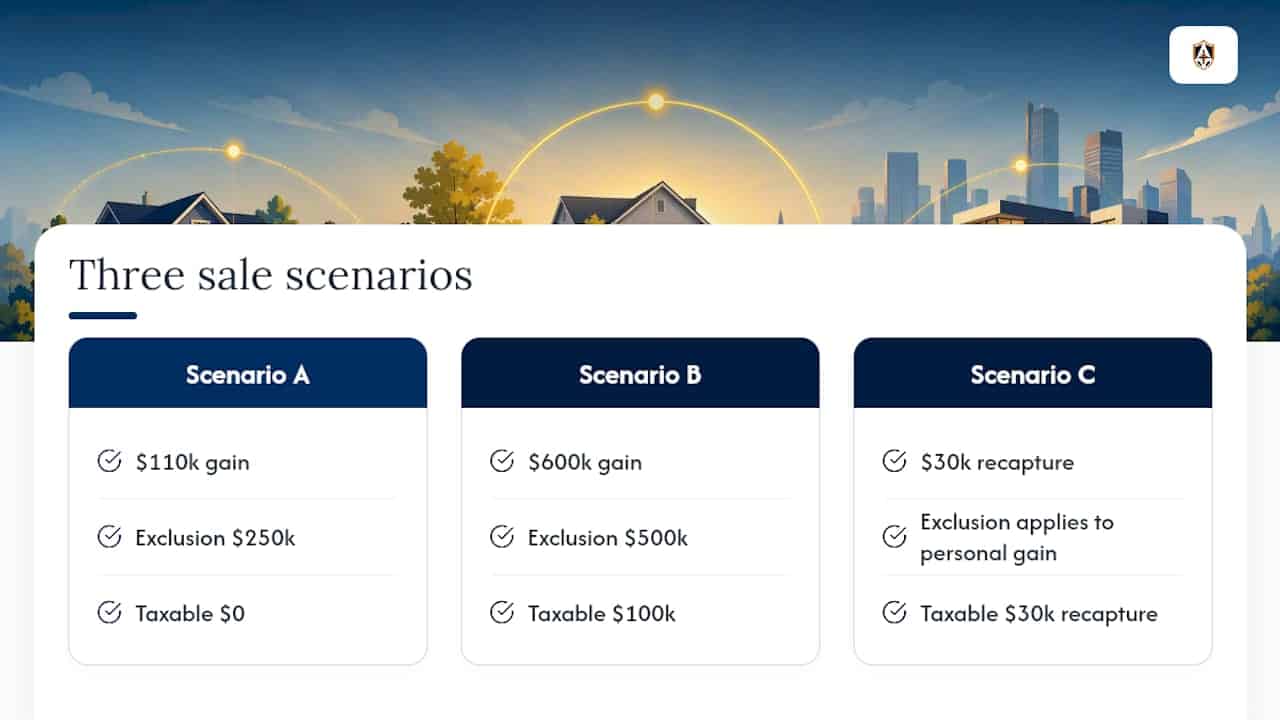
In Scenario A, the single filer’s $110,000 gain falls entirely under the $250,000 exclusion. No tax owed, though the sale may still need reporting if a 1099-S was issued.
In Scenario B, the couple’s $600,000 gain exceeds their combined $500,000 exclusion by $100,000. That excess gets reported on Schedule D and Form 8949 and taxed at capital gains rates.
In Scenario C, the seller used part of the home as a rental and claimed $30,000 in depreciation over the years. That $30,000 is recaptured as taxable income regardless of the exclusion, while the remaining personal-use gain may still qualify for exclusion up to the applicable limit. Each of these scenarios maps to a specific worksheet inside Publication 523, which walks through the exact lines for your filing status.
What Mistakes Cost Homeowners the Most at Tax Time?
The most expensive mistake is also the most avoidable: forgetting to add capital improvements to your basis. A kitchen remodel, a new HVAC system, an addition, these all raise your basis and shrink your taxable gain, but only if you can document them. Homeowners who toss old receipts often end up reporting a gain thousands of dollars higher than it should be.
Other common errors worth watching for:
- Forgetting to subtract selling expenses (commissions, legal fees, title costs) from the amount realized.
- Failing to report the sale after receiving a 1099-S, even when the gain is fully excludable.
- Mixing up repairs with improvements, only the latter adjusts your basis.
- Overlooking depreciation recapture on a home with any rental or business history.
Pro Tip: Build a simple folder, digital or physical, with your original purchase closing statement, every improvement receipt, your final closing disclosure, and any 1099-S you receive. That one habit resolves most of the disputes homeowners have with the IRS after a sale.
For anything involving mixed personal and rental use, a canceled debt situation, or a complicated divorce timeline, a CPA’s fee is usually far cheaper than an IRS correction letter.
How AAS Home Buyers Helps Sellers Plan for Tax Outcomes
Selling services assist sellers by reviewing rough numbers, purchase price, improvements, and expected sale price prior to closing, helping provide a realistic sense of potential tax exclusion eligibility.
When a situation involves rental history, an inherited property, or a canceled debt scenario, sellers are advised to consult a CPA or tax attorney before closing. Assistance may be provided in gathering the paperwork a tax professional will ask for. If you’re working through an inherited home, our guide to selling through probate covers the documentation side in more detail, and our overview of selling options explains how different sale paths can affect your timeline and your numbers.
— AAS
Get a Transparent Home Sale Estimate From AAS Home Buyers
Once you’ve got a handle on your likely tax outcome, the next question is usually how to sell without losing more equity than necessary. Selling services offer multiple paths including direct cash purchases, retail programs with listing support, or referrals to local agents, providing options beyond one-size-fits-all sales.

We build every valuation around your actual property and your actual documentation, rather than relying on generic formulas, which can be important for sellers with inherited homes, rental history, or tight timelines. Before you request pricing, pull together your purchase closing statement, improvement receipts, and any prior 1099 forms. That paperwork speeds up both our estimate and whatever your tax preparer needs afterward.
Ready to see your numbers? Start our three-step process to get a transparent, no-obligation valuation and talk through which selling path fits your situation best.
Where to Verify These Tax Rules Yourself
Every figure and rule in this guide traces back to IRS publications you can check directly. Publication 523, Selling Your Home, covers the exclusion, adjusted basis, and includes the worksheets referenced throughout this guide. Topic No. 701 summarizes the ownership and use tests in condensed form. The Form 1099-S instructions explain when that form gets issued and what it requires of you. For the mechanics of reporting a taxable gain, Schedule D and Form 8949 instructions inside Publication 523 walk through each line.
If your situation involves rental history, inherited property, or canceled debt, a licensed CPA or tax attorney should review your specific numbers before you file.
This article is general information, not a substitute for advice from a qualified financial advisor. Consult a qualified financial professional about your own circumstances before acting on anything here.
FAQ
How Much Federal Tax Do You Pay When You Sell a House?
It depends entirely on your gain after the exclusion. If your profit falls under $250,000 (single) or $500,000 (married filing jointly) and you meet the ownership and use tests, you typically owe nothing; anything above that is taxed at capital gains rates.
How Do You Avoid Capital Gains Tax When Selling a House?
Meet the two-of-five-year ownership and use tests so your gain qualifies for the $250,000/$500,000 exclusion, and make sure your adjusted basis includes every capital improvement you can document, since that directly shrinks any taxable gain.
How Much Is Capital Gains Tax on a $500,000 House Sale?
It depends on your adjusted basis, not the sale price alone. If your gain after subtracting basis and selling costs falls under your exclusion limit, you may owe nothing regardless of the $500,000 sale price; if it exceeds the exclusion, the excess is taxed at applicable capital gains rates.
Do You Always Pay IRS Taxes When Selling a House?
No. Most sellers of a primary residence who meet the ownership and use tests owe nothing, though you generally still need to report the sale if you receive a Form 1099-S, even when the gain is fully excluded.