
5 Steps Sellers Need for Title Insurance: Quitclaim vs Warranty Deed
A warranty deed guarantees the seller actually owns the property free of hidden claims, which is why it’s the standard for arm’s-length purchases. A quitclaim deed transfers only whatever interest the grantor happens to hold, with zero promises attached, so it works best for family transfers, divorce settlements, and other non-sale situations where trust already exists between the parties.
TL;DR:
- A quitclaim deed transfers only the interest the grantor currently holds, inheriting any existing title issues without promises or warranties.
- Warranty deeds include promises that the grantor owns the property free of liens and defects, offering the buyer legal recourse if problems arise.
- Lenders and title companies almost always require a warranty deed for financing, while quitclaims are mainly used for trust, family, or non-sale transfers.
- Using a quitclaim deed in a fair market sale can complicate title insurance and may expose buyers to hidden claims without legal remedies.
- Responding to potential title problems involves asking whether buying title insurance is still possible and verifying the grantor’s claim to ownership.
Table of Contents
- Quitclaim Deed vs Warranty Deed: What a Quitclaim Actually Does
- What a Warranty Deed Guarantees You
- Quitclaim vs Warranty Deed: The Practical Differences
- How to Decide Which Deed Fits Your Transfer
- What the Legal Record Says About Deed Risk
- What Sellers Should Weigh Before They Transfer Title
- Sources
- FAQ
Quitclaim Deed vs Warranty Deed: What a Quitclaim Actually Does
A quitclaim deed hands over whatever ownership interest the grantor has at that moment, no more and no less. If the grantor’s title is clean, the recipient gets clean title. If it’s clouded by a lien, an old easement, or a competing heir’s claim, the recipient inherits that problem too, because the deed contains no promises to the contrary.
Execution follows the same basic mechanics as any deed: the grantor signs it, a notary acknowledges the signature, and the county recorder’s office files it into the public record. Requirements shift slightly by state. Some counties want a legal description formatted a specific way, others require a transfer tax form filed alongside it, and a few states still recognize dower or homestead signature rules that trip up out-of-state grantors.
Quitclaims show up constantly in situations where money isn’t changing hands for fair market value:
- Adding or removing a spouse’s name after marriage or divorce
- Transferring property into a family trust or between siblings inheriting a house
- Clearing a “cloud” on title, like a name misspelling from decades ago
- Moving property into or out of an LLC the owner already controls
A properly signed, notarized, and recorded quitclaim deed is fully valid. The legal issue was never whether it works. It’s what happens afterward if a title problem surfaces and the new owner has no warranty to fall back on.
What a Warranty Deed Guarantees You
A warranty deed does something a quitclaim never attempts: it makes legally binding promises about the condition of the title being transferred. The grantor is stating, in writing, that they own the property, have the legal right to sell it, and that no hidden liens or competing claims exist that they haven’t already disclosed.
Those promises are called covenants, and they typically include:
- Covenant of seisin: the grantor actually owns the interest being conveyed
- Covenant against encumbrances: no undisclosed mortgages, liens, or easements exist
- Covenant of quiet enjoyment: the buyer won’t be disturbed by a third party’s superior claim
- Covenant of further assurance: the grantor will fix paperwork problems that surface later
There are two main flavors. A general warranty deed covers the property’s entire history, even defects that occurred before the current seller owned it. A special warranty deed, sometimes called a limited warranty deed, only guarantees against problems that arose during the current seller’s period of ownership, which is why it shows up often in estate sales and commercial deals where the seller can’t vouch for what happened generations ago.
Lenders and title companies expect a warranty deed in nearly every financed purchase, because it creates a contractual party the buyer can pursue if title problems emerge after closing.
Quitclaim vs Warranty Deed: The Practical Differences
The gap between these two documents comes down to one question: who’s on the hook if the title turns out to be wrong?
| Factor | Quitclaim deed | Warranty deed |
|---|---|---|
| Warranties | None | Yes, one or more covenants |
| Buyer recourse if title is defective | Little to none | Can sue the grantor for breach |
| Lender acceptance for financing | Rarely accepted | Standard requirement |
| Owner’s title insurance availability | Often difficult to obtain | Typically straightforward |
| Typical use | Family, divorce, trust transfers | Arm’s-length sales |
A general warranty gives you a contractual remedy against a specific person. Title insurance covers a wider set of hidden problems and steps in even when the seller has vanished or can’t pay. The two aren’t interchangeable, and a warranty deed alone doesn’t replace a policy.
Before accepting a quitclaim in any transaction involving real money, ask:
- Can I still get an owner’s title insurance policy on this property?
- Does my lender require a warranty deed to close the loan?
- What’s the grantor’s actual claim to this property, and can they prove it?
How to Decide Which Deed Fits Your Transfer
Choosing the right deed isn’t guesswork. It follows a short set of criteria you can walk through before you sign anything.
- Determine whether money is changing hands at fair market value. If yes, a warranty deed is almost always the appropriate instrument.
- Check whether a lender is involved. Mortgage lenders routinely require a warranty deed as a condition of financing.
- Assess trust between the parties. Family transfers, amicable divorce settlements, and trust funding rarely need warranties because the parties already know the property’s history.
- Flag any known title issues. If there’s a pending lien, a boundary dispute, or an heir who hasn’t signed off, a quitclaim won’t fix that problem, and a warranty deed exposes the grantor to a claim they may not be able to back up.
- Consider a special warranty deed for estate or representative sales, since executors and trustees often can’t vouch for the property’s full history but still want to offer more protection than a quitclaim.
Practitioners caution that using a quitclaim in a sale for fair market value is usually inappropriate, since it removes the buyer’s statutory path to recourse and tends to invite disputes after closing.
Pro Tip: Get an owner’s title insurance policy regardless of which deed you receive. A warranty deed gives you someone to sue; title insurance gives you a company that actually pays out when problems surface years later.
What the Legal Record Says About Deed Risk
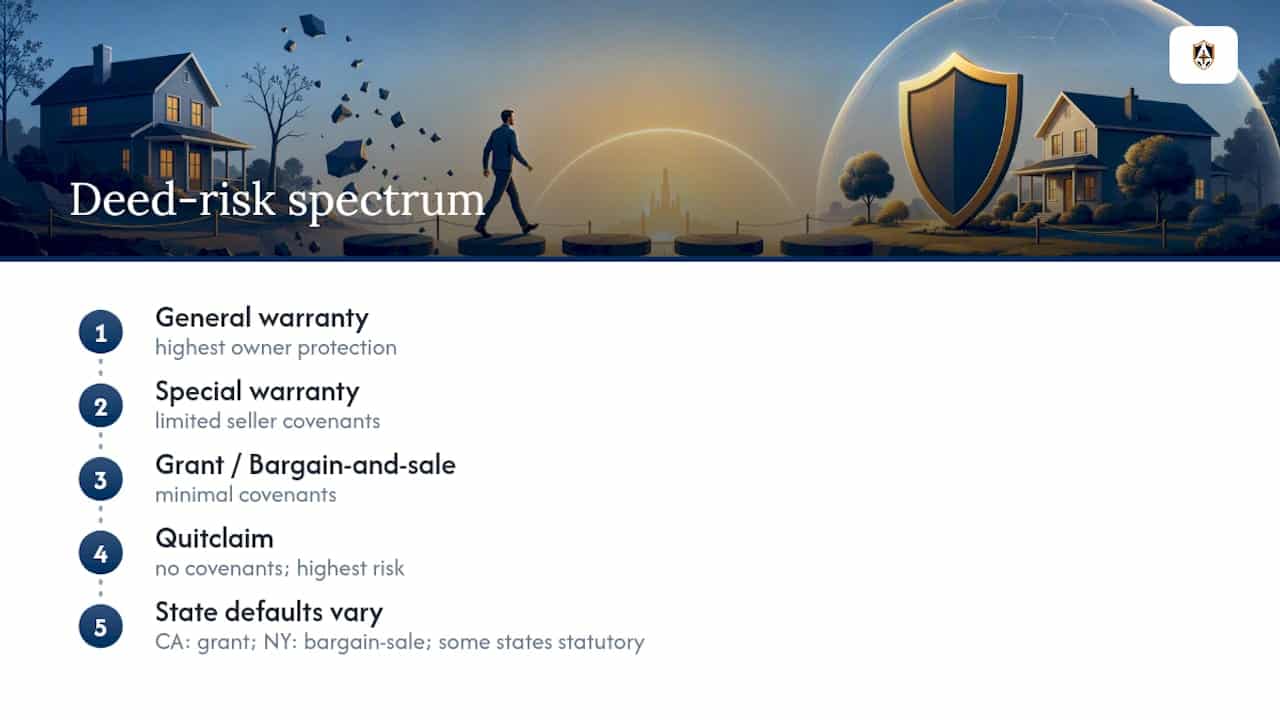
That spectrum runs from general warranty, to special warranty, to grant or bargain-and-sale deeds, down to quitclaim at the bottom. A Colorado Bar Association analysis of real estate deed practice notes that several states default to different forms entirely. California commonly uses grant deeds, New York often relies on bargain-and-sale deeds, and several states have statutory warranty deed forms baked into their codes. Terminology that sounds unfamiliar in your state isn’t necessarily a red flag, but it’s worth confirming with local counsel or a title company.
The title insurance angle deserves its own caution: a quitclaim deed can sever the continuation clauses in an existing owner’s title policy, meaning a new owner may have to purchase a fresh policy at their own cost, even in a transfer between family members. Accepting a quitclaim in a standard purchase often prevents obtaining owner’s title insurance altogether, which leaves the buyer with no financial backstop if a stranger later shows up with a valid competing claim.
What Sellers Should Weigh Before They Transfer Title
Deed choice shapes how ready your property is to sell. Buyers and their lenders expect a clean warranty deed at closing, and any quitclaim in the property’s recent history tends to trigger extra title company scrutiny before a policy gets issued.
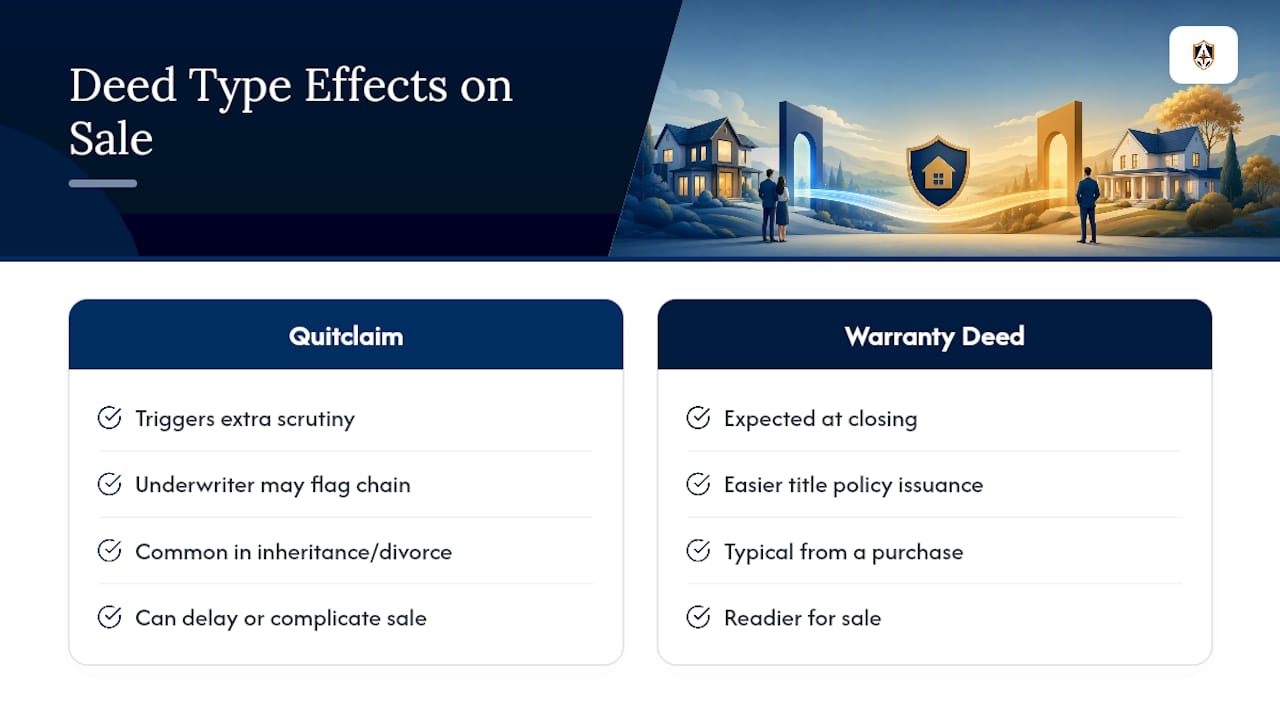
If you’re navigating an inherited property, a divorce, or a title cloud from years back, talk to a title company or real estate attorney before you record anything. Getting the deed right the first time avoids a scramble later when a buyer’s underwriter flags the chain of title.
When the goal is simply selling, whether the property came to you through a quitclaim or a standard purchase, AAS Home Buyers can walk through selling options that fit your actual situation, title complications included.
— AAS
Sources
For deeper reading on deed law and title protections, consult the Legal Information Institute’s Wex entry on bona fide purchaser status, the Ohio State Bar Association’s quitclaim deed overview, and U.S. Bank’s explainer on warranty deeds. Readers weighing co-ownership arrangements may also find this breakdown of deed of trust clauses useful.
This article is general information, not a substitute for advice from a qualified lawyer. Consult a qualified legal professional about your own circumstances before acting on anything here.
- Legal Information Institute — Wex: Bona fide purchaser / deed explanations
- Realtor
- Colorado Bar Association — Real estate deed forms and warranties (practitioner article)
FAQ
Is a Quitclaim Deed as Good as a Warranty Deed?
No. A quitclaim deed transfers whatever interest the grantor holds with no guarantees, while a warranty deed legally promises clear title and gives the buyer recourse if that promise turns out to be false.
Who Benefits the Most From a Quitclaim Deed?
Family members transferring property between relatives, divorcing spouses adjusting ownership, and trustees funding a family trust benefit most, since these transfers rely on existing trust rather than a stranger’s guarantee.
How Long Does a Quitclaim Deed Give You Ownership?
A quitclaim deed conveys ownership permanently once it’s signed, notarized, and recorded, exactly like any other deed. There’s no built-in expiration; the risk is in the quality of the title received, not the duration of the transfer.
What Are the Disadvantages of a Quitclaim Deed?
The biggest disadvantages are the lack of any warranty against hidden defects and the difficulty of getting owner’s title insurance afterward, which can leave a buyer without recourse if a competing claim to the property surfaces later.