
Cap Your Cash Risk With a $10,000 Example: Appraisal Gap Clause for Buyers
An appraisal gap clause is your written promise to cover the difference, up to a set dollar amount, if the home’s appraised value comes in below your offer. Buyers use it to strengthen offers in competitive markets, but it requires cash at closing above your down payment. Cap your exposure and keep an appraisal contingency alongside it, so a bad appraisal never forces you into a deal you can’t afford.
TL;DR:
- Buyers should set a fixed dollar cap on their appraisal gap to ensure they can afford the out-of-pocket payment if the appraisal comes in low.
- Combining an appraisal gap clause with an active appraisal contingency provides protection against exceeding financial limits when the appraisal drops below the offer price.
- It is essential to prepare proof of funds, a realistic timeline, and lender confirmation before submitting a gap offer to prevent surprises or disputes.
- FHA and VA loans override gap clauses with mandatory protections that allow buyers to cancel and recover their earnest money if appraised values are low.
- Setting a gap cap based on actual cash availability and confirming documentation with lenders helps buyers avoid overextending in competitive markets.
Table of Contents
- How Does an Appraisal Gap Clause Work in a Purchase Contract?
- Appraisal Gap Clause vs. Appraisal Contingency: How Do They Work Together?
- What Should an Appraisal Gap Clause Actually Say?
- What Are Your Options When the Appraisal Comes In Low?
- How Do FHA and VA Rules Affect an Appraisal Gap Clause?
- How Do You Pick an Affordable Gap Cap?
- What Should You Prepare Before Submitting a Gap Offer?
- Our Take: Cap Your Risk Before You Chase the Deal
- Where to Learn More
- Sources
- FAQ
How Does an Appraisal Gap Clause Work in a Purchase Contract?
An appraised value is what your lender’s independent appraiser says the home is worth. The contract price is what you agreed to pay. When those two numbers don’t match, and the appraisal comes in lower, you have an appraisal gap.
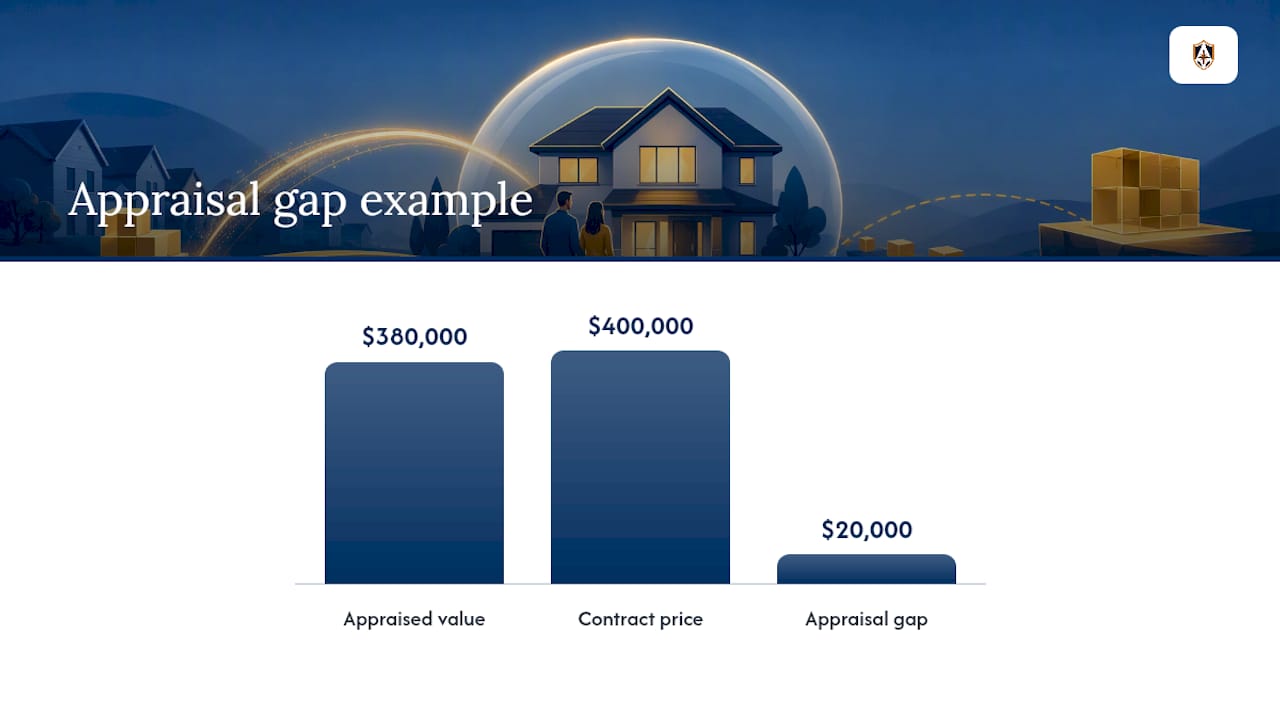
Lenders won’t loan more than a property is worth. If you offered $400,000 and the appraisal says $380,000, your lender bases your mortgage on the lower figure. That leaves a $20,000 hole between what the bank will finance and what the seller expects. An appraisal gap clause commits you to filling part or all of that hole in cash, rather than asking the seller to drop the price or walking away.
The clause activates the moment your lender orders and receives the appraisal. From there, three mechanics matter most:
- The cap, a fixed dollar amount you’re willing to pay above the appraised value
- The ceiling, language confirming you’ll never pay more than your original offer, regardless of how low the appraisal comes in
- The payment timing, which specifies the gap funds are due as extra cash at closing, separate from your down payment
Sellers read this clause as proof your offer can survive a low valuation. That’s exactly why it shows up so often in bidding wars.
Appraisal Gap Clause vs. Appraisal Contingency: How Do They Work Together?
An appraisal contingency protects you. It lets you cancel the contract and get your earnest money back if the home appraises below the contract price, with no obligation to proceed. A gap clause does the opposite: it’s an affirmative commitment to pay, not an escape hatch.
Used alone, an appraisal contingency can make your offer look weak in a seller’s market, because sellers see an easy way out for you. Used alone, a gap clause with no cap is dangerous, because you’re agreeing to cover an unknown shortfall with no ceiling. Combining them correctly is what actually protects buyers:
- Cap the gap clause at a specific dollar figure you can actually fund in cash
- Keep the appraisal contingency active for any shortfall beyond that cap
- Sequence the language so the contingency only triggers once the gap exceeds your stated cap, not before
Pro Tip: Have your agent write the gap cap and the contingency threshold in the same paragraph. Separating them into different sections of the contract is where most ambiguity, and most disputes, start.
What Should an Appraisal Gap Clause Actually Say?
A workable clause needs six specific components. Skip any one of them and you’ve written something a seller’s attorney can poke holes in later.
- Maximum dollar cap. The exact amount you’ll pay above the appraised value, stated as a number, not a percentage that leaves room for argument.
- Trigger appraisal. Language tying the clause to the lender-ordered appraisal specifically, not any informal valuation.
- Ceiling at purchase price. A statement you’ll never pay more than the original contract price, even if your cap technically allows it.
- Source of funds. Confirmation the gap money comes from cash at closing, not mortgage proceeds.
- Timeline. A short window, often around five business days, for the seller to respond once the appraisal comes back low.
- Contingency fallback. What happens if the gap exceeds your cap, typically the right to renegotiate or terminate.
Practical drafting guidance recommends language along these lines for a straightforward clause:
A more protective version adds a fallback:
Attach proof-of-funds documentation, or escrow instructions confirming where the gap money sits, when you submit either version. Sellers want evidence, not just promises.
What Are Your Options When the Appraisal Comes In Low?
A low appraisal isn’t the end of the deal. You generally have four paths forward, and each carries different financial consequences:
- Pay the difference in cash. This keeps the deal alive at the original price, but the money comes on top of your down payment and closing costs, not folded into the mortgage.
- Renegotiate with the seller. Bring the appraisal report as evidence and ask the seller to meet you closer to the appraised value. Sellers in cooling markets often agree rather than restart the search for a buyer.
- Challenge the appraisal. Request a reconsideration of value from your lender if you have solid comparable sales the appraiser missed. This works occasionally, not often, and takes time you may not have.
- Invoke the appraisal contingency. If your cap has been exceeded and the contingency is still active, you can cancel and recover your earnest money deposit.
Which option makes sense depends entirely on how much cash you have left after your down payment, and how badly you want that specific house.
How Do FHA and VA Rules Affect an Appraisal Gap Clause?
FHA and VA loans come with federally mandated protections that sit above any gap clause you write. The HUD amendatory clause guarantees FHA buyers the right to cancel without penalty if the property appraises below the contract price, and recover their earnest money in full. VA loans carry a comparable escape provision.
These protections override conflicting contract language. A few things to keep in mind:
- You cannot waive the amendatory clause protection, even if your gap clause implies otherwise
- Any gap cap you agree to should be written as voluntary, layered on top of the mandatory escape right, never as a replacement for it
- Agents drafting offers for FHA or VA buyers should flag this explicitly so sellers understand the difference upfront
How Do You Pick an Affordable Gap Cap?
Start with the math, not your gut. If you offer $400,000 and the appraisal lands at $380,000, your gap is $20,000. Set your cap at $10,000, and you’d pay that amount in cash, then renegotiate or terminate under your contingency for anything beyond it.

Because lenders base your loan amount strictly on the appraised value, the gap can’t be rolled into your mortgage. It’s cash, due at closing, separate from your down payment.
A few guidelines worth following:
- Cap your gap as a fixed dollar figure, not a percentage, so you always know your worst-case number
- Set the cap at an amount you could produce within days, not one that depends on selling other assets
- Confirm with your lender that your gap funds are documented as separate from mortgage proceeds and won’t affect your loan approval
Run the numbers on a mortgage calculator before you submit an offer, so your cap reflects real cash-at-closing math instead of a round number picked to sound competitive.
What Should You Prepare Before Submitting a Gap Offer?
Sellers and their agents look for specific proof before they trust a gap clause. Get these ready before your agent submits the offer:
- Proof of funds for the gap amount, separate from your down payment and closing cost reserves.
- Your earnest money amount, clearly stated, since larger deposits signal a more serious offer.
- A realistic appraisal timeline, coordinated with your lender so everyone knows when the report is due.
- Confirmation from your lender that the gap funds won’t disrupt your loan approval or debt-to-income calculations.
Pro Tip: Never waive your appraisal contingency entirely to “win” a bidding war. An uncapped waiver with no fallback is the single riskiest move a buyer can make, and it’s the first red flag agents flag when reviewing competing offers.
Our Take: Cap Your Risk Before You Chase the Deal
Buyers get caught up in winning the house and forget the appraisal gap clause is a financial commitment, not a competitive gesture. The buyers who come out fine are the ones who calculate their maximum cash exposure before they ever sign, not after the appraisal comes back low and they’re scrambling.
At AAS Home Buyers, we believe in transparent valuations because we’ve seen how much stress an unclear number creates for people on either side of a transaction. If you’re a buyer working through this, confirm your available funds and your contingency language with your lender and agent before you sign anything, not during the five-day window after a low appraisal lands. And if you’re a homeowner watching this process from the seller’s side, our transparent, no-hidden-fee approach offers a more predictable alternative to the appraisal uncertainty buyers face in traditional sales.
— AAS
Where to Learn More
For primary documents and official guidance, review the HUD amendatory clause model language for FHA transactions and the CFPB’s mortgage resources for broader borrower protections.
Sources
- Appraisal gap: What it means for buyers | Rocket Mortgage
- Appraisal Gap: What Buyers Can Do | NerdWallet
- Amendatory clause model document | HUD
- How to write an appraisal gap clause in real estate | LegalClarity
FAQ
Is Appraisal Gap Coverage a Good Idea?
It can strengthen your offer in a competitive market, but only if you cap it at an amount you can pay in cash and keep an appraisal contingency active for anything beyond that cap.
Can You Give an Example of an Appraisal Gap Clause?
A common version reads: “If the appraised value is less than the purchase price, Buyer agrees to pay the difference in cash at closing, up to a maximum amount you specify, provided the total price paid does not exceed the original purchase price.”
What Does a $5,000 Appraisal Gap Mean?
It means the appraised value came in below your offer, and under a gap clause capped at that amount or higher, you’d pay the difference in cash at closing to keep the deal at the original price.
How Much of an Appraisal Gap Should I Offer?
Base your cap on what you can pay in cash within days, not a round number meant to look competitive. Many buyers set caps between $5,000 and $15,000 depending on the purchase price and local market conditions.