
Novation Can Add 1–4 Weeks to a Sale: Seller’s Real Estate Checklist
Novation replaces the original contract with a new one that substitutes a party or changes key obligations, and every original party must expressly agree before it takes effect. You’ll typically see it when a buyer needs to swap in an LLC, a seller needs to transfer a lease, or a deal needs restructured terms after inspection. Once signed, novation cancels the old agreement entirely rather than just adjusting it.
TL;DR:
- Novation requires explicit consent from all original parties and completely cancels the old contract before replacing it with a new one.
- It is commonly used to substitute a buyer with an LLC, transfer leases, or renegotiate terms after inspection issues, especially when a full release of obligations is needed.
- Successful novation involves precise drafting, signing from all parties including lenders if financing is involved, and proper coordination with title companies.
- Lenders often decline novations for financed properties if the incoming buyer’s credit or income doesn’t meet qualification standards, causing potential delays or failure.
- Tax implications can arise if the substitution results in different prices or entity changes, requiring consultation with tax professionals before signing.
Table of Contents
- What Is Novation in Real Estate, Legally Speaking?
- Novation vs Assignment in Real Estate: What Actually Changes
- Where Novation Shows Up in Everyday Real Estate Deals
- How Do You Actually Novate a Real Estate Contract?
- When Does a Real Estate Novation Fail or Cause Problems?
- Novation, Assignment, or Amendment: How to Choose
- What Happens to Existing Obligations After Novation?
- How Novation Affects Financing and Mortgage Agreements
- Are There Tax Consequences When You Novate a Contract?
- Does Novation Work the Same Way in Every State?
- What Real Novation Situations Look Like in Practice
- AAS Home Buyers’ Take: Protecting Sellers Through Contract Changes
- Where to Verify the Legal Details
- A Cleaner Path Than Navigating Novation Alone
- Sources
- FAQ
What Is Novation in Real Estate, Legally Speaking?
A novation is a legal process where an existing contract is completely nullified and replaced by a new, binding agreement that substitutes one or more original parties, according to Cornell Law School’s Legal Information Institute. That word “nullified” is the key. Once a novation is signed, the original contract stops existing. Everyone’s obligations under it disappear, replaced entirely by whatever the new agreement says.
An amendment works differently. It keeps the original contract alive and just edits a clause, a price, or a deadline. Novation tears up the paper and writes a new one.
- Amendment example: “The closing date in Section 4 is changed from March 1 to April 15.” The contract survives; only the date changed.
- Novation example: “This agreement supersedes and extinguishes the Purchase Agreement dated January 10, 2026, and substitutes Buyer LLC for the original Buyer.” The old contract is gone.
Novation vs Assignment in Real Estate: What Actually Changes
Assignment transfers the benefits of a contract, like the right to buy a property, but the assignor usually stays on the hook unless the counterparty formally releases them. Novation goes further: it moves both benefits and burdens to the new party and wipes out the original party’s obligations entirely, a distinction confirmed in MasterClass’s breakdown of novation examples.
That difference explains why one requires more paperwork than the other.
- Assignment: usually one signature (the assignor) plus notice to the counterparty; original party often remains liable.
- Novation: requires signatures from all original parties plus the incoming party; original party is fully released.
- Lenders and sellers tend to demand novation, not assignment, when they want a clean break from the departing buyer’s creditworthiness.
Pro Tip: If your goal is simply to hand off a contract without erasing your own liability, assignment is usually faster and cheaper. Reach for novation only when a full release is the point.
Where Novation Shows Up in Everyday Real Estate Deals
Novation isn’t a rare legal maneuver reserved for complicated commercial deals. It shows up in ordinary residential transactions more often than most buyers and sellers expect.
- Retail buyer substitution. A buyer under contract decides to assign the deal to a different purchaser entirely, requiring a fresh agreement naming the new buyer.
- Switching to an LLC. A buyer who signed as an individual later wants to close in the name of an LLC, a common ask from lenders or asset-protection-minded investors.
- Post-inspection renegotiation. Inspection reveals repair issues, and instead of amending the price clause, the parties draft a novation that resets the deal’s core terms.
- Lease transfers. A tenant assigns a lease to a new occupant, and the landlord requires a novation to release the original tenant from future rent obligations.
Common scenarios like changing buyer identity to an LLC or transferring leases with landlord approval come up specifically because a simple assignment won’t fully satisfy the counterparty’s need for release.
How Do You Actually Novate a Real Estate Contract?
The mechanics of novation follow a fairly predictable sequence, though the timeline stretches depending on lender involvement.
- Draft explicit novation language. The new agreement must state that it extinguishes the prior contract, not just modifies it. Vague wording invites disputes later.
- Collect signatures from all three parties. The original contracting party, the counterparty, and the incoming party each need to sign, since novation requires all three to knowingly consent to the substitution.
- Loop in the lender early. If a mortgage or financing arrangement is part of the deal, the lender typically needs to sign off, and that sign-off often means requalifying the new buyer.
- Coordinate with the title company. Escrow instructions and settlement statements must reflect the new party and new terms, since misaligned documents create post-closing disputes.
- Confirm earnest money handling. Decide whether existing earnest money transfers to the new agreement or gets refunded and reposted under the new buyer’s name.
- Set a realistic timeline. Expect one to four weeks beyond a standard closing timeline if lender requalification is involved; expect faster turnarounds for all-cash, no-lender scenarios.
Budget for attorney drafting fees, title company administrative charges, and possible recording fees if the property’s chain of title needs updating.
Pro Tip: Ask your title company for a “novation checklist” before you sign anything. Most title offices have handled this before and can flag missing consent or unclear escrow language in minutes.
When Does a Real Estate Novation Fail or Cause Problems?
Novation fails more often from sloppy paperwork than from bad intentions. A handful of predictable failure points cause most of the trouble.
- Lender refusal. A lender can decline to release the original borrower or refuse to qualify the incoming buyer, especially when background checks or new underwriting reveal credit concerns.
- Ambiguous wording. Courts do not presume novation from unclear documents, according to Tar Heel State Title’s analysis of novation versus assignment. If the new contract doesn’t explicitly state the old one is extinguished, a judge may rule the original agreement still controls.
- Title inconsistencies. If escrow instructions or the settlement statement still list the original buyer’s name, the mismatch can trigger delays or disputes after closing.
- Overlooked tax and liability consequences. Releasing a party from a contract can carry downstream tax or liability effects that vary by situation.
One consistent theme across title-industry guidance: novation is never presumed. The document must say, in plain terms, that it replaces and cancels what came before it. That single sentence, done wrong, is the most common reason a novation later collapses in court. Talk to a licensed attorney and a tax advisor before signing, not after.
Novation, Assignment, or Amendment: How to Choose
Pick the tool that matches what you actually need changed, not the one that sounds the most formal.
- Do you need the original party fully released? If yes, novation is the only option that accomplishes that cleanly.
- Is counterparty consent realistic? Novation requires everyone’s buy-in. If the counterparty is unlikely to agree, an assignment (which needs less consent) may be the only workable path.
- Are the terms changing materially, or just the parties? If only the identity of a party changes and terms stay the same, assignment is usually sufficient and far simpler.
- Is this a minor tweak, like a date or price adjustment? An amendment is the least risky, least expensive fix, since it doesn’t require dissolving and rebuilding the entire contract.
Reach for novation only when release and full substitution genuinely matter to your situation.
What Happens to Existing Obligations After Novation?
Every obligation tied to the original contract, payment schedules, repair commitments, contingency deadlines, disappears the moment novation takes effect. That’s the whole point of the mechanism, and it’s also where sellers and buyers get tripped up if they assume some terms “carry over” automatically.

They don’t, unless the new agreement explicitly restates them. If the original purchase agreement included a seller credit for repairs, that credit vanishes in the new contract unless someone rewrites it in. This is why attorneys treat novation drafting as a full rebuild, not a patch job. Every material term from the old deal, price, contingencies, closing date, financing conditions, needs to be re-examined and either carried forward on purpose or intentionally left out.
Liability follows the same logic. Once the original party is released, they generally can’t be pursued for breach of the extinguished contract, even if the new party later defaults. That protection is exactly why departing buyers or tenants push for novation instead of a simple assignment. A seller stuck with an assignee who defaults can, in many assignment scenarios, still come after the original signer. Novation closes that door.
For sellers managing a transaction where the buyer’s identity or entity structure changes late, this obligations reset is often the deciding factor. If you want the departing party truly gone, from liability and from future disputes, novation delivers that outcome in a way an amendment never can.
How Novation Affects Financing and Mortgage Agreements
Financing is usually where novation gets complicated, because a mortgage isn’t just a contract between buyer and seller. It’s a three-way relationship involving a lender with its own approval process.
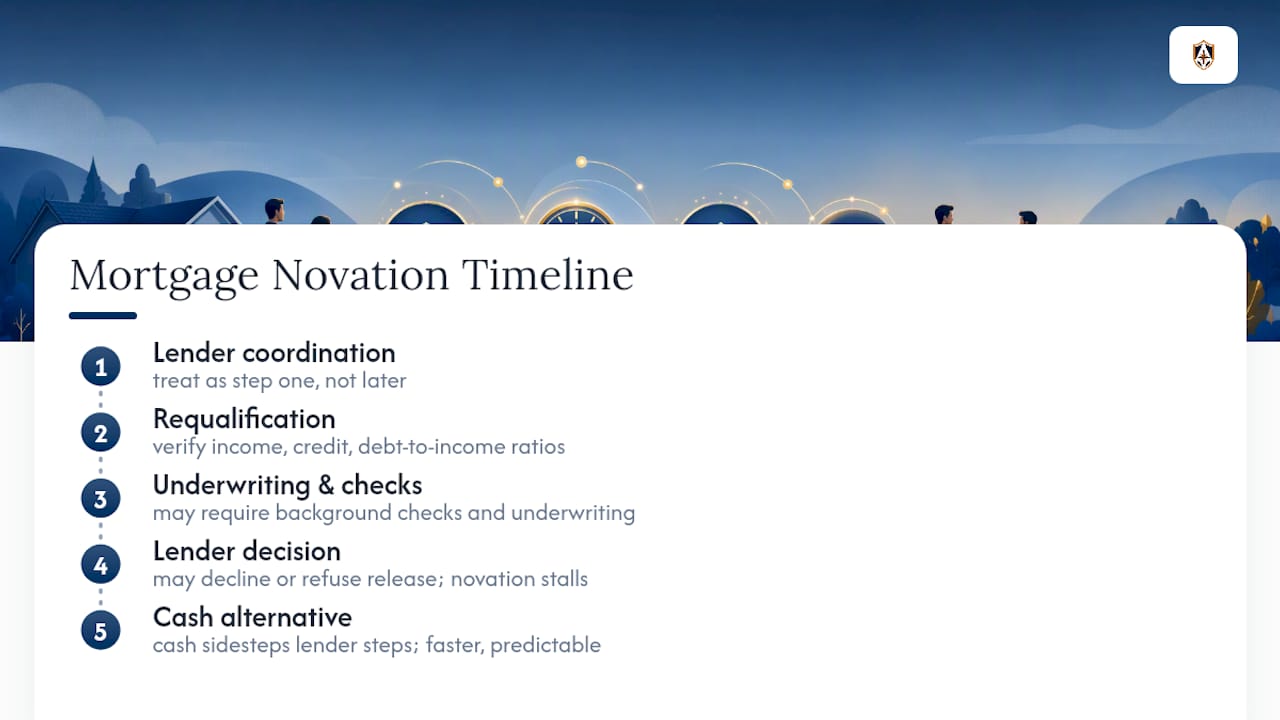
When a novation substitutes the buyer on a financed deal, the lender typically has to requalify the incoming party from scratch, verifying income, credit, and debt-to-income ratios as if it were a brand-new loan application. Lenders frequently require background checks or underwriting for an incoming buyer, and that step alone can add weeks to a timeline that might otherwise close quickly.
This is different from a mortgage assumption, which is a narrower, lender-specific process for taking over an existing loan’s exact terms. Novation in a financed deal often means the incoming buyer needs their own new financing arrangement entirely, since most conventional mortgages aren’t simply transferable to a new borrower without the lender’s explicit consent.
If the lender declines to release the original borrower or refuses to approve the new one, the novation stalls. No amount of agreement between buyer, seller, and incoming party overrides a lender’s underwriting decision on a financed property. That’s why real estate professionals treat lender coordination as step one, not step three, in any novation involving a mortgage. Cash transactions sidestep this entirely, which is one reason novation moves faster and more predictably when no financing is involved.
Are There Tax Consequences When You Novate a Contract?
Novation can trigger tax questions that a straightforward sale wouldn’t, mainly because substituting a party sometimes looks, to a tax authority, like two separate transactions instead of one continuous deal.
If a buyer is replaced through novation and the incoming buyer pays a different price than originally negotiated, that price difference can raise questions about whether the original buyer received a taxable benefit for stepping aside. Similarly, if an LLC steps in to replace an individual buyer, that entity switch can affect how the transaction is reported and how future depreciation or basis calculations get handled.
Sellers face their own version of this. A seller who agrees to a novation that changes payment terms, timing, or structure may find that the change affects how gain gets recognized for tax purposes, particularly in transactions structured around installment sales or specific closing-year timing.
None of these outcomes are automatic penalties. They’re simply consequences that depend heavily on the structure of the specific deal, the entities involved, and the timing of the substitution. This is exactly the kind of downstream detail that a real estate attorney’s review won’t fully cover, since tax treatment sits outside most attorneys’ scope of practice. Anyone considering a novation with meaningful financial stakes should loop in a tax advisor before signing, not after the new contract is already in escrow.
Does Novation Work the Same Way in Every State?
Novation is a contract law concept, and contract law is largely a matter of state jurisdiction in the United States, which means the exact requirements can shift depending on where the property sits.
Every state recognizes novation as a legal concept, and the core requirement, explicit consent from all original parties, holds everywhere. What varies is how courts in a given state interpret ambiguous novation language, what documentation local title companies expect, and how real estate licensing boards treat novation clauses in standard purchase agreements.
Some state real estate commissions publish guidance or standard forms that address contract substitution more directly than others. Title companies operating across state lines often maintain separate internal checklists for novation because recording requirements, escrow practices, and disclosure rules aren’t uniform nationally. A novation drafted for a property in one state, using boilerplate language pulled from another state’s template, is a common way novations end up challenged later.
This is also where local real estate agents and title officers earn their fee. They know which local quirks, a specific disclosure form, a county recording requirement, a state-specific consent statute, need to be addressed before a novation gets signed. A licensed attorney familiar with the property’s state is the only reliable way to confirm the novation language will hold up if it’s ever tested in that state’s courts.
What Real Novation Situations Look Like in Practice
The clearest way to understand novation is through the situations where it actually gets used, rather than abstract legal language.
Consider a buyer who signs a purchase agreement as an individual, then decides mid-contract to close through a newly formed LLC for liability protection. The seller and lender both need to consent to substituting the LLC for the individual buyer, and the resulting novation document explicitly states that the original agreement is extinguished and the LLC steps in as the new buyer of record. This scenario, changing buyer identity to an LLC, is one of the most common real-world novation triggers, according to Blueprint Title’s overview of novation use cases.
A lease transfer tells a similar story on the tenant side. A commercial tenant wants out of a five-year lease early and finds a replacement tenant willing to take over. The landlord, unwilling to simply let the original tenant off the hook through assignment, requires a novation: the new tenant signs a fresh lease, the landlord releases the original tenant from all future rent obligations, and the old lease is formally extinguished.
Post-inspection renegotiation offers a third pattern. Inspection turns up foundation issues serious enough that the buyer and seller agree the original purchase agreement’s terms no longer reflect reality. Rather than patch the deal with an amendment, they draft a novation with revised price, revised repair credits, and revised contingency deadlines, all replacing the original document outright. In each case, the same principle holds: something material enough that a simple assignment or a minor amendment can’t cleanly resolve it. That’s the signal that novation, not a lighter-touch fix, is the right tool.
AAS Home Buyers’ Take: Protecting Sellers Through Contract Changes
Novation gets discussed in the abstract more than it should, given how often real deals actually need it. We see it most often when a seller’s original buyer wants to substitute an LLC, or when inspection findings force a renegotiation deep enough that a simple amendment won’t cut it.
AAS Home Buyers offers direct cash purchases, a Retail Buyer Program with managed listing and marketing, and connections with vetted local agents, giving sellers more than one path when a deal’s structure needs to change. We rely on transparent, data-driven valuations with no hidden fees, so a seller facing a buyer substitution isn’t guessing at whether the new terms still serve their equity. When a novation-style change comes up in a transaction we’re involved with, we point sellers toward attorney review and proper title coordination before any signature happens. Contract substitution is not a shortcut. It’s a serious legal step that deserves the same rigor as the original deal.
— AAS
Where to Verify the Legal Details
For the plain-language legal definition of novation and its consent requirements, Cornell Law School’s Legal Information Institute remains the clearest starting point. Blueprint Title’s guide to novation in real estate walks through practical scenarios and lender considerations in more depth. For the legal distinction courts draw between novation and assignment, Tar Heel State Title’s analysis is worth reading before signing anything. Always confirm specifics with a licensed attorney or your title company before relying on any general guide.
A Cleaner Path Than Navigating Novation Alone
Sellers who realize mid-transaction that they need a contract change, a buyer substitution, a renegotiated closing, a way out of a stalled deal, often don’t need novation at all. They need a faster, more coordinated way to sell in the first place. AAS Home Buyers gives sellers that option directly: a cash purchase that skips buyer substitutions, lender requalification delays, and title complications entirely, because there’s no financing contingency to novate around.

Our three-step selling process handles title coordination and closing logistics on the seller’s behalf, so you’re not the one drafting novation language or chasing lender sign-offs. If your situation is complex enough that an agent-led sale makes more sense, our vetted agent network connects you with local professionals who handle contract issues like these regularly. Start by getting a transparent, no-obligation valuation at AAS Home Buyers to see which path fits your specific contract situation.
Sources
- Novation — Cornell Law School Legal Information Institute
- What is a Novation, and How is It Used in Real Estate? — Blueprint Title
- Novation v. Assignment — Tar Heel State Title
- Understanding Novation in Real Estate: 3 Examples of Novation — MasterClass
FAQ
What Is Novation in Simple Terms?
Novation replaces an existing contract with a brand new one, usually to swap out a party or change key terms, and it requires every original party to explicitly agree. The old contract is fully canceled, not just edited.
What’s the Difference Between Assignment and Novation?
Assignment transfers the benefit of a contract while the original party often stays liable unless formally released; novation transfers both benefits and obligations and fully releases the original party, according to MasterClass’s comparison of the two.
What Are the Risks of a Novation Agreement?
The biggest risks are lender refusal to requalify the incoming buyer, ambiguous contract wording that courts won’t treat as valid novation, and title or escrow documents that don’t match the new agreement, according to Tar Heel State Title.
How Do You Explain a Novation to a Seller?
Tell them plainly: the current contract will be canceled and replaced with a new one, likely swapping the buyer or changing terms, and it only works if everyone involved, including the seller, signs off in writing.
Does AAS Home Buyers Handle Novation Situations?
AAS Home Buyers doesn’t draft novation agreements directly, but sellers facing a buyer substitution or a stalled financed deal often find a direct cash sale avoids the need for novation entirely by removing the financing contingency.