
What Are Net Proceeds From a Home Sale?
Net proceeds are the cash you receive after subtracting your mortgage payoff, agent commissions, closing costs, prorations, and any seller concessions from your sale price. The formula is simple: Sale price minus (mortgage payoff + commissions + closing/settlement fees + prorations + seller concessions) = net proceeds. That’s the number that lands in your bank account, not the number on the sale contract.
Say your home sells for $400,000. After a $220,000 mortgage payoff, $24,000 in commissions, and $12,000 in closing costs and prorations, you’d walk away with roughly $144,000. Bankrate defines net proceeds the same way: the final cash you keep once every mortgage, commission, and closing expense is paid off.
Two things to do right now:
- Request a formal mortgage payoff statement from your lender.
- Draft a preliminary net sheet before you list, not after you get an offer.
Key Takeaways
Net proceeds equal your sale price minus mortgage payoff, commissions, closing costs, prorations, and concessions, and running that math early prevents closing-day surprises.
| Point | Details |
|---|---|
| Get the real payoff figure | Request a formal payoff statement, not your loan statement balance, since it includes per diem interest. |
| Watch commission negotiations | Post-2024 settlement rules mean buyer-agent contributions are negotiable, so confirm your actual listing terms. |
| Check local transfer taxes | Rates range from near zero to over 2% of sale price, so call your title company for county-specific numbers. |
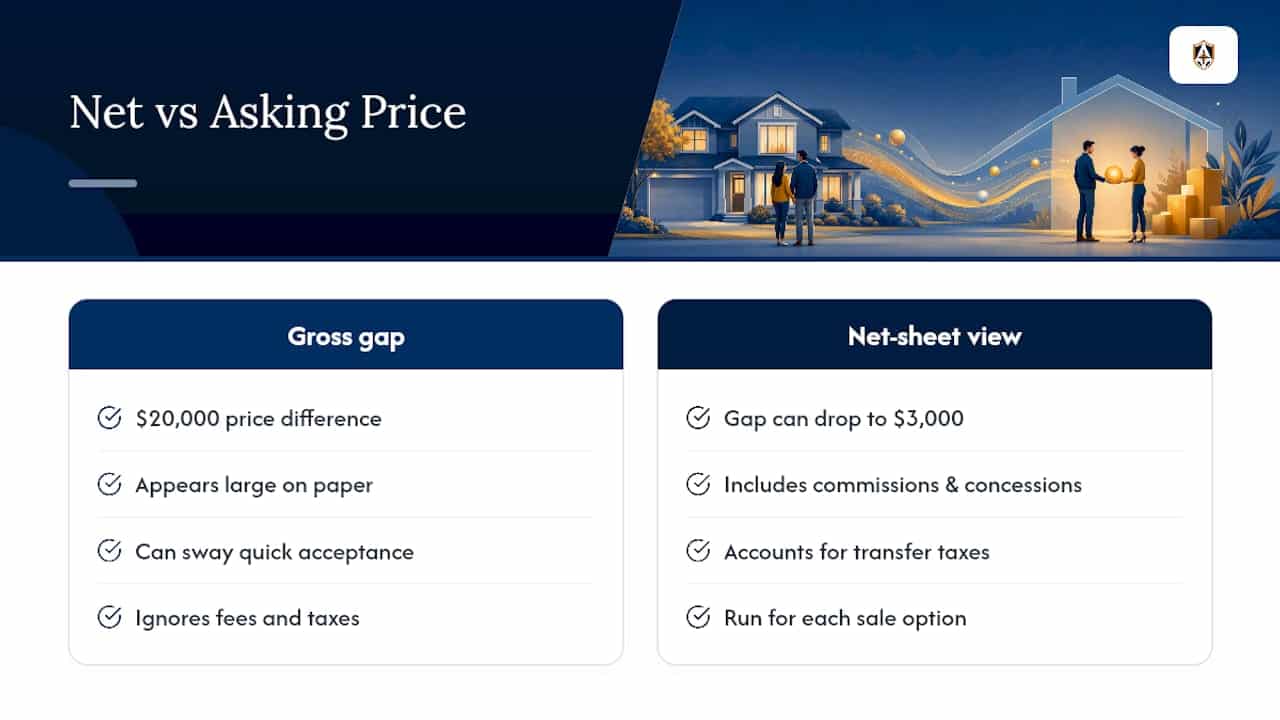
| Compare net, not gross | Run a net sheet for every offer since concessions can erase an apparent price advantage. |
| Consider AAS Home Buyers | Its direct cash purchase, Retail Buyer Program, and agent referrals each change your net-proceeds math differently. |
Table of Contents
- Line Items That Reduce Your Net Proceeds
- How Do You Calculate Net Proceeds From a Home Sale?
- Do You Pay Taxes on Net Proceeds From a Home Sale?
- Mistakes That Quietly Shrink Your Payout
- How AAS Home Buyers Helps You Protect Your Net Proceeds
- Verify the Numbers Yourself
- Why the Net Sheet Deserves More Attention Than the Asking Price
- A Faster Way to See Your Real Payout
- Sources
- FAQ
Line Items That Reduce Your Net Proceeds
Every dollar between your sale price and your bank deposit belongs to a specific line item. Understanding each one helps you plug accurate numbers into any calculator instead of guessing.

Sale price sets the baseline, but it also determines how much your percentage-based fees will cost. A commission rate on a sale costs tens of thousands of dollars depending on the sale price, illustrating how commissions scale with home value. Testing two or three price scenarios before you list shows you how proceeds shift as offers come in above or below asking price.
Mortgage payoff is not the same as your current loan balance. Your monthly statement shows what you owed last month; a formal payoff statement includes per diem interest accrued up to your actual closing date, plus any recording or release fees. That per diem figure can add several hundred dollars to a large loan if closing gets pushed back even a week.
Agent commissions have historically averaged 5% to 6% nationally, but the 2024 NAR settlement changed how compensation gets negotiated. Sellers now negotiate buyer-agent contributions directly rather than assuming a blanket rate, so your actual listing agreement, not a national average, determines this line.
Settlement fees cover title and escrow services, owner’s title insurance, recording fees, and notary or wire charges. These vary by title company but typically run in the low thousands.
Transfer taxes swing widely by location. Rates range from near zero to more than 2% of the sale price, which on a $400,000 home means the difference between $40 and more than $8,000 leaving your pocket depending purely on your county and state.
Round out your inputs with prorations (property tax and HOA dues split between you and the buyer), seller concessions, inspection repair credits, and any existing liens like a second mortgage or judgment against the property, all of which come off the top before you see a dollar.
How Do You Calculate Net Proceeds From a Home Sale?
Running your own net sheet takes three steps and about fifteen minutes once you have the right documents in hand.
- Gather your inputs. Get a formal payoff statement from your lender, settle on a realistic sale price based on comparable listings, confirm your closing date, review your commission terms, and pull your latest property tax bill.
- Compute the standard deductions. Calculate commission based on your actual listing agreement, then add title and escrow fees, recording charges, and your local transfer tax rate.
- Apply prorations and credits. Prorate property taxes and HOA dues to the closing date, then subtract any liens, second mortgages, or negotiated seller concessions.
Here’s how that plays out on a $400,000 sale:
Change one variable and the picture shifts fast. Add a $5,000 buyer concession for repairs and you lose almost that entire gain right back. Running a sensitivity table across a few scenarios before you accept an offer shows you which price and concession combination actually nets the most, rather than which one simply looks biggest on paper.
Do You Pay Taxes on Net Proceeds From a Home Sale?
Not necessarily, and not on the full amount. Net proceeds are the cash you collect at closing; taxable gain is a separate calculation based on your sale price minus your adjusted cost basis (what you paid, plus qualifying improvements). The two numbers rarely match.
The IRS lets qualifying homeowners exclude up to $250,000 in gain if single, or $500,000 if married filing jointly, as long as you owned and lived in the home for at least two of the five years before the sale. Most sellers of a primary residence owe nothing in federal capital gains tax because of this exclusion.
A few situations narrow or eliminate it:
- Renting out part of the home for an extended period can reduce the exclusion.
- Owning the property for less than two years typically disqualifies you, though certain military and job-relocation exceptions apply.
- Selling a second home or investment property gets no exclusion at all.
Keep every receipt for capital improvements. The IRS notes that these records establish your adjusted basis, and a higher basis means a smaller taxable gain if your proceeds do trigger a tax bill. When your numbers get close to those exclusion limits, a tax professional is worth the consultation fee.
Mistakes That Quietly Shrink Your Payout
The gap between what sellers expect and what they actually receive almost always traces back to a handful of avoidable errors.
Confusing your loan balance with your true payoff is the most common one. Request the formal payoff statement early and double check the per diem interest if your closing date slips. Commission rates are negotiable now more than ever, so ask your agent directly what contribution structure applies to your listing, and only agree to cover a buyer’s agent fee if it demonstrably nets you a better final offer. Transfer taxes and recording fees differ by county, so call your title company for a jurisdiction-specific quote rather than relying on a rule of thumb. Finally, expect inspection repair credits and buyer concessions to appear after you accept an offer, not before.
Pro Tip: Compare net proceeds across offers, not gross sale prices. A $410,000 offer with $12,000 in concessions can net you less than a $395,000 offer with none.
How AAS Home Buyers Helps You Protect Your Net Proceeds
AAS Home Buyers gives you three distinct paths, each with different net-proceeds math. A direct cash purchase skips commissions and many closing costs entirely. The Retail Buyer Program pairs managed listing and marketing with data-driven pricing to maximize your sale price. A vetted agent referral connects you with a local professional when you want traditional representation without guessing at quality.
Every option runs through the same transparent 3-step process, which is designed to surface your true payoff, fees, and prorations before you commit, not after.
- Direct cash offer with no commissions or hidden fees.
- Retail Buyer Program with managed marketing for a higher sale price.
- Vetted agent referral for sellers who want full market exposure.
Verify the Numbers Yourself
- IRS Topic No. 701 and Publication 523 for capital gains exclusion rules.
- AAS Home Buyers for a direct consult or written net sheet.
Why the Net Sheet Deserves More Attention Than the Asking Price
Most sellers spend weeks agonizing over their listing price and then accept the first strong offer without running the math that actually matters. That’s backward. A $20,000 gap between two offers on paper can shrink to $3,000 once commissions, concessions, and transfer taxes get applied, and by then you’ve already signed.
The conventional advice, price it right and let the market do the work, isn’t wrong, but it skips the step that determines what you actually keep. Your payoff statement, your county’s transfer tax rate, and the concessions you negotiate away matter more to your final number than an extra $10,000 on the sale price.
If you’re weighing multiple paths to sell, whether that’s a traditional listing, a cash offer, or something in between, the smartest move is running the net sheet for each option before you decide. AAS Home Buyers built its process around that exact comparison, because a seller who sees the real numbers upfront rarely gets surprised at closing.
A Faster Way to See Your Real Payout
If you’ve read this far, you already know gross sale price tells you almost nothing about what lands in your account. AAS Home Buyers is the alternative to guessing your way through a traditional listing: you get a data-driven cash offer or a managed Retail Buyer Program listing, either way built around a transparent net-proceeds figure from day one instead of a surprise settlement statement at closing.

Unlike a standard listing where commissions, concessions, and closing costs only get finalized once an offer lands, AAS Home Buyers shows you the math upfront through its transparent 3-step process, whether you choose a direct cash purchase, the managed Retail Buyer Program, or a vetted agent referral. If you’re facing a tight timeline, an inherited property, or repairs you don’t want to fund out of pocket, this structure protects your equity instead of eating into it. Visit the AAS Home Buyers landing page to request your no-obligation cash offer or written net sheet, and see your actual number before you commit to anything.
Sources
- Calculating net proceeds from the sale of a house | Bankrate
- Topic No. 701 Sale of Your Home | IRS
- What Is a Seller’s Net Sheet and What Does It Include? | LegalClarity
- Mortgage payoff statement explained | RealAlpha
FAQ
Do you pay taxes on net proceeds from a home sale?
Not on the full amount. You may owe capital gains tax on your taxable gain, but the IRS exclusion shelters up to $250,000 (single) or $500,000 (married filing jointly) if you meet the ownership and use tests.
How do you figure out net proceeds from a home sale?
Subtract your mortgage payoff, agent commissions, closing and settlement fees, prorations, and any seller concessions from your sale price. AAS Home Buyers can walk you through this using its transparent process for a specific offer.
How do you calculate net profit from the sale of property?
Net profit typically refers to taxable gain: your sale price minus your adjusted cost basis, which includes your original purchase price plus qualifying improvements. This differs from net proceeds, which is your actual cash at closing.
What do net proceeds mean when selling a house?
Net proceeds are the cash you keep after every mortgage payoff, commission, and closing cost is deducted from your sale price, as Bankrate outlines in its definition of the term.
Why does my payoff statement matter more than my loan balance?
Your monthly statement shows last month’s balance, while a formal payoff statement includes per diem interest accrued through your closing date, which can add several hundred dollars if closing is delayed.