
Cash Buyer Closing Costs: What Sellers Still Pay
If you’re selling to a cash buyer, you’ll still typically owe agent commission, transfer taxes, prorated property taxes, HOA dues, and any mortgage or lien payoff. What you’ll often avoid: lender fees, loan origination charges, and a lender-required appraisal, since there’s no mortgage underwriting sitting between you and the closing table.
Total seller closing costs, commission included, commonly run 6% to 10% of the sale price in a traditional sale. Cash sales don’t erase every line item, but they do remove several. You should also receive a Closing Disclosure that spells out final numbers three business days before closing, and a buyer like AAS Home Buyers can walk you through a net sheet well before that.
Costs sellers usually still owe in a cash sale:
- Agent commission (if you’re using a listing agent), transfer taxes, prorated property taxes, HOA fees, escrow/settlement fees, and payoff of your existing mortgage or any second liens.
Costs cash sales often reduce or remove entirely:
- Lender origination fees, lender-required appraisal costs, and the lender’s title insurance policy, since there’s no loan underwriting involved. Who pays the owner’s title policy is negotiable and varies by region.
Key Takeaways
Cash sales remove lender-driven fees like origination charges and lender-required appraisals, but sellers still typically owe commission, transfer taxes, prorations, and lien payoffs.
| Point | Details |
|---|---|
| Commission remains negotiable | Agent commission is usually the largest line item and can often be reduced or eliminated with certain cash buyers. |
| Lender fees disappear in cash deals | Loan origination, lender-ordered appraisals, and lender title policies don’t apply when there’s no mortgage. |
| Request a net sheet before signing | A written net sheet catches concessions, payoffs, and fees before they surprise you at closing. |
| Review the Closing Disclosure early | You’ll get final numbers three business days before closing, giving you a last chance to fix errors. |
| AAS Home Buyers offers a transparent net sheet | Its 3-step process provides a written net sheet and multiple selling paths before you commit. |
Table of Contents
- What Are Typical Seller Closing Costs and Their Ranges?
- How Does a Cash Sale Change Your Closing Costs?
- How Do You Estimate Your Net Proceeds Before Closing?
- What Concessions and Repair Credits Should You Expect?
- When Do You See Final Closing Numbers?
- How Do You Verify a Cash Buyer Is Legitimate?
- Can You Negotiate or Reduce Your Closing Costs?
- What Hidden Costs Show Up in Cash Sales?
- How AAS Home Buyers Helps You Sell With Fewer Surprises
- Sources
- FAQ
What Are Typical Seller Closing Costs and Their Ranges?
Every seller closing statement is built from the same handful of line items, whether the buyer is financing or paying cash. Knowing the rough size of each one lets you sketch a realistic net-proceeds number before you sign anything.
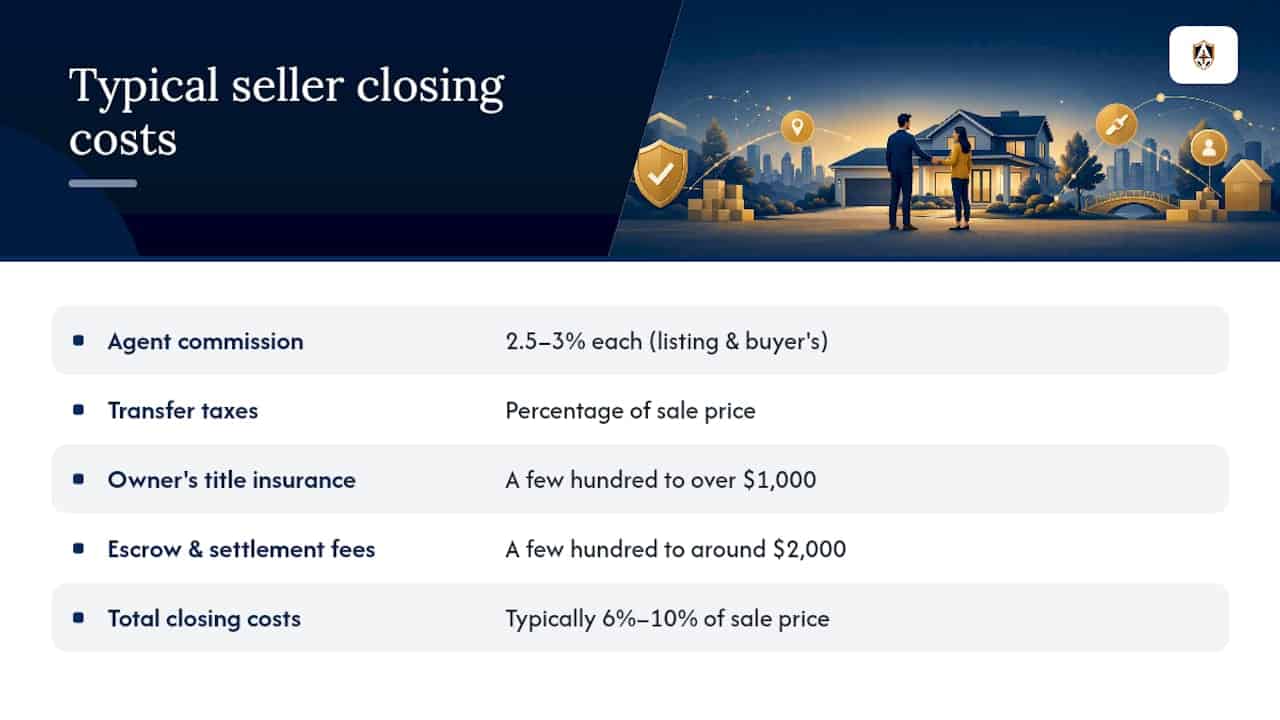
Agent commission. This is usually the largest line item on a seller’s closing statement. Listing agent and buyer’s agent commissions each tend to run around 2.5% to 3% today, and both are negotiable, especially if you’re working with an investor buyer who doesn’t require agent involvement at all.
Transfer taxes. Set by your state or county, these are calculated as a percentage of the sale price and are non-negotiable with the taxing authority, though who pays them (buyer or seller) can sometimes shift in negotiation.
Owner’s title insurance. In many markets, sellers customarily pay for the buyer’s owner’s title policy. This protects the new owner against title defects and typically costs a few hundred dollars to over a thousand, depending on sale price and state.
Escrow and settlement fees. These cover the neutral third party handling funds and paperwork, and they typically range from a few hundred dollars to around $2,000 depending on location and who the purchase agreement assigns them to.
Recording and filing fees, prorated property taxes, HOA transfer or prorated dues, attorney fees (required in some states), wire or courier fees, and title search costs round out the rest of a typical seller closing cost checklist. Any outstanding mortgage balance or second lien gets paid off from your proceeds at closing, too.
Add it all up, and sellers who pay a commission typically see 6% to 10% of the sale price go to closing costs.
Pro Tip: Ask for a draft net sheet as early as possible, and get quotes from more than one title or escrow provider. Settlement fees vary enough by company that shopping around can shave a few hundred dollars off your total.
How Does a Cash Sale Change Your Closing Costs?
Selling for cash doesn’t erase your closing statement. It shortens it. Cash transactions skip lender-driven fees like loan origination charges, lender-ordered appraisals, and the lender’s title insurance policy, because there’s no mortgage underwriter requiring them. What stays: transfer taxes, your commission if you use an agent, prorated taxes and HOA dues, and payoff of any existing mortgage or lien.
The tradeoff is worth weighing honestly. Lower fees don’t automatically mean a bigger check. Some investors and iBuyers charge service fees or factor repair costs into their offer instead of itemizing them as closing costs, which can offset the savings.
| Financed buyer | Cash buyer | |
|---|---|---|
| Agent commission | 6% to 10% | ~$20,000 (if agent used) or $0 |
| Lender-related fees | Buyer pays, doesn’t affect seller | Not applicable |
| Transfer tax, escrow, prorations | ~$4,000-$8,000 | ~$4,000-$8,000 |
| Mortgage payoff | Deducted from proceeds | Deducted from proceeds |
Pro Tip: Before comparing offers, ask each cash buyer for the exact deductions on their net sheet, not just the headline price. A slightly lower offer with no service fee can beat a higher offer that gets whittled down at closing.
How Do You Estimate Your Net Proceeds Before Closing?
A realistic number now beats a surprise later. Work through this checklist before you accept any offer:
- Request a detailed net sheet from your buyer or listing agent. Getting a draft net sheet early is the single best way to avoid last-minute deductions you didn’t see coming.
- Get a mortgage payoff demand from your current lender, including any prepayment penalty.
- Order a title search early to surface liens or judgments you may not know about.
- Confirm the transfer tax rate and recording fees for your county.
- Prorate property taxes and HOA dues based on your actual closing date. Proration means you pay only through the closing date, and you get a credit if you already paid ahead.
- Identify any second liens or judgments and get a rough payoff figure for each.
- Ask the buyer directly whether they expect you to purchase the owner’s title policy.
Pro Tip: If you bought the home within the last several years, ask your title company about a reissue rate on the owner’s policy. It’s a discounted rate for recent title work that can meaningfully lower this line item.
Once you’ve gathered those numbers, ask your buyer or listing agent for a net sheet in writing. AAS Home Buyers’ transparent 3-step process includes a detailed net sheet before you’re asked to commit to anything.
What Concessions and Repair Credits Should You Expect?
Cash buyers negotiate differently than financed ones, and that changes what you’ll be asked to give up. The most common asks are repair credits after inspection, a seller-paid buyer-agent commission, home warranty credits, and rent-back agreements if you need extra time to move out.
Magnitude varies widely. Small repair credits might run a few hundred dollars. Financed buyers face lender limits on how much sellers can contribute toward concessions. Cash deals have no such cap, which means concessions in a cash sale can sometimes run higher if you’re not paying attention.
Ways to keep concessions in check:
- Bundle every credit request into a single line item so you can evaluate the total impact at once, not piecemeal.
- Trade a higher sale price for a smaller concession package instead of accepting both a discount and a credit.
- Require written proof of funds before agreeing to anything, especially with an unfamiliar investor.
- If a lien payoff is small, consider clearing it yourself before listing rather than letting it complicate negotiations.
Pro Tip: A buyer who won’t provide proof of funds before asking for concessions is a buyer who hasn’t earned the negotiation leverage yet. Push back.
When Do You See Final Closing Numbers?
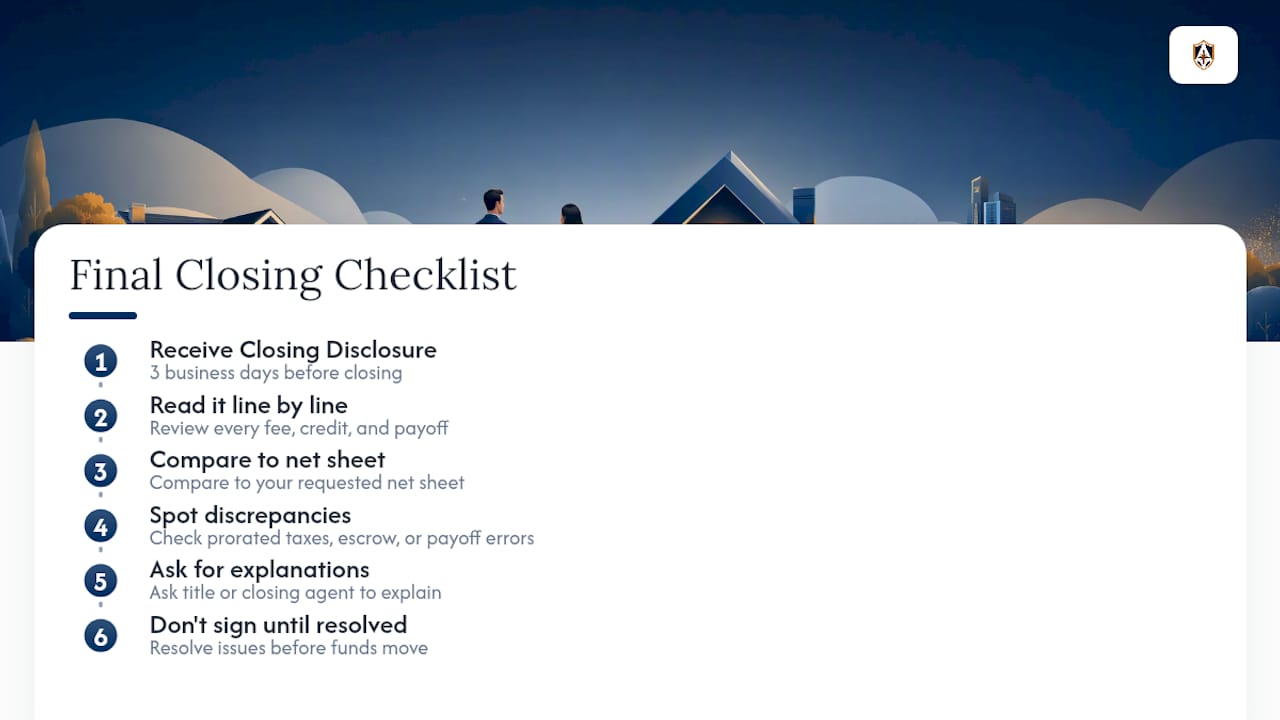
Final numbers don’t arrive as a surprise, at least not if you’re paying attention. Both parties receive a Closing Disclosure three business days before closing that itemizes every fee, credit, and payoff on the transaction. This is your last real checkpoint to catch an error before funds move.
In a cash sale, the timeline compresses considerably compared to a financed deal, since there’s no lender underwriting to wait on. That’s a real advantage, but it also means you have less time to react if something on the disclosure looks wrong. Read it line by line the moment you receive it. Compare it against the net sheet you requested earlier in the process.
Discrepancies happen more often than sellers expect: a prorated tax figure calculated against the wrong closing date, an escrow fee that crept up from the estimate, or a payoff amount that didn’t account for a per diem interest charge on your mortgage. Catching these before the money moves is far easier than trying to claw back funds afterward.
If your title company or closing agent can’t explain a number on the disclosure clearly, ask again before you sign. A legitimate buyer and a competent settlement agent will walk you through every figure without hesitation. That’s part of what a transparent process looks like, and it’s worth treating as a baseline expectation rather than a bonus.
How Do You Verify a Cash Buyer Is Legitimate?
Cash offers move fast, and that speed is exactly what scammers rely on. Before you sign anything, ask for proof of funds. A real cash buyer can produce a bank statement or a letter from their financial institution showing they actually have the money, not just a pre-approval letter, which only applies to financed buyers anyway.
Verify the buyer’s identity and business history. A legitimate company will have a real address, a working phone number, and a track record you can check through reviews or state business registries. Be wary of anyone pressuring you to skip title work, wire money before closing, or sign documents without a licensed escrow or title company involved.
Warning signs worth taking seriously:
- A buyer who refuses to use a licensed title or escrow company for the closing.
- Pressure to wire funds directly to the buyer instead of through escrow.
- Reluctance to provide proof of funds or basic company information when asked directly.
A title search protects you here, too. Confirming there are no undisclosed liens or ownership disputes on the property before closing isn’t just about your own liability. It also confirms that the party you’re dealing with has done the legal groundwork a real transaction requires. If a buyer discourages a title search, treat that as a serious red flag.
Can You Negotiate or Reduce Your Closing Costs?
Some of your closing costs are fixed by law. Transfer taxes and recording fees are set by your state or county, and there’s no negotiating with the tax authority. But a surprising number of other line items have more give than sellers assume.
Commission is the most obvious lever. If you’re working with an agent, the rate is negotiable, and some cash buyers don’t require agent involvement at all, which removes that line item entirely. Escrow and title fees vary by provider, so getting quotes from two or three companies before you commit to one can save real money, particularly on the settlement fee itself.
Ask who’s expected to pay the owner’s title policy. In many markets this defaults to the seller by custom, not by law, which means it’s a fair point to raise during negotiation, especially if the buyer is getting a below-market deal elsewhere in the contract.
If you’ve owned the home for only a few years, ask specifically about a reissue rate on title insurance. This discount applies when a title company already has recent records on file and can meaningfully cut what you’d otherwise pay for a fresh policy.
Finally, get everything in writing before you agree to it. A verbal understanding about who covers which fee is worth nothing at the closing table if it isn’t reflected on your settlement statement.
What Hidden Costs Show Up in Cash Sales?
Cash sales feel simpler, and mostly they are. But a few costs catch sellers off guard specifically because the deal moves fast and skips steps a financed sale would force into the open.
Second liens and judgments are the most common surprise. Without a lender ordering a full title search as a condition of financing, some sellers assume their title is clean until a search turns up an old contractor’s lien or an unresolved judgment they’d forgotten about. Ordering your own title search early, rather than waiting for the buyer’s side to do it, gives you time to address these before they eat into your proceeds unexpectedly.
Rent-back or occupancy agreements can also carry hidden costs if they aren’t spelled out clearly. If you need extra time in the home after closing, that arrangement should specify a daily or monthly rate in writing. Left vague, it can turn into a dispute or an unplanned deduction.
Some investor and iBuyer-style cash buyers build service fees or repair cost estimates into their offer rather than itemizing them as closing costs. That’s not necessarily dishonest, but it means the sale price you’re quoted isn’t always the number you’ll actually net. Always ask for the breakdown in writing before you compare one cash offer against another.
Author perspective: tradeoffs sellers should weigh when accepting a cash offer
Speed and certainty are real advantages of a cash offer. You skip financing contingencies, appraisal risk, and weeks of underwriting delay. But that certainty sometimes comes at the cost of a lower gross offer or a service fee buried in the paperwork. Before you sign, compare the cash buyer’s actual net sheet against what a traditional listing would likely net you. The right choice depends on your numbers, not just your timeline.
How AAS Home Buyers Helps You Sell With Fewer Surprises
AAS Home Buyers gives you a clear net sheet before you commit to anything, so you know exactly what you’ll walk away with instead of guessing until the closing table. Beyond a direct cash purchase, we also offer partner cash acquisitions and a Retail Buyer Program for sellers who want managed listing support without handling the process alone.

Our transparent 3-step selling process starts with a property evaluation, moves to a data-driven offer, and ends with a closing timeline you control. There are no hidden fees layered into the offer, and you can request a detailed net sheet before you decide whether a cash sale, our Retail Buyer Program, or a referral to a vetted local agent fits your situation best. Every offer and process detail is outlined plainly in our terms and disclaimer. If you want to see your real numbers before you decide anything, start with AAS Home Buyers and request your net sheet today.
Sources
- Seller Closing Costs: Complete Fee Breakdown, Calculator & Savings Guide | EffectiveAgents®
- Do Cash Buyers Ever Pay Closing Costs on Behalf of Sellers? | HomeLight
- Closing costs home seller | NerdWallet
- Understanding property tax prorations | Alliance Title
FAQ
Do cash buyers pay closing costs?
Buyers and sellers each pay their own share of closing costs regardless of financing. In a cash sale, the seller still typically covers commission, transfer taxes, prorations, and any lien payoff, while the buyer’s lender fees simply don’t exist.
What closing costs do sellers avoid in a cash sale?
Sellers typically avoid loan origination fees, lender-required appraisal costs, and the lender’s title insurance policy, since no mortgage underwriting is involved in the transaction.
How much are typical seller closing costs?
Sellers commonly pay 6% to 10% of the sale price when commission is included, or roughly 1% to 3% without a commission.
When do I find out my final closing numbers?
You’ll receive a Closing Disclosure three business days before closing that itemizes every final fee, credit, and payoff on the transaction.
How can I estimate my net proceeds before accepting a cash offer?
Request a detailed net sheet from your buyer or agent early. AAS Home Buyers provides one as part of its transparent 3-step process before you’re asked to commit.