
How to Sell a Hoarder House: Practical Options for Homeowners
If you need to sell a hoarder house quickly, a cash sale to a buyer who purchases homes as-is is the fastest, lowest-risk route for most sellers. Start with three calls: schedule a safety walkthrough, request a cash offer, and contact a licensed cleanout or estate-sale specialist.
For most urgent sellers, especially those dealing with an inherited property or a severe hoarding situation, selling as-is to a cash buyer avoids months of cleanup costs, contractor delays, and disclosure complications. Rehab-and-list makes sense only when the property has strong comparable sales nearby, the cleanup cost is manageable, and you have the time to wait 90–180 days for a retail closing.
Do this now:
- Walk the property with a licensed contractor or inspector to identify safety hazards (biohazards, mold, structural damage) and document everything with photos.
- Request a no-obligation cash offer from a buyer who specializes in distressed or hoarder properties so you have a baseline number.
- Call a professional cleanout firm or estate-sale specialist to get a cost estimate, even if you haven’t decided whether to clean before selling.
Key Takeaways
For most urgent sellers, a cash as-is sale is the fastest and lowest-risk route, while rehab-and-list makes financial sense only when the projected value gain clearly exceeds total cleanup, repair, and carrying costs.
| Point | Details |
|---|---|
| Cash sale is fastest | A cash as-is sale typically closes in 7–30 days with no cleanup or repair required. |
| Rehab math must work | Rehab pays off only when the value gain exceeds total cleanup, repair, and carrying costs. |
| Disclose what you know | Selling as-is does not remove disclosure obligations; known defects must still be reported. |
| Assess severity first | Use the mild/moderate/severe framework to determine cleanup cost before committing to any route. |
| AAS Home Buyers offers multiple routes | Cash purchase, Retail Buyer Program, and agent referrals give sellers flexibility without hidden fees. |
Table of Contents
- How do you assess the scope of a hoarder house before selling?
- What are your cleanup options, and what do they cost?
- What are your selling options, and which one fits your situation?
- When does rehab actually pay off versus selling as-is?
- How do you determine market value for a hoarder property?
- What are your legal and disclosure obligations when selling a hoarder house?
- What does a day-one-to-closing checklist look like?
- How AAS Home Buyers helps sellers of hoarder houses
- Ready to get a clear offer on your hoarder property?
- Sources
- FAQ
How do you assess the scope of a hoarder house before selling?
Before you can choose a selling route, you need an honest picture of what you’re dealing with. A quick visual walkthrough, done systematically, gives you the information that drives every decision that follows.
Visual checklist for your first walkthrough:
- Clutter concentration: Is it limited to one or two rooms, or does it fill every hallway, stairwell, and exit path?
- Obstructed exits: Are doors, windows, or staircases blocked? This is a fire and safety code issue.
- Blocked mechanicals: Can you access the electrical panel, HVAC unit, water heater, and plumbing shutoffs?
- Pest activity: Look for droppings, nesting material, chewed wiring insulation, or live insects.
- Water and mold damage: Check ceilings, walls, and floors for staining, soft spots, or visible mold growth.
- Structural concerns: Sagging floors, bowing walls, or cracked foundations require immediate professional evaluation.
A simple three-tier framework helps you triage the situation:
| Severity | Description | Typical cleanup cost | Typical timeline |
|---|---|---|---|
| Mild | Clutter in 1–2 rooms, no hazards, exits clear | a few thousand dollars | Days to 1 week |
| Moderate | Multiple rooms affected, some pest evidence or minor mold | several thousand to tens of thousands of dollars | 1–4 weeks |
| Severe | Whole-home clutter, biohazards, mold, structural concerns | tens of thousands of dollars or more | 4 weeks or more |
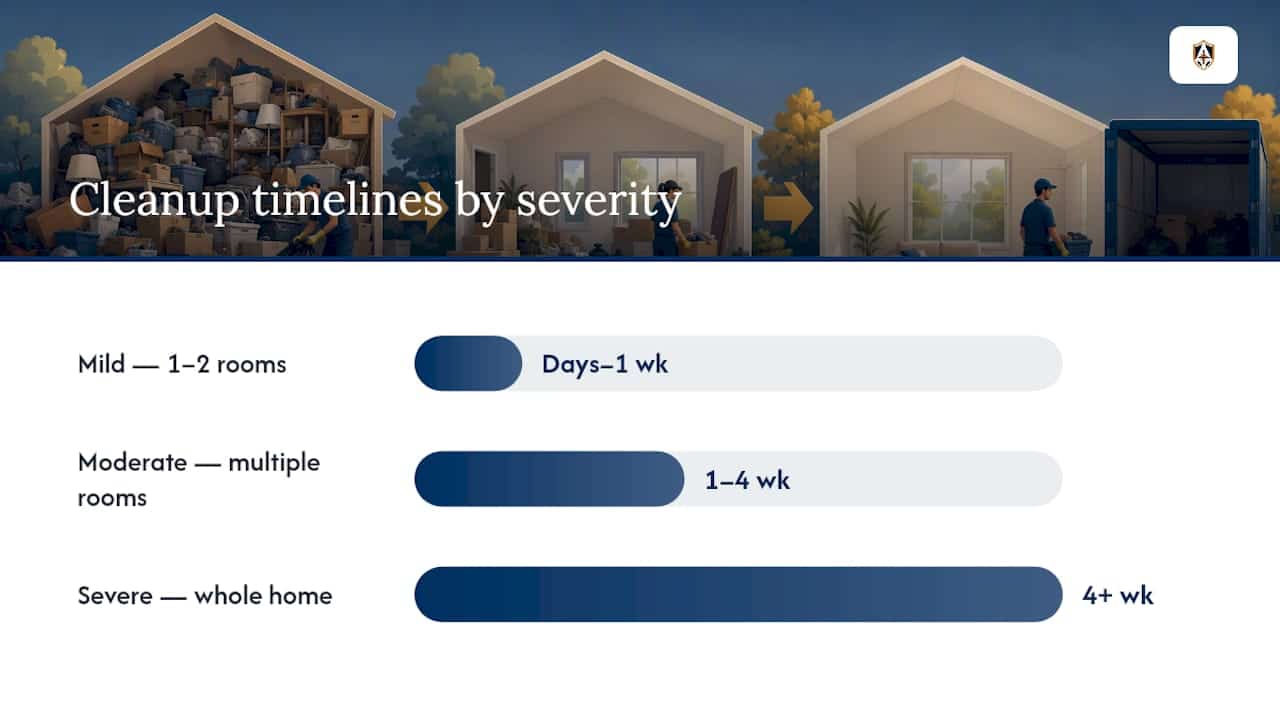
Certain hazards require professional intervention before anyone else enters the property. Visible mold covering more than a small area, animal waste or human biohazard material, compromised electrical wiring, and any structural instability all fall into this category. Professional cleanout services are often recommended for severe cases because they handle safety, disposal, and regulatory concerns that DIY methods simply cannot address safely.

Pro Tip: Photograph every room from multiple angles before anything is moved. Date-stamp the images and store them in a cloud folder. These photos serve as your disclosure record, your negotiation anchor, and your protection if a buyer later disputes the property’s condition at the time of sale.
What are your cleanup options, and what do they cost?
Cleanup is not always required before selling, but understanding your options helps you decide whether the cost is worth it. There are four realistic routes, each suited to a different situation.
DIY decluttering works only for mild cases where the clutter is personal belongings with no hazardous material. You and family members sort, donate, and haul items yourselves. The cost is mostly your time and a dumpster rental, typically $300–$600 per load. The risk is underestimating what’s there, especially in homes where clutter conceals damage.
Estate sale or auction makes sense when the home contains items of real value: furniture, collectibles, tools, or antiques. Expect 2–4 weeks to organize and run the sale before the property is cleared.
Junk removal services (companies that haul everything away, often in a single day) charge based on volume, typically $400–$1,500 for a standard load, with whole-home jobs running $2,000–$6,000 or more. They are faster than DIY and cheaper than licensed biohazard crews, but they are not equipped for contaminated material.
Licensed hoarding and biohazard cleanup firms are the right call for moderate-to-severe cases. These companies use trained crews and specialized equipment to safely remove contaminated material and remediate hazards such as mold, pest waste, and biological contamination that DIY methods cannot safely address. Specialized hoarding cleanup firms follow environmental and local disposal regulations, which can materially increase costs for severe jobs. Expect $10,000–$40,000 or more for a full-home remediation, with timelines of several weeks.
When choosing a cleanup vendor, ask these questions before signing anything: Are you licensed and insured for biohazard or mold remediation in this state? Do you carry general liability and workers’ compensation coverage? Can you provide a written itemized estimate and a disposal manifest? Have you worked on properties with code enforcement holds?
Verify any vendor’s reputation through the Better Business Bureau before signing a contract. A legitimate firm will not pressure you to sign before you’ve reviewed their license and insurance documents.
One point worth stating plainly: hoarding disorder is a recognized mental-health diagnosis, not a lifestyle choice. Understanding this helps sellers communicate respectfully with family members and explains why professional crews, who approach the work without judgment, often produce better outcomes than family-led cleanouts in emotionally charged situations.
What are your selling options, and which one fits your situation?
There are three primary routes for selling a hoarder home. Each serves a different seller goal, and choosing the wrong one costs you either time or money.
| Selling route | Best for | Time to close | Expected net proceeds | Cost and effort | Risk and disclosure exposure |
|---|---|---|---|---|---|
| Cash as-is sale | Urgent sellers, inherited properties, severe damage | 7–30 days | Below retail (typically 60%–40% of ARV) | Minimal: no cleanup or repairs required | Low: buyer accepts condition; fewer contingencies |
| Retail listing after cleanup/rehab | Sellers with time and equity to invest | 90–180 days | Closest to market value | High: cleanup, repairs, carrying costs | Moderate: inspection contingencies, financing risk |
| Auction or estate sale | Properties with valuable contents or investor interest | 3–6 weeks | Variable; can be below retail | Moderate: estate-sale fees, auction commissions | Moderate: reserve price risk, limited buyer pool |
Cash as-is sale: pros and cons
- Closes in days to weeks, not months
- No cleanup, staging, or repair costs
- Fewer contingencies and lower financing risk
- Offers are typically 20%–40% below retail market value
- Less room to negotiate once the offer is made
Retail listing after rehab: pros and cons
- Highest potential net proceeds when the market is strong
- Requires significant upfront investment in cleanup and repairs
- Inspection contingencies can trigger renegotiation or deal collapse
- Carrying costs (taxes, insurance, utilities) accumulate during the listing period
- Financing-dependent buyers add closing risk
Auction or estate sale: pros and cons
- Can move quickly if the property attracts investor interest
- Valuable contents can offset cleanup costs
- Reserve prices may not be met, leaving you with an unsold property
- Auction commissions and fees reduce net proceeds
To find cash buyers or investors who specialize in hoarder properties, search for local real estate investment groups, contact wholesalers in your market, or work with a company that specifically evaluates distressed properties. U.S. News coverage recommends using a nonjudgmental agent focused on practical outcomes, since many sellers of hoarder homes prioritize walking away with the best net result rather than reopening emotional ties to the property. Vet any investor by asking for proof of funds, references from recent transactions, and a clear written offer with no hidden fees.
When does rehab actually pay off versus selling as-is?
The decision comes down to one comparison: will the increase in sale price exceed the total cost of cleanup, repairs, and carrying costs? If yes, rehab makes sense. If not, selling as-is protects more of your equity.
Here is a practical framework:
- Get a licensed contractor’s estimate for all repairs needed to bring the home to retail-ready condition.
- Ask a local real estate agent for comparable sales (comps) of similar homes in move-in condition nearby.
- Subtract the estimated after-repair value (ARV) from the current as-is value to find the potential value gain.
- Compare that gain to the total cost of cleanup, repairs, and carrying costs (mortgage, taxes, insurance, utilities) for the expected listing period.
- If the value gain exceeds total costs by a meaningful margin, rehab may be worth pursuing. If costs eat most or all of the gain, sell as-is.
Repairs that typically move the needle:
- Safety and structural issues (roof, foundation, load-bearing elements): buyers and lenders require these
- Major systems (HVAC, electrical panel, plumbing): failing systems kill financing approvals
- Curb appeal basics (exterior paint, landscaping, entry door): high-visibility, relatively low cost
- Kitchen and bath functionality: not full remodels, but working fixtures and clean surfaces
Repairs to skip:
- Full kitchen or bathroom remodels rarely return dollar-for-dollar in a distressed-property sale
- Cosmetic flooring upgrades in rooms that still have structural issues
- Landscaping beyond basic cleanup when the interior needs significant work
A partial approach often delivers the best return per dollar spent. Clearing one or two rooms for staging, addressing curb appeal, and fixing the most visible safety issues can meaningfully improve a retail offer without committing to a full rehab. Targeted home updates focused on high-visibility areas tend to yield better returns than comprehensive renovations on distressed properties.
A conservative example: if comps show $300,000 for a move-in-ready home and the as-is cash offer is $200,000, the potential gain is $100,000. If full cleanup and repairs cost $60,000 and carrying costs add another $15,000 over a four-month listing period, the net gain from rehab is roughly $25,000. That may be worth it, or it may not be, depending on your timeline and risk tolerance. If the repair estimate comes in at $85,000, the math no longer favors rehab.
How do you determine market value for a hoarder property?
Valuation for a hoarder home works differently than a standard appraisal. The condition discount is real, and understanding how buyers calculate their offers helps you negotiate from a position of knowledge.
Valuation checklist:
- Pull recent comparable sales (comps) within a half-mile for similar-sized homes in standard condition
- Adjust downward for the estimated cost to bring the property to that condition (cleanup, repairs, deferred maintenance)
- Factor in carrying costs for the expected time to close under each selling route
- Account for closing costs: typically 2%–5% of sale price for sellers, plus any agent commissions
Cash buyers typically calculate their offer using the ARV minus repair costs minus their profit margin. Understanding this formula lets you push back if an offer seems too low relative to the actual repair estimate.
| Valuation factor | What to ask or verify |
|---|---|
| Comparable sales | Are comps from the last 90 days? Are they truly similar in size and location? |
| Repair cost estimate | Is it based on a licensed contractor walkthrough, or a visual guess? |
| Carrying cost assumption | How many months does the buyer assume before resale? |
| Contingencies | Is the offer subject to inspection, financing, or further due diligence? |
Questions to ask any agent or investor before accepting an offer: Are you pricing based on as-is condition or post-repair value? Is your financing already secured, or is this offer contingent on a loan? What contingencies are in the contract, and what triggers a price renegotiation?
A licensed appraiser can provide an independent as-is value estimate, typically for $300–$600. That number anchors your negotiations and gives you a credible counter when a buyer’s offer seems disconnected from reality. Local agents who specialize in distressed properties can also provide a realistic pricing range based on current market activity. The National Association of Realtors sets disclosure and practice standards that govern how agents handle material defects, which is worth understanding before you list.
What are your legal and disclosure obligations when selling a hoarder house?
Disclosure requirements vary by state, but the general principle is consistent: sellers must disclose known material defects that would affect a buyer’s decision or the property’s value. In a hoarder home, that typically includes known mold, pest infestations, water damage, structural issues, and any code enforcement actions against the property.
A critical point many sellers overlook: selling a property as-is does not eliminate your disclosure obligations. “As-is” means the buyer accepts the condition, not that the seller is released from disclosing what they know. Failing to disclose a known material defect can expose you to post-closing legal liability regardless of the sale structure.
Key legal and estate considerations:
- Probate and estate administration: If the property belonged to someone who has died, the estate must go through probate before the property can be sold, unless it was held in a trust or had a transfer-on-death deed. Probate timelines vary widely by state, from a few weeks to more than a year.
- Who can sign: Only the legally authorized executor, administrator, or trustee can sign a purchase agreement. Confirm this before marketing the property.
- Code enforcement holds: Some municipalities place liens or holds on severely deteriorated properties. Check with your local code enforcement office before listing.
- Health department involvement: In extreme cases, local health departments may have issued orders requiring remediation before occupancy. These orders must typically be disclosed and resolved.
- Contractor estimates for disclosure: Getting written estimates from licensed contractors for known defects gives you documentation that satisfies disclosure requirements and reduces renegotiation risk during inspections.
For any situation involving probate, title disputes, or significant code violations, consult a real estate attorney before signing anything. The AAS Home Buyers terms and disclaimer outlines the company’s own policy framework, which is a useful reference for understanding how a structured buyer approaches these situations.
When in doubt, disclose more rather than less. The cost of a post-closing lawsuit far exceeds the cost of transparency upfront.
What does a day-one-to-closing checklist look like?
A clear sequence prevents the most common mistakes: starting cleanup before you have an offer, or marketing the property before resolving title issues.
Day 1 rapid checklist:
- Confirm who holds legal authority to sell (executor, trustee, or owner of record).
- Photograph every room, every visible defect, and every blocked area.
- Secure the property: change locks, address any immediate safety hazards (gas leaks, exposed wiring).
- Locate key documents: deed, title, any existing liens, probate filings, and prior inspection reports.
- Call a licensed contractor or inspector for a safety assessment and written estimate.
Timeline by selling route:
| Selling route | Typical time to close | Key milestones |
|---|---|---|
| Cash as-is sale | 7–30 days | Offer in 24–72 hours; title search; closing |
| Auction or estate sale | 3–6 weeks | Inventory, marketing, sale day, proceeds distribution |
| Retail listing after rehab | 90–180 days | Cleanup, repairs, staging, listing, inspection, closing |
Actionable steps mapped to who to call:
- Licensed contractor or inspector: safety assessment and written repair estimate (call within 48 hours of deciding to sell).
- Probate attorney: if the property is part of an estate and no trust or transfer-on-death deed exists (call before marketing).
- Professional cleanout firm: cost estimate for cleanup, even if you plan to sell as-is (use for negotiation leverage).
- Cash buyer or investor: request a no-obligation offer based on current condition (use as your baseline).
- Licensed real estate agent: if you’re considering a retail listing, get a comparative market analysis and a realistic net-proceeds estimate.
Keep receipts and written estimates for all work performed. These documents support your disclosure obligations and may be relevant for estate tax recordkeeping or capital gains calculations at closing.
How AAS Home Buyers helps sellers of hoarder houses
AAS Home Buyers evaluates hoarder properties without requiring cleanup or repairs first. The process is built around transparency: you describe the property’s condition, share photos, and receive a clear valuation with multiple options, not a single take-it-or-leave-it offer.
How the process works:
- Submit your property information. Share basic details and photos of the home’s current condition. No staging or cleanup required.
- Receive a transparent valuation. AAS uses data-driven pricing to present an honest assessment of the property’s as-is value and the options available to you.
- Choose your selling route. Options include a direct cash purchase, the Retail Buyer Program (a managed listing with marketing support), or a referral to a vetted local agent through the agent referral network.
What sellers consistently need from a buyer in this situation: no hidden fees, a clear explanation of how the offer was calculated, and genuine flexibility to choose the route that fits their timeline and financial goals. AAS Home Buyers is built around exactly those three commitments.
AAS is the right fit when you need to move quickly, want to avoid the cost and delay of a full rehab, or simply want someone to walk you through your options without pressure. The Retail Buyer Program is also available for sellers who have the time to pursue a higher net price through a managed listing.
What to have ready for a fast AAS valuation:
- Photos of every room, including visible damage and blocked areas
- Title or deed information and any probate documents
- A list of known defects or code enforcement issues
- Any existing contractor estimates or inspection reports
The three-step process is designed to give sellers clarity within 24–72 hours of submitting their property information.
What sellers of hoarder homes often get wrong
The most common mistake we see is sellers spending money on cleanup before they have a firm offer in hand. It feels productive, but it frequently costs more than it returns. A $15,000 cleanout on a property where the best retail offer is only $20,000 above the as-is cash offer leaves you with a net gain of $5,000 for months of work and stress.
The second mistake is treating every offer as a negotiation to win rather than a decision to make. Cash buyers price hoarder homes using a formula that accounts for their risk and carrying costs. Pushing too hard on price without a competing offer or an independent appraisal to back you up usually stalls the deal rather than improving it.
The emotional weight of selling a property affected by hoarding is real, particularly when it belonged to a family member. Prioritizing safety documentation and getting professional help for hazardous conditions is not just practical; it protects you legally and financially. The goal is to protect your equity and close on a timeline that works for your life, not to resolve every complicated feeling about the property before you can move forward.
Ready to get a clear offer on your hoarder property?
Selling a property in any condition does not have to mean months of cleanup, contractor negotiations, and uncertain retail outcomes. AAS Home Buyers gives you a straightforward path: submit your property details and photos, receive a transparent valuation, and choose the option that fits your situation, whether that’s a direct cash purchase, a managed listing through the Retail Buyer Program, or a referral to a vetted local agent.

Before you reach out, gather your photos, title information, any probate documents, and a note of the major known defects. That preparation lets AAS move quickly and give you an accurate offer. There are no hidden fees, no pressure to accept a single route, and no requirement to clean or repair before requesting a valuation. Visit AAS Home Buyers to submit your property and get started.
Sources
- Inherited a Hoarder House? Here’s How To Deal With It (and Possibly Make a Profit)
- Psychiatry
- Biorecovery
- How To Sell A Hoarded House | Real Estate | U.S. News
This article is general information, not a substitute for advice from a qualified financial advisor. Consult a qualified financial professional about your own circumstances before acting on anything here.
FAQ
What is the best way to sell a hoarder house?
The fastest and lowest-effort route is a cash as-is sale to a buyer or investor who specializes in distressed properties, closing in as little as 7–30 days with no cleanup required. If you have time and the repair math works in your favor, a retail listing after cleanup can yield a higher net price.
Do people actually buy hoarder houses?
Yes. Cash buyers, real estate investors, and companies like AAS Home Buyers regularly purchase hoarder homes in any condition, pricing their offers based on the property’s after-repair value minus estimated costs and margin.
What should you do first if you inherit a hoarder house?
Confirm legal authority to sell (executor or trustee status), secure the property, and photograph every room before anything is moved. Then get a safety assessment from a licensed contractor and a no-obligation cash offer to establish your baseline options.
What is the hardest part of selling a hoarder home?
The biggest practical challenge is accurately estimating cleanup and repair costs before committing to a selling route. Getting written estimates from licensed contractors and a cash offer simultaneously gives you the numbers needed to make a sound financial decision.