
Your Complete Guide to Home Selling Options in 2026
Choosing how to sell your home is one of the most consequential financial decisions you’ll make, and the right path depends almost entirely on your personal priorities. Here is a quick snapshot of the main home selling options and when each one makes the most sense:
- Traditional agent/MLS listing — Best for maximum net proceeds; plan on 30–90 days to close. MLS-listed homes have sold for a significant premium compared to pocket listings, making this the strongest choice when time is on your side.
- Direct cash sale / cash buyer — Best for speed and certainty; closings often happen in 7–21 days with no repairs required. Expect offers below full market value in exchange for that convenience.
- iBuyer / instant-offer platform — Best for sellers who want a quick, predictable process without negotiating; typical close in 14–30 days. Fees and offer discounts vary, so compare net proceeds carefully.
- For Sale By Owner (FSBO) — Best for experienced sellers who want to avoid agent commissions and are comfortable managing showings, disclosures, and negotiations themselves. Timeline is variable and effort is high.
- Sell to an investor or wholesaler — Best for distressed properties, major repairs needed, or inherited homes; closes in as few as 7–14 days. Offers are typically well below market value.
- Auction or short sale — Best for sellers in financial distress or facing foreclosure; timelines and outcomes vary widely. Short sales require lender approval and can take months.
- Seller financing / rent-to-own — Best for sellers who can carry the note and want to attract a broader buyer pool or defer capital gains. Requires legal documentation and carries ongoing risk.
The core tradeoff runs through every one of these paths: speed and certainty versus net proceeds and control. The sections below break each option down in detail so you can match the right method to your situation.
Key Takeaways
The single most important decision in any home sale is matching your selling method to your actual timeline and equity needs, not the method that sounds best in theory.
| Point | Details |
|---|---|
| MLS listing yields the most | Traditional agent listings produce the highest net proceeds; Zillow data shows MLS homes sell for roughly 17.5% more than pocket listings. |
| Cash sales buy speed and certainty | Direct cash sales typically close in 7–21 days with no repairs required, but offers run 10%–30% below market value. |
| Run your carrying-cost math | Multiply your monthly carrying cost by the extra months a slower method takes; if that exceeds the proceeds gap, the faster option wins. |
| Tax timing affects net proceeds | The Section 121 exclusion can shield up to $250,000 ($500,000 for married filers) of gain; meeting the two-year ownership and use test before selling can save significantly. |
| AAS Home Buyers offers multiple paths | AAS evaluates your situation and presents direct cash, partner investor, managed retail listing, or vetted agent referral options with transparent net-proceeds figures. |
Table of Contents
- What are your home selling options, and how does each one work?
- How do you decide which selling option fits your situation?
- Comparing costs, timelines, and net proceeds across selling methods
- How should you price your home and decide what to repair?
- What U.S. tax and legal considerations affect your home sale?
- How AAS Home Buyers fits into your selling decision
- Sources
- FAQ
What are your home selling options, and how does each one work?
Understanding how each selling method actually operates in practice helps you set realistic expectations for timeline, fees, and the effort you’ll put in. Fast-sale channels like investor purchases, wholesalers, short sales, and auctions each carry distinct timelines and tradeoffs, and knowing the mechanics prevents costly surprises.
Traditional agent listing on the MLS
You hire a licensed real estate agent, sign a listing agreement, prepare the home, and the agent markets it on the Multiple Listing Service. Buyers submit offers, you negotiate, accept one, and proceed through inspection, appraisal, and a mortgage underwriting period before closing.
Typical timeline: 30–90 days from listing to close, depending on local market conditions.
Pros:
- Highest potential net proceeds
- Maximum buyer exposure
- Agent handles marketing, showings, and paperwork
Cons:
- Longest timeline
- Requires home preparation and showings
- Outcome depends on buyer financing and inspections
Best for: Sellers who prioritize maximum net proceeds and can accommodate a standard 60–90 day process.
Direct cash sale to a buyer
A cash buyer, whether an individual investor, a local homebuying company, or a regional firm, evaluates your property and makes a direct offer. No MLS listing, no open houses, no mortgage contingency. You accept, sign a purchase agreement, and close through a title company.

Typical timeline: 7–21 days.
Pros:
- Fast, certain close
- No repairs or staging required
- Flexible closing date
Cons:
- Lower offer price
- Less competitive pressure on the buyer
Best for: Sellers who need to close quickly, have a property in poor condition, or face an urgent life situation such as relocation, divorce, or foreclosure.
iBuyer / instant-offer platform
iBuyers use automated valuation models to generate near-instant offers online. You submit your home details, receive an offer within 24–48 hours, and if you accept, the iBuyer handles the transaction. Some platforms offer variations: an immediate payout at a discount versus a shared-upside model where you wait for a retail sale and split proceeds.
Typical timeline: 14–30 days.
Pros:
- Convenient, largely digital process
- Predictable timeline
- No showings or open houses
Cons:
- Offers may be lower than a competitive MLS sale
- Fee structures can be complex
- Limited availability in some markets
Best for: Sellers who value convenience and a defined timeline over squeezing out every dollar of equity.
For Sale By Owner (FSBO)
You manage the entire sale yourself: pricing, photography, listing on third-party sites, scheduling showings, negotiating offers, and coordinating closing. You avoid paying a listing agent commission, though you may still pay a buyer’s agent fee.
Typical timeline: Highly variable; often 60–120 days or longer.
Pros:
- Saves on listing commission
- Full control over the process
Cons:
- High effort and time commitment
- Risk of mispricing or missing legal disclosure requirements
- Statistically lower sale prices without professional marketing
Best for: Sellers with real estate experience, a ready buyer already identified, or strong local market knowledge.
Sell to an investor or wholesaler
Investors buy properties to renovate and resell or rent. Wholesalers contract to buy your home and then assign that contract to another investor for a fee. Both move fast and buy as-is, but offers reflect the investor’s need to profit after renovation costs.
Typical timeline: 7–21 days for investors; wholesaler assignments can close in 7–14 days.
Pros:
- Extremely fast
- No repairs, cleaning, or showings
- Buys properties in any condition
Cons:
- Lowest net proceeds of any option
- Wholesaler contracts can include assignment clauses that complicate the transaction
Best for: Sellers with significantly distressed properties, inherited homes with deferred maintenance, or those facing imminent foreclosure.
Auction
Your home is listed for a public auction, either in-person or online. Buyers compete, and the highest bid wins. Reserve auctions protect you from selling below a minimum price; absolute auctions do not.
Typical timeline: 30–60 days from listing to auction day, plus a short closing period.
Pros:
- Creates competitive bidding pressure
- Defined sale date
Cons:
- Uncertain final price
- Limited buyer pool compared to MLS
- Absolute auctions carry real downside risk
Best for: Unique or high-value properties, estate sales, or sellers who need a defined sale date.
Short sale and foreclosure paths
A short sale occurs when your lender agrees to accept less than the outstanding mortgage balance. It requires lender approval, extensive documentation, and patience. Foreclosure is the lender-initiated process that follows missed payments; some sellers pursue a deed-in-lieu of foreclosure as an alternative.
Typical timeline: Short sales often take 3–6 months due to lender review. Foreclosure timelines vary by state.
Costs: No equity proceeds in most cases; potential credit and tax implications.
Best for: Sellers who owe more than the home is worth and cannot afford to continue payments.
Seller financing and rent-to-own
You act as the lender, carrying the mortgage note for the buyer. In a rent-to-own arrangement, the buyer rents the property with an option to purchase later. Both approaches expand your buyer pool and can generate ongoing income.
Typical timeline: Negotiated; initial close can happen in 30–60 days, but the full transaction extends over years.
Costs: Legal documentation costs; ongoing risk if the buyer defaults.
Best for: Sellers who own the property free and clear or have significant equity, want to defer capital gains, or are selling in a slow market with limited conventional buyers.
How do you decide which selling option fits your situation?
The right method comes down to four personal variables: how quickly you need to close, how much equity you need to walk away with, the condition of your property, and your tolerance for uncertainty. Work through this checklist before committing to any path.
Decision checklist
- Timeline: Do you need to close in under 30 days? If yes, direct cash sale, investor purchase, or iBuyer are your realistic options.
- Cash needs: Do you need maximum proceeds to pay off a mortgage, fund a move, or cover other obligations? If yes, MLS listing with an agent is the strongest path.
- Property condition: Does the home need significant repairs? If yes, cash buyers and investors buy as-is; an MLS listing will require either repairs or a price reduction.
- Tenant status: Is the property currently occupied by a tenant? Selling an occupied property adds complexity; cash buyers and investors are typically more comfortable with this. For practical steps on selling a home as-is with tenants or deferred maintenance, review local as-is selling guides.
- Risk tolerance: Can you absorb the risk of a deal falling through due to buyer financing? MLS listings carry this risk; cash sales do not.
- Tax timing: Are you close to meeting the two-year ownership and use test for the Section 121 capital gains exclusion? Timing your sale to qualify can save tens of thousands of dollars.
Questions to ask prospective buyers or agents
- What is your realistic timeline from offer to close?
- What fees or commissions will be deducted from my proceeds?
- Will you purchase the property as-is, or will you require repairs?
- Is your offer contingent on financing, inspection, or appraisal?
- Can I choose my own closing date?
- What happens if you cannot close on the agreed date?
Red flags to walk away from
- A buyer who cannot provide proof of funds or a pre-approval letter
- Vague or verbal fee schedules with no written breakdown
- Pressure to sign a purchase agreement before you have reviewed disclosures
- An unlicensed buyer or one who refuses to close through a licensed title company
- Contracts with excessive assignment clauses or rights to market your property to third parties without your consent
Weighing speed against net proceeds
A useful rule of thumb: estimate your monthly carrying cost (mortgage payment, taxes, insurance, and utilities) and multiply it by the number of additional months a slower sale method would take. If that carrying cost exceeds the difference in expected net proceeds between a fast sale and an MLS listing, the faster option may actually put more money in your pocket. In a softening market where buyer demand and clearance rates are declining, this calculation shifts further toward speed-oriented strategies.
Comparing costs, timelines, and net proceeds across selling methods
The table below compares the primary selling methods across the dimensions that matter most to sellers. All net-proceeds figures are relative to an estimated full market value sale.
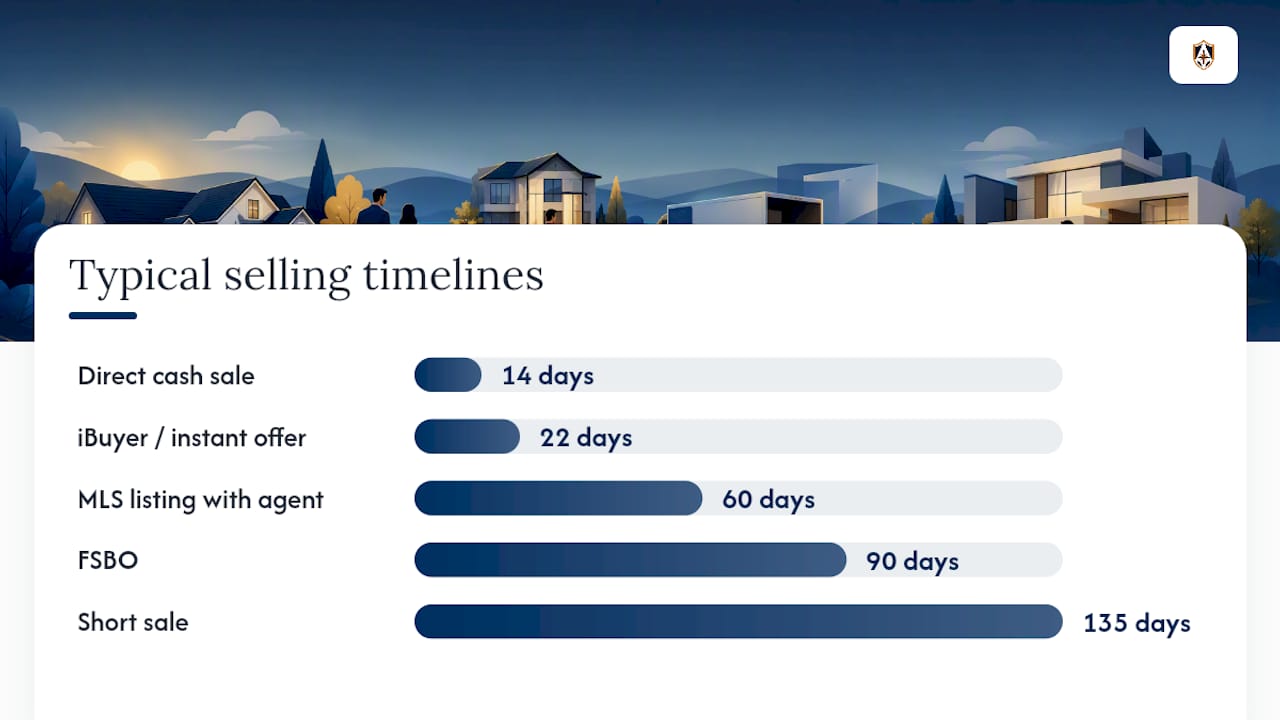
| Selling Method | Typical Timeline | Estimated Fees/Costs | Net Proceeds vs. Market | Repairs Required | Closing Date Control | Seller Effort |
|---|---|---|---|---|---|---|
| MLS listing with agent | 30–90 days | 5%–6% commission + 1%–3% closing costs | Highest (baseline) | Often yes | Low (buyer-driven) | High |
| Direct cash sale | 7–21 days | 0%–1% closing costs | 10%–30% below market | No | High | Low |
| iBuyer / instant offer | 14–30 days | 5%–8% service fee + repair credits | 5% below market | No | Moderate | Low |
| FSBO | 60–120 days | 0%–3% (buyer agent fee) | Variable; often below MLS | Often yes | Moderate | Very high |
| Investor / wholesaler | 7–21 days | Minimal | 20% below market | No | High | Very low |
| Auction | 30–60 days | 5%–10% auction fees | Uncertain | Sometimes | Defined date | Moderate |
| Short sale | 3–6 months | None (no equity) | None | No | Very low | High |
| Seller financing | 30–60 days (initial) | Legal fees | Near market (over time) | Negotiated | High | Moderate |
Sample net-proceeds calculation
Assume a home with a market value of $350,000.
MLS listing with agent:
Sale price: $350,000
Pre-sale repairs (estimate): ($8,000)
Estimated net proceeds: $315,750
Direct cash sale:
Repairs: $0
Estimated net proceeds: $278,600
The gap here is roughly $37,000. Whether that gap is worth closing depends entirely on your timeline, carrying costs, and circumstances.
Key points for reading this comparison:
- MLS exposure and listing media quality directly affect final sale price; a well-marketed listing with professional photography consistently outperforms a bare listing.
- Cash and investor offers reflect the buyer’s renovation costs and profit margin, not just a discount for convenience.
- iBuyer fees can approach or exceed traditional agent commissions once repair credits are factored in, so always request a net-proceeds breakdown before accepting.
How should you price your home and decide what to repair?
Pricing and preparation decisions made before you list can add or subtract tens of thousands of dollars from your final proceeds. The goal is not to spend the most on preparation; it is to spend strategically on the items that move buyers.

Choosing a pricing method
Comparable market analysis (CMA): A licensed agent pulls recent sales of similar homes within a defined radius and adjusts for differences in size, condition, and features. This is the most widely used pricing tool and the most grounded in actual buyer behavior.
Professional appraisal: An independent licensed appraiser provides a formal written opinion of value, typically costing $300–$600. Useful when you need an objective number for estate purposes, divorce proceedings, or when you suspect an agent’s CMA is inflated.
Online estimate tools: Automated valuation models (AVMs) from platforms like Zillow or Redfin provide a quick ballpark, but they can miss recent renovations, condition issues, or hyper-local demand signals. Use them as a starting point, not a final number.
Repair vs. as-is decision guide
Not every repair pays for itself. Focus on items that directly affect buyer perception and lender requirements:
- High-ROI repairs: Fresh interior paint, refinished hardwood floors, updated light fixtures, and landscaping cleanup consistently return more than their cost in buyer-perceived value.
- Moderate-ROI repairs: Kitchen and bathroom updates can add value, but full renovations rarely recoup their cost in a standard sale.
- Skip these: Major structural repairs, full roof replacements, and HVAC system upgrades rarely return dollar-for-dollar in a sale; price the home to reflect them instead.
- Lender-required repairs: If your buyer is using FHA or VA financing, certain conditions (peeling paint, broken windows, missing handrails) must be corrected before the loan closes. Cash buyers eliminate this requirement entirely.
Pro Tip: Before spending on repairs, ask a local agent to walk the property and identify the three items most likely to kill a deal or trigger a price reduction request. Fix those three things and price the rest into the asking price rather than renovating speculatively.
Staging and presentation also matter. Homes with professional photography and high-resolution media attract more online views and tend to generate stronger offers. Zillow’s data shows that Showcase listings with premium media sell for a measurable premium over comparable listings with standard photos.
What U.S. tax and legal considerations affect your home sale?
Selling a home triggers legal and financial obligations that can materially affect your net proceeds. These are the key areas to understand before you close.
Section 121 capital gains exclusion
Under IRS Tax Topic 701, homeowners may exclude up to $250,000 of capital gain ($500,000 for married couples filing jointly) from the sale of a primary residence, provided they have owned and lived in the home for at least two of the five years preceding the sale. If you do not meet these tests, the gain is taxable. Partial exclusions are available in certain hardship circumstances. Consult a tax professional before closing if your situation is at all complex.
Short sales and foreclosures carry additional tax implications. Forgiven debt may be treated as ordinary income in some circumstances, though exclusions exist. The IRS and a qualified CPA are the right resources here.
Fair housing obligations
Sellers and their agents must comply with the Fair Housing Act, enforced by HUD. This means you cannot discriminate in marketing, showings, or negotiations based on race, color, national origin, religion, sex, familial status, or disability. Violations carry serious legal consequences.
Closing, escrow, and title basics
Most U.S. residential sales close through a licensed title company or real estate attorney (required in some states). The title company:
- Conducts a title search to confirm clear ownership
- Manages the escrow account where buyer funds are held
- Pays off any existing liens, mortgages, or judgments from sale proceeds
- Issues title insurance to protect the buyer and lender
If you are selling a property with an existing mortgage, the payoff amount is requested from your lender and settled at closing. Any remaining equity is disbursed to you.
Buyer financing and mortgage contingencies
When your buyer is using a mortgage, the sale is contingent on their loan being approved. This introduces timeline risk: appraisals can come in low, underwriting can uncover issues, and deals can fall through weeks into the process. Cash sales eliminate this risk entirely.
If a buyer or lender involved in your transaction is a mortgage company or loan originator, you can verify their licensing through NMLS Consumer Access, a public registry maintained by state regulators.
How AAS Home Buyers fits into your selling decision
AAS Home Buyers is built around the recognition that no single selling method works for every homeowner. Rather than pushing one path, AAS evaluates your situation and presents the option that genuinely fits your goals, whether that is a direct cash purchase, a partner investor acquisition, a managed retail listing, or a connection to a vetted local agent.
The AAS 3-step process
The AAS Home Buyers process is designed to be transparent and low-pressure:
- Property evaluation: AAS reviews your home’s condition, location, and your timeline to establish a realistic valuation. No obligation at this stage.
- Options presentation: Based on the evaluation, AAS presents the selling paths available to you, with clear fee disclosures and estimated net proceeds for each. You choose the option that fits.
- Closing coordination: AAS manages the closing process, whether through a direct purchase, a partner investor, or a managed retail listing, coordinating with title, escrow, and any other parties to reach your target close date.
When AAS is typically the recommended path
- Urgent or time-sensitive closings: Relocation, divorce, job loss, or a pending foreclosure where a 7–21 day close is necessary.
- Inherited properties: Homes with deferred maintenance, estate complications, or out-of-state heirs who cannot manage a traditional listing.
- Major repairs needed: Properties where the cost and time of pre-sale renovation would erode equity or delay a needed move.
- Tenant-occupied properties: Selling with tenants in place is complex; AAS has experience navigating occupied-property transactions.
- Sellers who want certainty: When the risk of a buyer’s financing falling through is unacceptable, a direct or partner cash purchase removes that variable entirely.
When a traditional MLS listing yields more
AAS is transparent about this: if your home is in good condition, you have 60–90 days to sell, and your local market is active, a traditional MLS listing with a skilled agent will typically produce higher net proceeds than a direct sale. AAS’s agent referral network connects sellers to vetted local agents when that path is the right fit, so you are not forced into a cash sale when the market supports a retail listing.
The honest answer is that the best home selling strategy depends on your specific numbers. AAS’s evaluation process is designed to show you both paths clearly, with real figures, so you can make an informed choice rather than a pressured one. Full terms and disclosures are available at AAS Home Buyers Terms & Disclaimer.
The speed-versus-proceeds tradeoff is real, but it is not always what you think
Most sellers assume the tradeoff between speed and net proceeds is simple: faster always means less money. That assumption is often wrong. When you factor in carrying costs, the psychological cost of an extended sale, the risk of a deal falling through after 60 days of preparation, and the possibility of a price reduction in a softening market, the gap between a fast cash sale and a traditional listing narrows considerably.
The sellers who consistently make the best decisions are the ones who run the actual numbers for their specific situation rather than defaulting to the assumption that MLS is always better. Local market conditions matter enormously here. In a strong seller’s market with low inventory, an MLS listing with competitive bidding can produce results that dwarf any cash offer. In a market where buyer demand is softening and clearance rates are falling, the certainty of a cash close at 80 cents on the dollar may be the smarter financial move. The rule of thumb we use: if your monthly carrying cost multiplied by the expected additional months on market exceeds the proceeds gap between options, take the faster path.
Ready for a transparent valuation with no pressure?
AAS Home Buyers gives sellers in the Baltimore area a clear picture of what their home is worth and which selling path makes the most sense for their situation. There is no one-size-fits-all offer here. Whether you need to close in two weeks or want to maximize equity through a managed retail listing, AAS evaluates your property and presents real options with real numbers.

Here is what you get when you work with AAS:
- A transparent property valuation with no hidden fees or vague estimates
- A clear breakdown of net proceeds for each available selling path
- Control over your closing date, whether that is 10 days or 60 days out
- Escrow and closing coordination handled for you from offer to keys
If you are ready to see your options, request your valuation at AAS Home Buyers or review the full 3-step process before you commit to anything.
Sources
These are the primary official and industry resources referenced throughout this article:
- 14 Tips for Selling Your Home Fast and for More Money | Zillow
- Tax Topic No. 701 – Sale of Main Home | IRS
- HUD – Office of Fair Housing and Equal Opportunity
- Need to sell your house fast? Here are 7 great options | HousingWire
- Property market downturn: Seven expert strategies for selling your home during a price slump | AFR
- NMLS Consumer Access
This article is general information, not a substitute for advice from a qualified financial advisor. Consult a qualified financial professional about your own circumstances before acting on anything here.
FAQ
What is the most profitable way to sell your home?
A traditional MLS listing with a skilled agent typically produces the highest net proceeds.
What is the hardest month to sell a house?
January and February are historically the slowest months for U.S. home sales, with lower buyer activity and fewer competing offers. Listing in late spring, particularly May, tends to attract more buyers and stronger offers.
What is the 3-3-3 rule in real estate?
The 3-3-3 rule is a buyer-side financial preparedness guideline: three months of emergency savings, three months of mortgage payments saved, and obtaining three separate property valuations before purchasing. It is a buyer planning tool, not a selling strategy.
What is the 70% rule in house flipping?
This is why investor and wholesaler offers to sellers often land well below market value; the discount reflects the investor’s required profit margin after renovation.
When does a cash sale make more sense than listing on the MLS?
A cash sale makes more financial sense when your monthly carrying costs multiplied by the additional months a traditional listing would take exceeds the difference in expected net proceeds between the two options, or when your property condition, tenant situation, or timeline makes a standard listing impractical.