
How to Sell Your House for Cash Fast and Safely
Selling your house for cash is the fastest reliable route when speed, convenience, or an as-is sale is your priority. Most cash closings happen in 7–21 days, compared to 45–60 days for a financed sale. If you need to move quickly, the right next step is to request a verified cash offer from AAS Home Buyers, review the written net-proceeds statement, and confirm independent escrow before you sign anything.
- Cash sales close in as little as 7–10 days when title is clear and the seller is ready
- Expect a purchase price below open-market value in exchange for speed and certainty
- Always verify proof of funds and insist on an independent title and escrow company
Key Takeaways
Selling for cash means speed and certainty in exchange for a price below open-market value — verify proof of funds, insist on independent escrow, and get a written net-proceeds statement before you accept any offer.
| Point | Details |
|---|---|
| Cash sales close fast | Most cash transactions close in 7–21 days, skipping lender underwriting and appraisal delays. |
| Expect a price discount | Cash buyers offer below open-market value to account for repairs, risk, and carrying costs. |
| Three verification checks | Confirm proof of funds, independent escrow/title, and a written net-proceeds statement before signing. |
| Cash sales are a well-established route | All-cash buyers represent about 32% of U.S. home purchases, making cash sales a well-established route. |
| AAS Home Buyers | Offers direct cash purchases, a Retail Buyer Program, and vetted agent referrals with transparent, no-hidden-fee valuations. |
Table of Contents
- How does selling a house for cash actually work?
- Cash sales: what you gain and what you give up
- How do you verify a cash buyer is legitimate?
- How do you compare cash offers and choose the right buyer?
- What timeline and costs should you expect at closing?
- What should you do right now to close quickly?
- Our perspective on when a cash sale is the right call
- Useful resources to verify facts and procedures
- Ready to get a verified cash offer on your home?
- Sources
- FAQ
How does selling a house for cash actually work?
The cash home sale process removes the two biggest delays in a traditional transaction: mortgage underwriting and lender appraisal. Here is the sequence you can expect.
- Request a valuation. Contact a cash buyer and share basic property details. Most buyers respond with a preliminary offer within 24–72 hours.
- Receive a preliminary offer. This is a starting figure, not a final commitment. Many preliminary offers are adjusted after an in-person or remote property assessment, so treat this number as directional.
- Property assessment. The buyer evaluates condition, needed repairs, and comparable sales. This step usually takes 1–3 days.
- Final written offer. You receive a written, itemized offer that shows the purchase price, any fees, and estimated net proceeds. This is the number that matters.
- Escrow and title review. An independent title company searches for liens, encumbrances, or ownership disputes. This typically takes 5–10 business days.
- Closing and funds transfer. You sign the closing documents, the title company disburses funds, and the sale is complete. Cash deals often close in as little as 7–10 days because they skip lender underwriting entirely.
Your two key decision points are: accepting the final written offer and selecting your closing date. Both are negotiable with a reputable buyer.
Cash sales: what you gain and what you give up
Cash sales are faster and more certain, but they usually return a lower net sale price than an open-market listing. That trade-off is the core of every cash-sale decision.
home purchases](https://www.investopedia.com/how-to-make-cash-offer-on-house-without-cash-11695231) as of recent reporting. This shows how mainstream cash transactions have become. Cash buyers discount their offers because they absorb repair costs, carrying costs during resale, and the risk of buying without a financing contingency. When a property needs significant work, that discount can be reasonable — even preferable — compared to funding repairs yourself before listing.
Situations where a cash sale tends to make the most sense:
- Foreclosure or pre-foreclosure: Speed protects your credit and stops the clock.
- Inherited property: Avoids months of carrying costs and maintenance on a home you did not plan to own.
- Major repairs needed: Selling as-is eliminates contractor bids, timelines, and upfront cash outlay.
- Relocation deadline: A firm closing date lets you coordinate your move without contingency risk.
If maximizing sale price is the priority and you have 60–90 days, a traditional listing or a Retail Buyer Program may return more. Bankrate notes that cash offers typically give sellers speed and convenience but usually arrive below open-market value.
How do you verify a cash buyer is legitimate?
Always verify proof of funds and insist on an independent title and escrow company before you sign anything. A buyer who resists either check is a red flag.
Verification checklist:
- Proof of funds. Request a bank letter or escrow-ready confirmation showing liquid funds sufficient to close. A screenshot of an account balance is not acceptable.
- Written itemized offer. The offer should list the purchase price, any service fees, estimated closing costs, and your net proceeds. No legitimate buyer objects to this.
- Independent title company. You choose the title and escrow provider, not the buyer. Use an independent title and escrow company for protection; never let a buyer steer you to an unvetted escrow provider.
- Company references and reviews. Check Bbb for complaint histories and documented reviews before accepting any offer.
- Reasonable decision window. Some cash offers include tight expiration windows designed to pressure sellers. Request enough time to compare at least two offers.
Red flags to watch for:
- Pressure to sign before you have reviewed the written offer
- Vague or verbal-only fee disclosures
- Refusal to use a licensed title or escrow company
- Inability to provide verifiable proof of funds
- No physical address or verifiable business registration
A cash offer can still fall through if the buyer cannot provide verified proof of funds or if title defects surface during closing. Running an independent title search early protects you from both scenarios.
Pro Tip: Before agreeing to a closing date, request a short, itemized written estimate of your net proceeds. This single document reveals every fee and lets you compare offers on equal terms.
How do you compare cash offers and choose the right buyer?
Compare offers by net proceeds, fees, timeline, inspection contingencies, and flexibility on closing and move dates. The headline purchase price is rarely the number that matters most.
What to compare across every offer:
- Who pays closing costs (buyer, seller, or split)
- Whether the offer is as-is or subject to repair credits
- Cancellation and offer-expiration windows
- Proof-of-funds verification provided upfront
- Flexibility on your preferred closing date
Questions to ask at first contact:
- What is your proof of funds, and can I verify it independently?
- Is this offer final, or will it change after the property assessment?
- Which title and escrow company will you use, and can I choose my own?
- What fees are deducted from the purchase price before I receive proceeds?
- What is your typical timeline from accepted offer to closing?
How AAS Home Buyers fits into this comparison
AAS Home Buyers offers three routes depending on your situation. The direct cash purchase suits sellers who need to close fast, sell as-is, or face a distressed situation. The Retail Buyer Program suits sellers who want managed marketing and a higher potential sale price with a predictable timeline. The vetted agent referral suits sellers whose property and timeline favor a traditional listing with a trusted local professional.
All three routes include transparent, data-driven valuations and no hidden fees, so the net-proceeds figure you see is the one you can plan around. You can review AAS Home Buyers’ transparent 3-step process before making any commitment.
Illustrative net-proceeds example (not a guarantee; for comparison purposes only):
Always request this breakdown in writing from every buyer you consider.
What timeline and costs should you expect at closing?
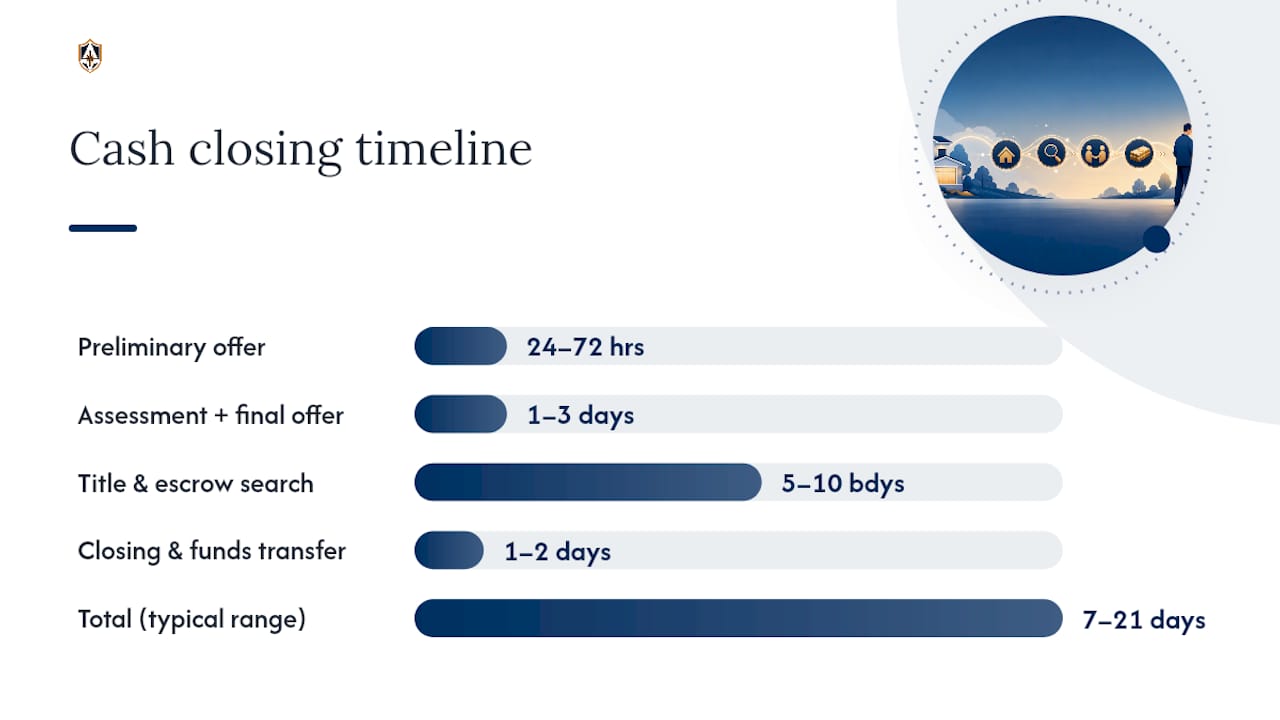
Cash closings can be as fast as 7–14 days, but most average 2–3 weeks depending on title complexity and how quickly you can provide required documents.
| Milestone | Typical Timing |
|---|---|
| Preliminary offer | 24–72 hours after contact |
| Property assessment | 1–3 days |
| Final written offer | Within 24 hours of assessment |
| Title and escrow search | 5–10 business days |
| Closing and funds transfer | 1–2 days after title clears |
| Total (typical range) | 7–21 days |
Some closing costs may still apply, including title insurance, transfer taxes, and recording fees. These vary by state and are negotiable in some transactions.
Tax considerations: Capital gains rules still apply when you sell your home for cash. If you have owned and lived in the property as your primary residence for at least two of the last five years, you may exclude up to $250,000 in gains ($500,000 for married couples filing jointly) under IRS rules. Consult a qualified tax advisor for guidance specific to your situation, since the tax treatment of investment properties, inherited homes, and short-term ownership differs significantly.
What should you do right now to close quickly?
If speed is your priority, follow these steps in order.
- Contact AAS Home Buyers and request a verified cash offer at Aashomebuyers.
- Gather your documents: deed or title information, mortgage payoff statement, recent utility bills, government-issued ID, and a spare set of keys.
- Request proof of funds from the buyer in writing before the property assessment.
- Schedule the property assessment promptly — delays here push back your closing date.
- Review the itemized net-proceeds statement line by line before accepting the final offer.
- Sign with an independent escrow company of your choosing to protect the transaction.
Having your mortgage payoff amount ready before the assessment speeds up the final offer calculation and reduces back-and-forth at closing.
Our perspective on when a cash sale is the right call
We recommend a direct cash sale for sellers whose situation makes speed, certainty, or as-is condition the deciding factor. A property facing foreclosure, carrying deferred maintenance that would cost more to fix than it would add in sale price, or tied to an estate that needs a clean, fast resolution — these are the cases where a cash offer’s discount is a reasonable price for the outcome you need.
That said, not every seller should take the first cash offer they receive. If your home is in good condition and you have 60–90 days, a Retail Buyer Program or a vetted agent referral through AAS Home Buyers’ agent network may return meaningfully more. We present both options because the right answer depends on your specific goals, not on which route generates a faster transaction.
What we stand behind in every case: transparent valuations, a written net-proceeds statement before you commit, and your choice of independent escrow. Those three elements protect you regardless of which route you take.
Useful resources to verify facts and procedures
These authoritative sources help you confirm disclosure requirements, title practices, licensing, and consumer protections before you close.
- Hud: The federal resource for housing policy and consumer-protection guidance, including fair housing rules and seller disclosure requirements.
- NMLS Consumer Access: A public registry where you can verify the licensing of mortgage professionals and related service providers and check for consumer complaints.
- Bbb: Search any cash-buying company’s business profile for documented reviews and complaint histories before accepting an offer.
- Bankrate — Cash Homebuyer Companies: Consumer-facing analysis of cash-buyer programs, fee structures, and what sellers typically net.
- Investopedia — Cash Offers: Explains how cash transactions work and what share of the market they represent.
- Zillow — Should I Accept a Cash Offer?: Covers the speed advantages of cash deals and what sellers should weigh before accepting.
Use these links to verify proof-of-funds formats, confirm title and escrow practices, and research any buyer’s complaint history before you sign.
Ready to get a verified cash offer on your home?
When you need to sell fast, without repairs, and without the uncertainty of a financed buyer falling through, AAS Home Buyers gives you a concrete alternative. We evaluate your property in any condition, present a written offer with no hidden fees, and let you choose the route that fits your timeline — direct cash purchase, Retail Buyer Program, or a referral to a vetted local agent.

The difference with AAS Home Buyers is straightforward: you see exactly what you will net before you commit, you pick your closing date, and an independent title company handles the transaction. No pressure, no vague paperwork, no surprises at the table.
Request your verified cash offer today and get a written net-proceeds statement within 24–72 hours. If you want to understand the full process first, review our transparent 3-step selling process before reaching out.
This article is general information, not a substitute for advice from a qualified financial advisor. Consult a qualified financial professional about your own circumstances before acting on anything here.
Sources
- Cash Homebuyer Companies In 2025 | Bankrate
- How to Make a Cash Offer on a House Without the Cash | Investopedia
- Should I Accept a Cash Offer for My House? | Zillow
- How To Make a Cash Offer on a House — Even When You Don’t Have Cash | Homeownership Hub
- Hud
- Nmlsconsumeraccess
FAQ
Is selling your house for cash a good idea?
It depends on your priority. A cash sale is a strong choice when speed, certainty, or as-is condition matters more than maximizing sale price — but sellers with time and a move-in-ready home may net more through a traditional listing or a Retail Buyer Program.
How much will a cash buyer pay for a house?
Cash buyers typically offer below open-market value to account for repair costs, carrying costs, and resale margin. The exact discount varies by property condition, location, and buyer, which is why requesting an itemized written offer from multiple buyers is the most reliable way to compare.
Do I pay taxes to the IRS when I sell my house for cash?
Yes, capital gains rules apply regardless of how you sell. If the home is your primary residence and you have owned and lived in it for at least two of the last five years, you may exclude up to $250,000 in gains ($500,000 for married couples filing jointly). Consult a tax advisor for your specific situation.
Are cash home buyers legitimate?
Many are, but verification is essential. Confirm proof of funds in writing, check the company’s profile on Bbb, and insist on an independent title and escrow company. AAS Home Buyers provides written, itemized offers and supports independent escrow on every transaction.